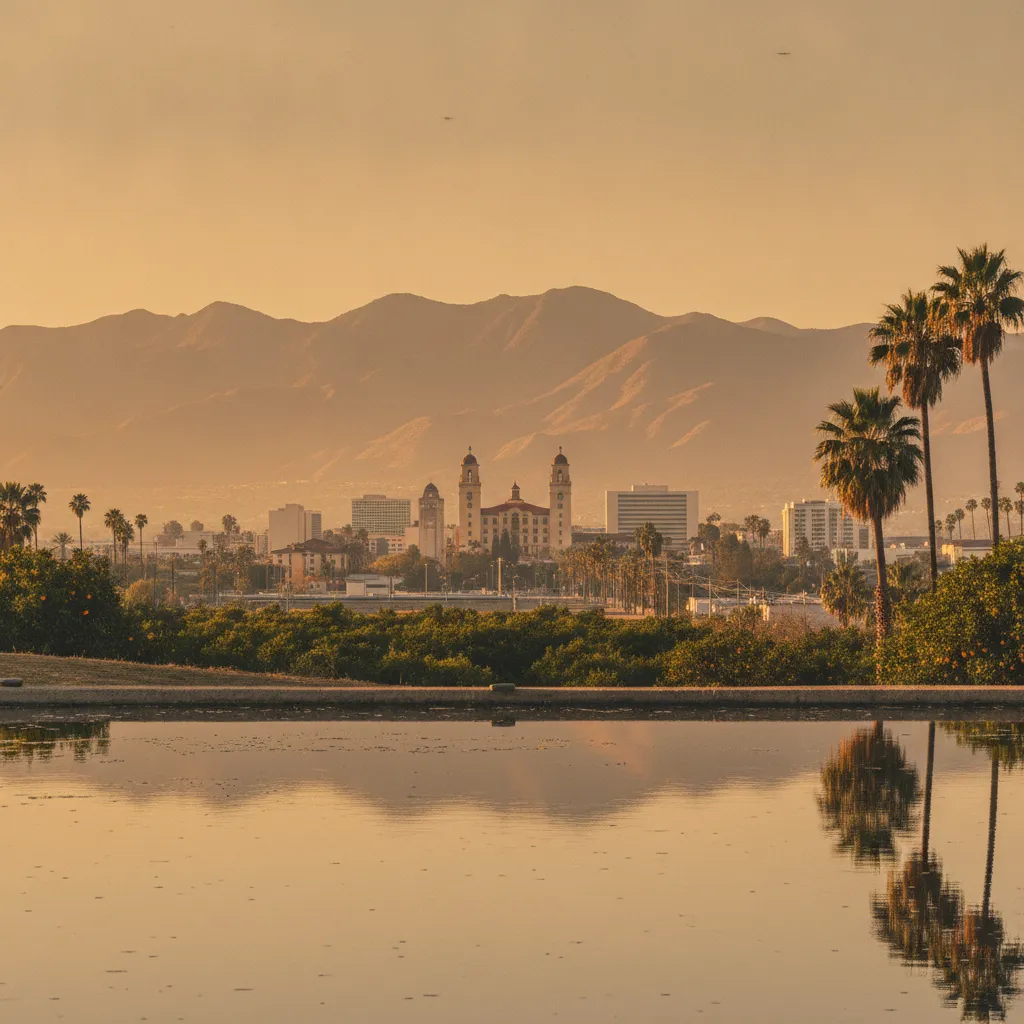
Riverside Water Quality Report 2026: What’s in Your Tap Water
QUICK SUMMARY:
- Overall Rating: Fair
- Top Contaminants of Concern: PFAS (“forever chemicals”) detected near the EPA’s new limit, and a legacy of perchlorate, nitrate, and solvents in the Inland Empire’s groundwater basins
- Recommended Filter Type: A reverse osmosis system or an NSF 53 PFAS-certified carbon block at the tap — see the best reverse osmosis systems and best water filters for PFAS removal guides
- Water Hardness: Hard — commonly around 200 mg/L (roughly 12 grains per gallon), varying by well
> Affiliate disclosure: FilterdWaterGuide.com earns a commission if you purchase through some of the links on this page, at no additional cost to you. We recommend products based on verified third-party certifications and independent testing, not commission rates. Our recommendations would not change if these links earned us nothing.
Riverside Public Utilities (RPU) serves roughly 325,000 people in the heart of the Inland Empire, and in its most recent annual water quality report the system met state and federal drinking water standards. That is the headline, and it is true. But Riverside’s water comes from local groundwater rather than imported supply, and that groundwater carries the fingerprints of the region’s industrial and agricultural past — perchlorate, nitrate, and solvents in some basins — alongside the newer, nationwide concern of PFAS. The system manages these actively. Understanding what it is managing is the point of this report.
Where Does Riverside Get Its Water?
Unlike much of coastal Southern California, which depends heavily on imported water from the Colorado River and Northern California, Riverside draws almost entirely on local groundwater. The city pumps from the Bunker Hill and Riverside groundwater basins through a network of wells, and RPU runs more than 22,000 water quality tests a year from well to tap.
That groundwater dependence is the key to Riverside’s contaminant profile. Surface water systems worry mostly about disinfection byproducts; a groundwater city like Riverside worries about what has leached into the aquifer over decades — and the Inland Empire has a long history of contamination from manufacturing, defense, and agriculture. RPU’s job is to keep affected wells offline or treated so the water reaching customers stays within limits, and the utility has built infrastructure specifically to do that.
What Contaminants Are in Riverside Tap Water?
Here is what the data shows. The values below come from RPU’s water quality reporting, California State Water Resources Control Board notification and response levels, and the EPA’s 2024 PFAS rule.
| Contaminant | Status in Riverside | Regulatory Benchmark | Health Concern |
|---|---|---|---|
| PFOS / PFOA (PFAS) | PFOS detected near 4 ppt at one source (2023); monitored systemwide | EPA MCL 4 ppt (PFOA and PFOS), effective 2029 (2031 proposed) | Immune, developmental, cancer risk |
| Perchlorate | Legacy contaminant; treated/managed, affected basin abandoned | CA MCL 6 ppb | Thyroid function |
| Nitrate | Present in groundwater; managed below the limit | 10 ppm (as nitrogen) | “Blue baby” syndrome in infants |
| Hardness | ~200 mg/L (about 12 GPG) | Aesthetic, not health-based | Scale on fixtures and appliances |
Two of these define Riverside’s profile and deserve a closer look.
For local context across the full contaminant list, the EWG Tap Water Database entry for the City of Riverside (PWS ID CA3310031) is the most accessible reference.
The PFAS Question in Riverside
PFAS — per- and polyfluoroalkyl substances, the “forever chemicals” used in firefighting foam, nonstick coatings, and countless industrial products — are the newest and fastest-moving concern in Riverside’s water. In April 2024 the EPA finalized the first enforceable national limits for six of these compounds, setting the maximum for PFOA and PFOS at just 4 parts per trillion each, with utilities originally required to comply by 2029 — a deadline the EPA proposed in May 2026 to extend to 2031 (see our 2026 EPA PFAS rule changes explainer).
Riverside states that it has not detected PFAS above California’s notification levels in the water it distributes to customers, and the utility monitors for all six newly regulated compounds. At the same time, sampling has shown PFOS in the city’s groundwater close to that new 4 ppt EPA limit at one source — a reminder that the regulatory bar has moved far below where it used to sit, and that a result which was “non-detect” under the old framework can be meaningful under the new one. California’s own notification levels (6.5 ng/L for PFOS, 5.1 ng/L for PFOA) sit in the same low range.
The practical takeaway is that PFAS is the contaminant most worth filtering for in Riverside, both because of the documented detections and because the compliance landscape is tightening. PFAS are not removed by a basic carbon pitcher; it takes a filter specifically certified for them — an NSF 53 (or NSF 58 RO) system validated for PFOA/PFOS reduction. Our best water filters for PFAS removal guide covers which technologies actually work.
The Perchlorate and Groundwater Legacy
The second half of Riverside’s story is older. The Inland Empire was home to aerospace, defense, and manufacturing operations that left perchlorate — a component of rocket propellant — along with solvents and the byproduct MTBE in parts of the regional groundwater, and decades of agriculture added nitrate. These are not hypotheticals: Riverside abandoned wells in its Arlington basin because of elevated nitrate, MTBE, and perchlorate, and the utility installed treatment to remove perchlorate from water drawn from affected wells before it enters the supply.
The reassuring part is that this is actively managed — the contaminated sources are treated or taken offline, which is why the water delivered to customers stays within California’s perchlorate limit of 6 ppb and the federal nitrate limit of 10 ppm. The sobering part is that it is a permanent feature of the region’s water, not a one-time cleanup. Perchlorate affects thyroid function and is of particular concern for pregnant women and infants; nitrate at high levels is dangerous for infants specifically. For households that want an extra margin beyond what the utility provides, reverse osmosis is the technology that reduces all three — PFAS, perchlorate, and nitrate — in a single system.
Riverside Water Hardness
Riverside’s groundwater is hard — commonly around 200 mg/L as calcium carbonate, or roughly 12 grains per gallon, though it varies from well to well across the city and can run higher. On the standard scale (0–3 GPG soft, 3–7 moderately hard, 7–10 hard, 10+ very hard), that puts Riverside solidly in the hard-to-very-hard range, which is typical for Southern California groundwater.
In practical terms, that means visible scale on fixtures and inside water heaters, spotting on glassware, and shorter appliance life if left unaddressed. Unlike the contaminants above, hardness is an aesthetic and maintenance issue, not a health one — but it is the thing most Riverside residents actually notice day to day. Whether a whole-house softener is worth it depends on your household; our hard water guide walks through the trade-offs.
Best Water Filters for Riverside Residents
Riverside’s profile points to point-of-use treatment for the contaminants of concern, with reverse osmosis as the standout because it addresses PFAS, perchlorate, and nitrate together. Here are the options that fit.
One distinction to keep in mind across all of them: “NSF certified” means a product is registered with an accredited body that audits the factory and re-tests the product over time, while “tested to NSF standards” is just a one-time lab result with no ongoing oversight. Every pick below carries a verified third-party certification (NSF, WQA, or IAPMO), not merely a one-time test.
Reverse Osmosis: Waterdrop G3P800
For Riverside, reverse osmosis is the most complete answer: a quality RO membrane reduces PFAS, perchlorate, and nitrate — the city’s three documented groundwater concerns — in one system, which no single-stage carbon filter can claim. The Waterdrop G3P800 holds NSF 58 certification for TDS reduction and NSF 372 certification for lead-free construction. Independent testing by IAPMO confirmed PFOA and PFOS reduction performance, but the membrane itself is not separately NSF 53 certified for PFAS. The tankless system runs at 800 gallons per day, avoiding the slow refill of older tank-based units. See the best reverse osmosis systems guide for the full comparison.
The weaknesses worth weighing: RO wastes some water to drain during filtration (the G3P800 improves on older units but still does), and it strips beneficial minerals along with contaminants, leaving water some people find flat-tasting — though in hard-water Riverside, removing minerals also means no scale. It requires an electrical outlet under the sink and more installation effort than a simple carbon filter.
Buy Direct from Waterdrop | Check on Amazon
Under Sink: Aquasana Claryum 3-Stage Max Flow
If you want a simpler, non-RO option focused on PFAS, the Claryum 3-Stage Max Flow (Aquasana refreshed the SKU from AQ-5300+ to AQ-6300 in late 2025 — same Claryum technology, new model number) is WQA-certified to NSF/ANSI Standards 42, 53, and 401. Its Standard 53 certification covers PFOA and PFOS reduction — the PFAS-specific protocol once designated P473, which the NSF folded into Standard 53 in 2019 — which is the point in Riverside. It is easier to install than RO, wastes no water, and keeps water flowing at the tap without an electrical hookup. Independent reviewers including Wirecutter have rated Aquasana’s Claryum line well for contaminant reduction relative to its price.
The trade-offs: it is a carbon system, so while it is certified for PFAS, it does not reduce perchlorate or nitrate the way RO does — choose it if PFAS is your priority and you’ll manage hardness separately. The three-cartridge design needs replacement roughly every six months, the proprietary cartridges cost more than generic blocks, and flow rate drops as the cartridges load up near end of life.
Buy Direct from Aquasana | Check on Amazon
Budget Pitcher: ZeroWater 10-Cup Ready-Pour
For renters and anyone not ready to install hardware, the ZeroWater pitcher is IAPMO-certified to NSF/ANSI 53 for lead and chromium reduction and, through its multi-stage ion-exchange media, reduces total dissolved solids more aggressively than a standard pitcher — useful in Riverside’s high-TDS, hard groundwater. It is the most accessible point-of-use option.
The limitations are real, and important in Riverside specifically: the filters exhaust quickly in high-dissolved-solids water, so in a hard-water city like this one they need replacing more often than in a soft-water region — budget for that. It is also not the right tool if PFAS, perchlorate, or nitrate are your primary worry; for those, RO is the appropriate technology. And because it strips nearly everything, the output tastes flat to some people. Test the taste before committing.
How to Test Your Riverside Tap Water
A citywide report is an average across many wells and monitored points. It cannot tell you exactly what is reaching your home from the particular wells serving your area, or what your own plumbing adds. RPU publishes its annual Water Quality Report and is a reasonable first reference, particularly for PFAS and perchlorate monitoring data.
For a fuller, home-specific picture, an independent laboratory test is the most reliable step. Get a Tap Score Test — its mail-in kits cover PFAS, perchlorate, nitrate, hardness, and the broader contaminant panel, and the results arrive in a format you can act on. Our guide on how to test your water at home explains how to read what comes back. Testing before you buy is the difference between choosing a filter for your actual water and guessing.
Frequently Asked Questions
Is Riverside tap water safe to drink?
By state and federal standards, yes — RPU’s most recent report met the enforceable limits, and the utility treats or removes from service the wells affected by perchlorate, nitrate, and solvents. The qualifiers are forward-looking: PFAS has been detected in the city’s groundwater near the EPA’s new 4 ppt limit, and the perchlorate legacy requires ongoing management. For households that want a margin beyond the utility’s, point-of-use filtration is reasonable.
Does Riverside water have PFAS?
Riverside monitors for the six PFAS compounds the EPA regulated in 2024, and states it has not detected PFAS above California’s notification levels in distributed water. That said, sampling has shown PFOS in the city’s groundwater close to the EPA’s new 4 ppt limit at one source, and the original compliance deadline is 2029 (which the EPA has proposed extending to 2031). PFAS is the contaminant most worth filtering for in Riverside, using an NSF 53 PFAS-certified carbon block or a reverse osmosis system.
How hard is Riverside water?
Hard — commonly around 200 mg/L as calcium carbonate, or roughly 12 grains per gallon, varying by well and sometimes higher. That is typical for Southern California groundwater and is enough to leave noticeable scale on fixtures and in water heaters. Hardness is an aesthetic and maintenance concern, not a health one, but it is the thing most residents notice; a softener is a personal-preference decision.
Do I need a water filter in Riverside?
For the city’s documented concerns — PFAS, perchlorate, and nitrate — a reverse osmosis system at the kitchen tap is the most complete single solution, since it reduces all three. If PFAS alone is your priority, an NSF 53 PFAS-certified carbon block is a simpler option. Hard water is a separate question best handled by a softener if it bothers you. Test your water first, then match the filter to what you find.
Sources Cited
- Riverside Public Utilities — Annual Water Quality Report and PFAS monitoring page
- California State Water Resources Control Board — PFAS notification and response levels; perchlorate and nitrate MCLs
- U.S. EPA — 2024 PFAS National Primary Drinking Water Regulation (PFOA/PFOS MCL 4 ppt)
- EWG Tap Water Database — City of Riverside (PWS ID CA3310031)
- Riverside–Corona Resource Conservation District — Inland Empire groundwater background (Arlington basin perchlorate/nitrate/MTBE)