New Orleans Water Quality Report 2026: What’s in Your Tap Water
QUICK SUMMARY:
- Overall Rating: Fair
- Top Contaminants of Concern: Lead at the tap — a 6 ppb 90th-percentile with individual homes testing as high as 100 ppb — plus haloacetic acids peaking near the federal limit, a 3.2 ppm chloramine residual, and a treatment system that logged turbidity violations at both plants in January 2025
- Recommended Filter Type: Reverse osmosis or an NSF/ANSI 53 lead-certified filter at the kitchen sink, with whole-house catalytic carbon for the chloramine and byproducts — see the best water filters for lead removal and best reverse osmosis systems guides
- Water Hardness: ~8 GPG (about 138 ppm) — Hard (independent compilations; the utility does not publish hardness in its CCR)
> Affiliate disclosure: FilterdWaterGuide.com earns a commission if you purchase through some of the links on this page, at no additional cost to you. We recommend products based on certification and independent testing, not commission rates. Our recommendations would not change if these links earned us nothing.
In the Sewerage and Water Board of New Orleans’ own words, the system “met most water quality requirements” in 2025. The qualifier is doing real work. In January 2025, a hard freeze pushed both of the city’s treatment plants into violation of the federal Surface Water Treatment Rule for turbidity, and more than 5% of the Eastbank’s monthly bacteria samples came back positive for total coliform — a result that triggered a formal Level 2 assessment. The same year’s tap sampling found lead over the 15 ppb federal action level at four monitored homes, with one Westbank result reaching 100 parts per billion.
None of those results made New Orleans water an emergency, and the utility’s own transparency about them is to its credit. But the pattern matters for anyone deciding whether to filter. The compliance tables below describe water that is legal on the annual averages while running closer to the limits than most cities we profile — haloacetic acids peaking at 57 ppb against a 60 ppb ceiling, chloramine averaging 3.2 ppm against a 4.0 ceiling, and a lead profile that depends heavily on the pipe under your particular block. Here’s what the data actually shows.
Where Does New Orleans Get Its Water?
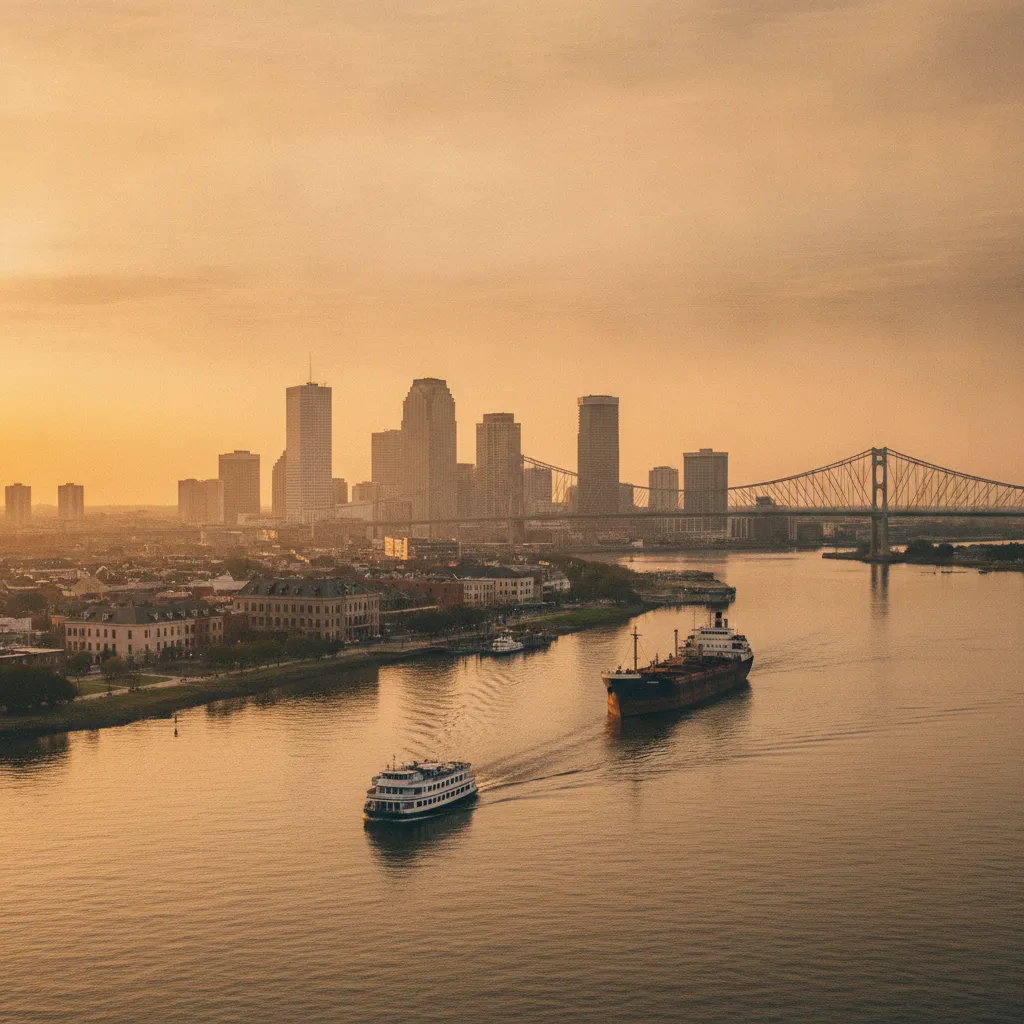
New Orleans draws its drinking water from the Mississippi River — the endpoint of a watershed that drains 41% of the continental United States, farms, cities, and chemical corridors included. Louisiana’s source-water assessment program rates the intake’s susceptibility to contamination as “high,” which is standard language for a lower-Mississippi surface supply and the reason the treatment burden here is heavier than in cities drawing on protected reservoirs.
Two plants treat that water. The Carrollton Water Treatment Plant serves the Eastbank — the great majority of the city — treating an average of 137 million gallons per day. The much smaller Algiers plant serves the Westbank at about 13 million gallons per day. The Louisiana Department of Health grades water systems on long-term viability; for 2025, Carrollton earned a B (82/100, up from prior years) and Algiers an A (95/100). Both plants coagulate, settle, filter, and disinfect with chloramine; fluoride is added, and corrosion control differs by bank — lime on the Eastbank, lime plus a zinc orthophosphate pilot on the Westbank.
In 2025 the utility also detected Cryptosporidium in its Mississippi River source water (one sample, 0.11 oocysts per liter). It was not detected in finished tap water — but the utility notes, accurately, that common filtration methods cannot guarantee 100% removal of the parasite.
What About Lead in New Orleans?
Lead is the contaminant where New Orleans’ numbers separate most sharply from the cities we rate higher, so it comes first. The 2025 monitoring round put the 90th-percentile at 6 parts per billion on both banks — compliant, but triple Louisville’s figure and among the highest we have profiled. The ranges are the more important number: individual homes tested as high as 23 ppb on the Eastbank and 100 ppb on the Westbank, and four sites in total exceeded the 15 ppb action level. Treated water leaves both plants with no detectable lead; what varies is the pipe.
The structural facts explain why. New Orleans’ housing stock is among the oldest in the South — homes built before 1988 may carry lead in service lines, solder, and fixtures — and the utility is still inventorying which of its service lines contain lead. Federal regulations require every lead line in the system to be replaced by December 31, 2037; SWBNO has secured $86 million in state revolving funds, hired a program manager (CDM Smith) that begins citywide work in 2026, and has started with schools and early-childhood facilities. Until a given line is replaced, the utility offers residents with lead, galvanized, or unknown service lines a free water filter pitcher with a six-month filter supply, and free lead testing kits on request — an unusually direct acknowledgment that point-of-use filtration is the interim protection.
The evidence supports treating lead as unresolved in any pre-1988 New Orleans home until the service line is confirmed and a tap test comes back clean. Check your address in the inventory at swbno.org/Projects/LeadAwareness, and see our lead in drinking water guide for how lead enters water and what removes it.
What Contaminants Are in New Orleans Tap Water?
The table below draws on SWBNO’s 2025 Consumer Confidence Report (published June 2026) and the EWG Tap Water Database. The EPA’s Maximum Contaminant Level (MCL) is the legal limit; the EWG guideline is a stricter, health-based benchmark. Several federal limits have not been revisited in decades — the gap between the columns is where the meaningful risk lives.
| Contaminant | Detected Level | EPA MCL | EWG Guideline | Health Concern |
|---|---|---|---|---|
| Haloacetic acids (HAA5) | 34 ppb LRAA, range 4–57 (Eastbank) | 60 ppb | 0.1 ppb | Cancer, reproductive harm |
| Total trihalomethanes (TTHMs) | 28–30 ppb LRAA, range 14–35 | 80 ppb | 0.15 ppb | Cancer (bladder), fetal development |
| Chloramine (residual) | 3.2 ppm highest RAA (range 0.6–4.8) | 4.0 ppm (MRDL) | — | Taste/odor; byproduct formation |
| Lead (90th percentile, 2025) | 6 ppb (single results to 100) | 15 ppb (action level) | 0 ppb | Neurological damage |
| PFOA / PFOS | 1.7 ppt / 2.0–2.2 ppt averages | 4.0 ppt each | ~0 | Cancer, immune effects |
| Atrazine | 0.049–0.19 ppb | 3 ppb | 0.1 ppb | Hormone disruption |
| Combined radium | up to 1.62 pCi/L (Eastbank) | 5 pCi/L | — | Cancer risk |
Read the disinfection byproducts first. Haloacetic acids ran a 34 ppb locational running annual average on the Eastbank with individual results reaching 57 ppb — 95% of the 60 ppb federal ceiling — and the Westbank’s numbers are nearly identical. That is the highest HAA5 pressure of any chloraminated system we have profiled, driven by a warm climate and an organic-rich river. Trihalomethanes are more moderate at 28–30 ppb. Both are present in every tap, far above health-based guidelines, and highest in warm months.
The chloramine residual itself runs at a 3.2 ppm running annual average on the Eastbank — second only to Richmond among cities we cover, with individual readings as high as 4.8 ppm. Chloramine is harder to remove than free chlorine; ordinary activated carbon reduces it slowly and incompletely, which is why the recommendations below specify catalytic carbon. Our chloramine vs chlorine in tap water explainer covers the chemistry.
PFAS deserves a precise reading. Both plants detected PFOA (averaging 1.7 ppt) and PFOS (2.0–2.2 ppt) in 2025 — under the 4.0 ppt federal limits, but detections rather than zeros, consistent with a river that drains industrial corridors upstream. Atrazine, the row-crop herbicide, appears every year in this agricultural watershed at levels well under its limit. The full independent compilation is at the EWG Tap Water Database entry for New Orleans.
One more 2025 line belongs in the record: the January freeze pushed treated-water turbidity into violation at both plants — 6.5% of Carrollton’s monthly measurements exceeded the standard, and Algiers briefly exceeded the never-exceed cap. Turbidity itself has no health effects, but it can shelter microbes from disinfection, which is why it is regulated. Tests during the violations found no bacteria in the water, and the utility is rehabilitating filtration facilities at both plants in response.
New Orleans Water Hardness
SWBNO does not publish hardness in its annual report, but independent compilations of its utility data put New Orleans tap water around 138 ppm as calcium carbonate — roughly 8 grains per gallon, in the hard range. That is enough for visible scale on fixtures and gradual buildup in water heaters, though well short of the extreme hardness of Texas or Florida groundwater systems.
A softener in New Orleans is a comfort purchase, not a necessity — and it does nothing about the lead, byproducts, or chloramine that define the city’s actual risk profile. Our hard water guide and solutions covers where softening pays.
Best Water Filters for New Orleans Residents
New Orleans’ documented profile — lead risk concentrated in older homes, haloacetic acids near the limit, a high chloramine residual, and trace PFAS — points to certified reduction at the kitchen sink first, with whole-house catalytic carbon as the second layer. One honest caveat up front: during a boil-water advisory — a recurring event in this city’s aging system — no filter below makes microbially unsafe water safe. Boil or use bottled water until the advisory lifts, then flush your taps and change cartridges. The picks, each matched to the documented profile with named third-party certification:
Reverse Osmosis: Waterdrop G3P800
For drinking and cooking water, reverse osmosis is the most complete single answer to this city’s list: the membrane provides certified reduction of lead, rejects the disinfection byproducts and trace PFAS, and adds a wide safety margin for a system that has run close to its limits. The Waterdrop G3P800 is certified by IAPMO R&T to NSF/ANSI Standards 42, 53, 58, and 372. To label that precisely: IAPMO R&T is an accredited certifier to the NSF/ANSI standards, so this is a genuine certification, but it will not appear in NSF International’s own database. Its tankless design fits a standard cabinet and produces 800 gallons per day.
The trade-offs are the technology’s, not the model’s: RO strips beneficial minerals along with contaminants and tastes flat to some palates; it sends a portion of feed water to the drain; and it needs an outlet under the sink. And the microbial caveat applies — an RO unit is not a substitute for boiling during an advisory. Consumer Reports’ testing consistently ranks RO highest for breadth of removal. Comparisons are in the best reverse osmosis systems guide.
Buy Direct from Waterdrop | Check on Amazon
Whole House: SpringWell CF+
The house-wide exposures here — chloramine at 3.2 ppm and trihalomethanes that are inhaled in hot showers as well as ingested — reach every tap, which is the structural case for whole-house carbon. The media is the critical detail: the SpringWell CF+ uses catalytic carbon, the type that meaningfully reduces chloramine where ordinary activated carbon struggles. On certification, precision matters: the CF+’s components and media are certified to NSF/ANSI 61 and 372 (materials safety and lead-free materials), while the complete system is tested to NSF standards for performance rather than holding a system-level performance certification. “Tested to,” not “certified for” removal — a lesser claim than the model-level certifications behind the other two picks, stated plainly.
Two real limitations. Installation happens on your main line — a plumber job, and not an option for renters, who are a large share of this city. And a whole-house carbon unit is not a lead solution: lead enters in the service line and home plumbing after any point-of-entry filter, which is why the certified point-of-use picks carry that job. Households wanting a certified whole-house chloramine system can also price the dealer-sold Kinetico CRS, WQA-certified to NSF/ANSI 42 for chloramine. Sizing guidance is in the best whole house water filters guide.
Budget / Renter: ZeroWater 10-Cup Pitcher
SWBNO itself distributes free filter pitchers to homes with lead, galvanized, or unknown service lines — the clearest official endorsement of the pitcher tier you will find. For households buying their own, the ZeroWater pitcher is certified by IAPMO R&T to NSF/ANSI 42 and 53 with lead and PFOA/PFOS on its certified list, at under $40 with no installation. Its five-stage ion-exchange design pulls total dissolved solids to near zero, covering a pitcher’s share of the city’s lead, byproduct, and trace-PFAS profile for drinking water.
The honest drawbacks: near-zero TDS water tastes flat to many people; filtration is slow; and cartridge life shortens in higher-TDS water, so ongoing filter costs are moderate but real. It is the certified budget entry, not a whole-home answer — chloramine at the shower and byproducts at every other tap remain untouched. Category comparisons are in the best water filter pitchers guide.
How to Test Your New Orleans Tap Water
In this city more than most, the system average is not your answer. The 2025 lead round sampled 137 homes across both banks; the 90th percentile was 6 ppb, but the worst single result was 100 ppb — a seventeen-fold spread that only a test at your own faucet can resolve. New Orleans residents have two good options, one of them free.
First, SWBNO provides free lead testing kits on request at swbno.org/Form/LeadTestingKitRequest, and its service-line inventory shows what the utility believes your line is made of. For the broader panel — disinfection byproducts, PFAS, atrazine, and the full metals list — Tap Score (run by SimpleLab) sends samples to accredited laboratories and reports results against the same EPA and health benchmarks used in this article. For any pre-1988 home, the lead panel is the priority; after a boil-water advisory lifts, a bacteriological panel is a reasonable addition. Our how to test your water at home guide walks through the options.
Frequently Asked Questions
Is New Orleans tap water safe to drink?
On the annual averages, New Orleans water met federal standards for the chemical contaminants in 2025 — but the margins are thinner than in most large cities, and the year included real failures: turbidity violations at both plants in January, a coliform assessment on the Eastbank, and four homes over the lead action level. The evidence supports drinking filtered tap water in newer housing with reasonable confidence, treating lead as unresolved in pre-1988 homes until tested, and keeping a boil-water plan ready — advisories are a recurring feature of this system.
Does New Orleans water have lead?
The water leaving both treatment plants has no detectable lead; the risk is the pipes. The 2025 monitoring round found a 90th-percentile of 6 ppb — compliant but high among major cities — with individual homes at 23 and 100 ppb, and four sites over the federal action level. Lead service lines remain in the ground ahead of a federally required full replacement by 2037. Check your address in the utility’s service-line inventory, request its free test kit, and use an NSF/ANSI 53 lead-certified filter or RO in the meantime — the utility itself gives filter pitchers to affected homes.
Does New Orleans water have PFAS?
Yes, at low levels. The 2025 compliance monitoring detected PFOA averaging 1.7 ppt and PFOS averaging 2.0–2.2 ppt at the two plants — under the 4.0 ppt federal limits that utilities must meet, but detections rather than zeros, consistent with a Mississippi River source that drains industrial corridors. Other regulated PFAS compounds were non-detect. Reverse osmosis or a PFAS-certified filter reduces the residual at the tap.
How hard is New Orleans water?
Hard, but not extreme: independent compilations put it around 138 ppm as calcium carbonate, roughly 8 grains per gallon (the utility does not publish hardness in its annual report). Expect spotting and gradual water-heater scale. A softener is optional; it addresses none of the contaminants that actually define this city’s water risk.
Do I need a water filter in New Orleans?
The case here is stronger than in most cities we profile. A reverse osmosis unit or NSF/ANSI 53 lead-certified filter at the kitchen sink addresses the lead risk, the near-limit haloacetic acids, and the trace PFAS together. A whole-house catalytic carbon system is a reasonable second layer against the 3.2 ppm chloramine residual and shower-borne trihalomethanes. During boil-water advisories, no filter substitutes for boiling — that protection depends on the infrastructure rebuild the utility has begun.
Related Articles
- Best Water Filters for Lead Removal 2026
- Best Reverse Osmosis Systems 2026
- Best Whole House Water Filters 2026
- Best Water Filter Pitchers 2026
- Lead in Drinking Water Guide
- Chloramine vs Chlorine in Tap Water
- PFAS in Drinking Water
- How to Test Your Water at Home
Sources Cited
- Sewerage and Water Board of New Orleans — Annual Update and 2025 Consumer Confidence Report on Water Quality (published June 2026): source water, treatment plants and LDH grades (Carrollton B 82/100, Algiers A 95/100), chloramine residual (highest RAA 3.2 ppm Eastbank, range 0.6–4.8), TTHM LRAA 28/30 ppb, HAA5 LRAA 34/33 ppb (ranges to 57), lead 90th percentile 6 ppb (ranges 0–23 / 0–100; 2 of 85 and 2 of 52 sites over the action level), PFOA/PFOS detections, January 2025 turbidity violations at both plants, Total Coliform Level 2 assessment, Cryptosporidium source-water detection (swbno.org/Reports/WaterQuality)
- SWBNO Lead Awareness program — service-line inventory, free filter pitchers, free lead testing kits, $86M SRF funding, CDM Smith program management, 2037 federal replacement deadline (swbno.org/Projects/LeadAwareness)
- EWG Tap Water Database — New Orleans Carrollton Waterworks (PWSID LA1071009): https://www.ewg.org/tapwater/system.php?pws=LA1071009
- Louisiana Department of Health — water system grades (ldh.la.gov/watergrade)
- US EPA, National Primary Drinking Water Regulations — Surface Water Treatment Rule; Stage 2 Disinfectants and Disinfection Byproducts Rule; Lead and Copper Rule Improvements (lead service line replacement by 2037)
- US EPA PFAS National Primary Drinking Water Regulation — PFOA/PFOS MCLs of 4.0 ppt finalized April 2024 (epa.gov/sdwa/and-polyfluoroalkyl-substances-pfas)
- Independent hardness compilations (tapwater.org / H2O Distributors) — ~138 ppm, used where the utility publishes no figure
- IAPMO R&T product listing directory (pld.iapmo.org), WQA Gold Seal listings (find.wqa.org), NSF International certified product listings (info.nsf.org) — certification verification for recommended products