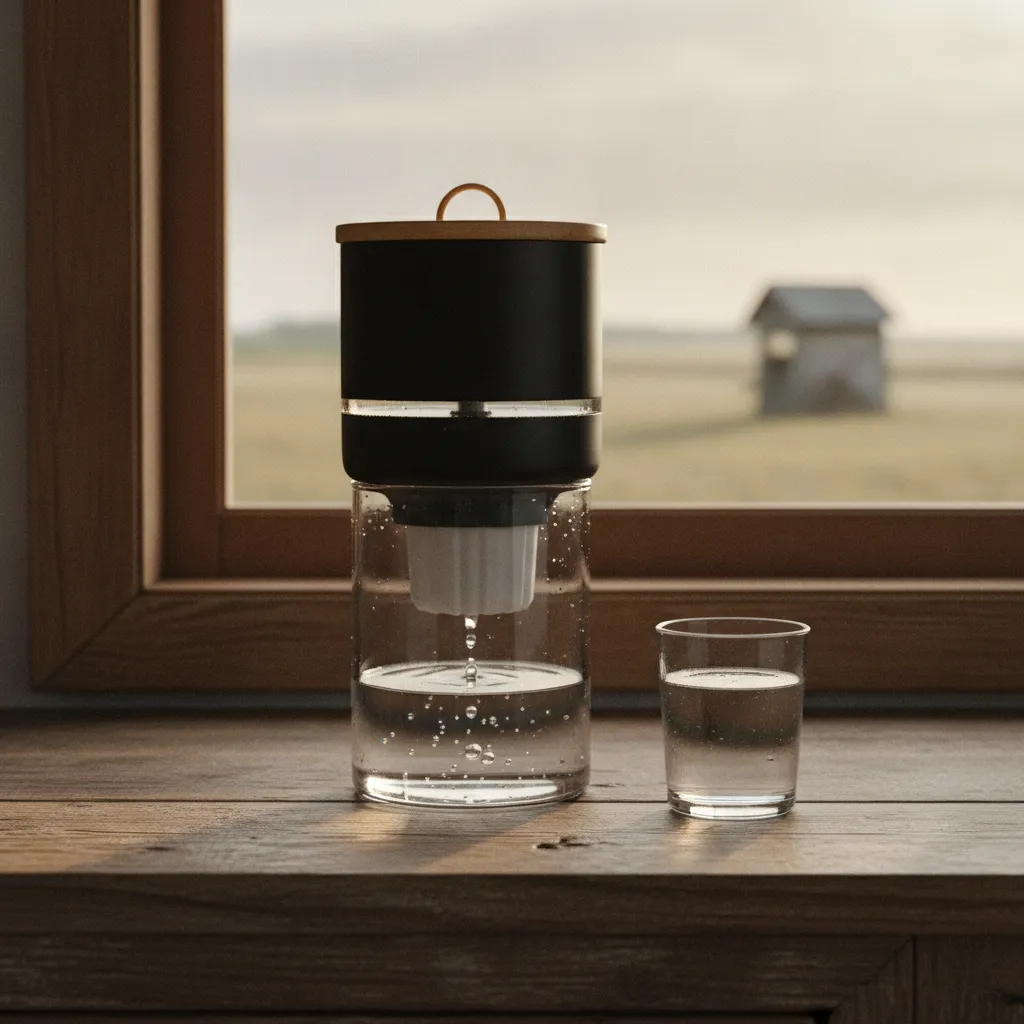
Epic Nano Review 2026: The Well-Water Pitcher, Minus the Hype
> Affiliate disclosure: FilterdWaterGuide.com has an affiliate relationship with Epic Water Filters. If you buy through our link (coupon `FILTERD15`), we earn a commission. We also earn from Amazon links. That relationship does not change what follows: this review is built on Epic’s own published certification documents, NSF International’s database, and Epic’s lab data, not on its marketing. It says plainly where the two disagree.
If you’re on a private well, you already know the problem. The utility isn’t disinfecting your water, because there is no utility. Nobody is testing it but you. And when you go looking for a pitcher that handles bacteria, not just chlorine taste, almost nothing on the shelf even claims to.
The Epic Nano is one of the few pitchers that does claim it. It’s the reason people on well water, in rural cabins, and in earthquake-kit households keep asking me about it. So I went through Epic’s certification PDFs, the NSF International listing, Epic’s performance data, and its own product-page fine print to answer the question the ads don’t: what’s actually verified, what’s merely tested, and is the difference worth $82 plus $46 every few months?
Short version: the Nano is a reasonable product with an honest-when-you-read-closely certification page and marketing that runs well ahead of it. Here’s what I found.
Quick Verdict
The Epic Nano XP earns 3.5/5. It’s a gravity pitcher with a genuine use case, microbiological protection for well water and emergencies, and Epic publishes real lab data behind that claim. But the only certifications it holds are NSF/ANSI 42 and NSF/ANSI/CAN 372, and both are materials certifications. NSF’s own listing says the Standard 42 certification is “for material safety requirements only.” Every contaminant Epic advertises removing (bacteria, viruses, cysts, PFAS, lead, even chlorine) is manufacturer-tested, not certified by any accredited body. The slow filter cycle and the cartridge bill take the rest of the points.
Buy Direct from Epic Water Filters (save 15% with code `FILTERD15`) | Check on Amazon
Specs at a Glance
| Spec | Detail |
|---|---|
| Price | $82 direct (Nano XP pitcher, Black & Bamboo) |
| Type | Gravity pitcher, 10-cup; no plumbing, no power |
| Filter | Nano XP: dual-layer pleated electropositive nanofiber media, 0.70 sq ft |
| NSF certifications (actual) | NSF/ANSI 42 (material safety only) and NSF/ANSI/CAN 372 (lead content), certified by NSF International |
| Tested-to (not certified) | NSF/ANSI 42, 53, 401, P231 (microbiological purifier), P473 (PFOA/PFOS) |
| Manufacturer-published reductions | Bacteria 99.9%, Giardia 99.99%, virus 99.95%, PFAS 99.6%, lead 99.4%, arsenic 95%, chlorine 96.8%, microplastics 99.25% |
| Fluoride | Not reduced (Epic states this explicitly for the XP filter) |
| Reservoirs | 1.5 L upper (unfiltered) / 2.0 L lower (filtered) |
| Filter capacity | 100 gallons per Epic’s current spec (older page copy still says 150, see below) |
| Filter time | 20 minutes to 1–2 hours per fill, per Epic |
| Replacement cost | $46 inner cartridge / $53 cased filter |
| Filter change | About 3–4 months at typical use (Epic’s guide: 2–6 months depending on use); 90-day LED countdown timer in the lid |
| Warranty | 3-year limited on the pitcher; 30-day return |
| Made in | Assembled in the USA; NSF-listed Epic facilities in Niwot, CO and Palmetto, FL |
What “NSF Certified” Means Here, and What It Doesn’t
Here’s what nobody tells you about the Epic Nano: the NSF mark on the box is real, and it doesn’t cover a single thing the box says the filter removes.
Epic’s own NSF page, to its credit the most candid page on the site, lays it out. Epic Water Filters holds NSF facility certificate C0817846 for NSF/ANSI 42 and NSF/ANSI/CAN 372, and the NanoXP pitcher filter is listed as a filter-cartridge component under those two standards. I re-checked NSF International’s database directly for this review. The NanoXP Pitcher Filter is there under Standard 42, and the listing carries one qualifier: “certified for material safety requirements only.” So when Epic says “NSF certified,” that’s accurate. NSF International is the certifier, and NSF is one of the three ANSI-accredited bodies (with WQA and IAPMO R&T) whose listings we trust.
The question you should actually be asking is: certified for what? Standard 42 normally covers aesthetic effects like chlorine taste and odor, plus materials safety. The Nano XP’s listing is the materials half only. It confirms the filter is safe to put in contact with drinking water. It does not certify a chlorine-reduction claim, let alone anything else. Standard 372 confirms the wetted parts are low-lead.
Neither one is a contaminant-removal certification. Standard 372 in particular gets misread constantly: it says the filter isn’t leaching lead, not that the filter removes lead. Epic’s page says as much in its own FAQ.
Everything else on the product page carries a different verb. The Nano XP is “independently tested to” NSF/ANSI 42, 53 (health contaminants like lead), 401 (pharmaceuticals and emerging compounds), P231 (the microbiological purifier protocol covering bacteria, viruses, and cysts), and P473 (PFOA/PFOS). Tested-to means a lab ran the protocol once, on Epic’s dime, and Epic published the result. Certified means an accredited body verified it, audits the factory, and re-tests on an ongoing basis. One is a receipt. The other is oversight.
Epic, to be fair, told another reviewer directly that cost is the reason it holds only a couple of actual certifications, and I believe that. It’s still the reason you can’t put the Nano in the same tier as a pitcher with a certified NSF/ANSI 53 claim.
If you want to see how that plays out across the whole category, our pitcher buying guide sorts every pick by certified-versus-tested, and Kenji’s PFAS explainer covers why the distinction matters for that contaminant specifically.
The Bacteria and Virus Claim: The Reason You’d Buy This
This is the Nano’s whole pitch, so let’s be precise about it.
The Nano XP uses an electropositively charged nanofiber media. The fibers carry a positive charge that attracts negatively charged particles like bacteria, viruses, and protozoan cysts as water passes through. That’s a legitimate mechanism, and it’s the same broad approach used in some backcountry purifiers. Epic’s published figures for the XP are 99.9% bacteria, 99.99% Giardia, and 99.95% virus reduction. Epic’s FAQ is explicit that the Nano is “designed for people on well water or for emergency preparedness.”
Those numbers come from testing to NSF P231, the EPA-derived microbiological purifier protocol. Nobody has certified the Nano to P231. And the numbers matter. The P231 protocol’s own benchmarks are 99.9999% (6-log) for bacteria, 99.99% (4-log) for viruses, and 99.95% (3.3-log) for cysts. Epic’s 99.99% Giardia figure clears the cyst bar. Its 99.9% bacteria and 99.95% virus figures do not. That’s not a scandal, a pitcher was never going to be a purifier, but it means you should read “removes bacteria and viruses” as “reduces them substantially in a lab test,” not “makes unknown water safe.”
Practical translation for a well household: the Nano is a reasonable layer of protection against low-level bacterial contamination once you know what’s in your well. It is not a substitute for a well test, and it is not a substitute for a UV system or chlorination if your well has a real coliform problem. Start with a lab panel (Get a Tap Score Test) or read our well water testing guide first. If the test comes back with bacteria, Mike’s well water filtration guide covers the whole-house options that actually solve it.
PFAS, Lead, and the Contaminant List
Epic also publishes 99.6% PFAS and 99.4% lead reduction for the Nano XP. Same caveat, same tier: manufacturer lab data, not certified. We don’t recommend the Nano, or its sibling the Epic Pure, as a lead or PFAS solution, and the reason is simple. Pitchers exist that are certified for both: ZeroWater (IAPMO R&T to NSF/ANSI 53 for lead and PFOA/PFOS) and the Brita Elite OB06 (NSF International for lead, IAPMO R&T for PFOA/PFOS). If lead or PFAS is your actual worry, buy one of those. Our PFAS filter guide has the certified picks at every price.
Two more things from the fine print. First, the Nano XP does not reduce fluoride. Epic states this in the current product bullets, even though older copy on the same page still lists fluoride among the things the filter removes. Second, the “removes 200+ contaminants” line is marketing shorthand; the current XP page also says “70+,” and the number you can actually check is whatever appears on the filter’s performance data sheet. Follow the money on that headline number: it’s there to compete with Clearly Filtered’s “365+,” and neither figure is a certification.
Living With It: The Flow Rate Is the Trade-off
Epic is upfront that the filter is slow, and describes it as intentional: more contact time with the media. The product page says a fill takes “anywhere between 20 minutes and 1–2 hours.” (A different section of the same page says 10–15 minutes; the longer range matches what independent hands-on reviewers report, so plan on it.) The upper reservoir holds 1.5 liters, so you’re waiting on roughly six cups at a time. The workaround every long-term user lands on is the same: refill it before it’s empty and keep it in the fridge.
The XP filter is a real improvement here. Epic doubled the media area from 0.29 to 0.70 square feet and claims up to 30% faster flow than the previous Nano. Owner reviews on Epic’s site consistently note the speedup. It’s still nowhere near a Brita.
Design details that earned points from me: the flip-top lid lets you refill one-handed, an internal barrier keeps unfiltered water from sloshing into your glass mid-pour, and the lid has a 90-day LED countdown so you’re not guessing about filter age. The XP’s split design, where you keep the outer housing and replace only the inner cartridge, cuts plastic waste and shaves $7 off each refill. The pitcher is Tritan, so no glass option. Dimensions are 10 × 6 × 10 inches; it fits a fridge door shelf.
One availability note: as of early September 2026, the Nano XP pitcher shows sold out on Epic’s site with a “back in stock” notice that has been up since mid-August. Replacement filters are in stock. If you need one now, check Amazon.
What It Actually Costs
The sticker is $82. The filters are where the money goes. Epic’s current spec is 100 gallons per filter, and its own change guide runs from every 2–3 months at heavy use to every 4–6 months at light use. The inner cartridge is $46, or $53 if you need the cased version.
| Usage (per Epic’s own guide) | Filters/year | Annual cartridge cost |
|---|---|---|
| Light (1–2 fills a day) | 2–3 | $92–$138 |
| Normal (2–3 fills a day) | 3–4 | $138–$184 |
| Heavy (3+ fills a day) | 4–6 | $184–$276 |
At $46 per 100 gallons, that’s about $0.46 per gallon. Over five years at normal use, you’re looking at roughly $770–$1,000 all-in. That’s the same neighborhood as the AquaTru Classic, a countertop RO unit that’s IAPMO-certified to four standards. The comparison isn’t quite fair (the AquaTru needs an outlet and doesn’t target bacteria), but it tells you the Nano isn’t cheap.
One honest discrepancy: Epic’s current bullets say 100 gallons per filter, while older copy lower on the same page, and most third-party reviews, still say 150. I’ve used the lower figure. If the real-world life is closer to 150, your cost drops by a third. Epic’s own filter-change guide is calendar-based, which is the number to plan around either way. Our filter replacement guide explains why calendar and gallon estimates diverge.
Who It’s For, and Who Should Pass
Buy the Nano if: you’re on a tested well with no active coliform problem and want a no-install, no-power pitcher that adds a bacterial layer; you’re building an emergency kit and want something that also works as your everyday pitcher; or you’re on municipal water and specifically want the Nano’s microbiological coverage during boil-water advisories. Its 3-year warranty is the longest in this category.
Pass if: your water test shows lead or PFAS (buy a pitcher certified for them instead); your well has a real bacteria problem (you need UV or disinfection at the wellhead, not a pitcher); you need fluoride reduction (the XP doesn’t do it); or you drink enough that waiting 20 minutes to two hours for six cups will drive you back to bottled water. Renters who want certified broad-spectrum protection without plumbing should look at the AquaTru Classic instead.
FAQ
Is the Epic Nano NSF certified? Yes, but narrowly. The Nano XP filter is certified by NSF International to NSF/ANSI 42 and NSF/ANSI/CAN 372, and NSF’s listing states the Standard 42 certification is for material safety requirements only. It is not certified for bacteria, virus, cyst, PFAS, lead, or chlorine reduction. Those claims are based on manufacturer lab tests to NSF standards 42, 53, 401, P231, and P473, which is a different tier of evidence.
Does the Epic Nano remove bacteria and viruses? Epic publishes lab results of 99.9% bacteria, 99.99% Giardia, and 99.95% virus reduction for the Nano XP. These are manufacturer-tested figures, not certifications. The bacteria and virus numbers fall below the NSF P231 purifier benchmarks of 99.9999% for bacteria and 99.99% for viruses. Treat it as a reduction layer, not a purifier.
Does the Epic Nano remove fluoride? No. Epic states that the Nano XP filter does not reduce fluoride. Some older text on the product page still lists fluoride; the current specification is the one to trust.
How long does the Nano filter last? Epic rates the XP filter at 100 gallons, or about 3–4 months at typical use (2–6 months depending on how much you drink). The lid has a 90-day LED countdown timer. Replacement cartridges are $46 (inner cartridge) or $53 (cased).
Is the Nano or the Pure the right Epic pitcher? Same pitcher, different cartridge, and they’re interchangeable. The Pure is Epic’s everyday chemical-contaminant filter; the Nano adds microbiological media for well water and emergencies. Neither is certified for lead or PFAS removal.
Bottom Line
The Epic Nano XP is a well-built gravity pitcher aimed at a real gap, bacteria on well water, and Epic’s certification page is more honest than its product-page headlines. But honesty on page three doesn’t change what’s on page one: “NSF certified” here means materials only, and every removal claim you’re paying for is a lab test Epic commissioned, not a certification anyone audits. At 3.5/5, it’s a reasonable choice for the specific household that needs what it offers, and the wrong choice for anyone who needs a certified lead or PFAS pitcher. Test your water first. Then decide.
Buy Direct from Epic Water Filters (save 15% with code `FILTERD15`) | Check on Amazon
Sources
- Epic Water Filters — NSF Certified page (facility certificate C0817846; NSF product listing snapshot dated April 8, 2026; NSF/ANSI 42 + 372 scope) — epicwaterfilters.com/pages/nsf-certified
- Epic Water Filters — Nano XP Pitcher product page (price, specs, reductions, filter time, capacity) — epicwaterfilters.com/products/epic-nano-water-filter-pitcher
- Epic Water Filters — Nano XP Replacement Filter page (cartridge pricing, media area, XP FAQ) — epicwaterfilters.com/products/epic-nano-filter-replacement-filter
- NSF International Certified Drinking Water Treatment Units Database — Epic Water Filters listing (“certified for material safety requirements only”) — info.nsf.org/Certified/DWTU/Listings.asp?CompanyName=Epic+Water+Filters
- NSF P231 — Microbiological Water Purifiers protocol summary (6-log bacteria / 4-log virus / 3.3-log cyst benchmarks) — nsf.org standards for water treatment systems
- The Filtery — hands-on Nano Dispenser review (flow-time observations; Epic’s statement on certification cost) — thefiltery.com/epic-water-filter-review