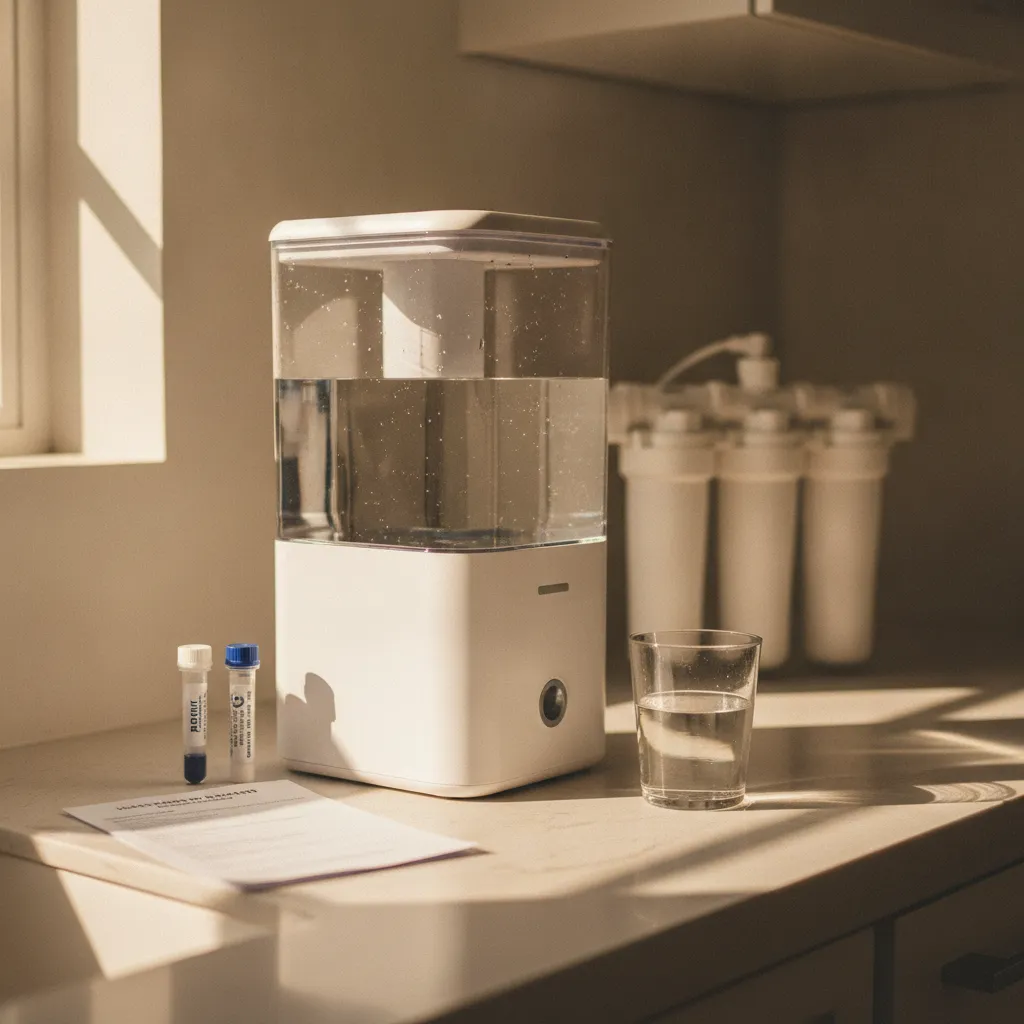
Best Water Filters for Arsenic Removal 2026: Certified Picks
Affiliate disclosure: FilterdWaterGuide.com earns a commission from qualifying purchases made through links in this article. This does not affect our recommendations — products are evaluated based on certification data and independent testing results, not commission rates.
Arsenic is the contaminant nobody sees coming. It has no taste, no smell, no color — and the water that carries it usually comes out of the ground, not a headline. A USGS analysis estimated about 2.1 million Americans draw water from private wells with arsenic above the EPA’s 10 parts per billion limit, and most of them don’t know it, because private wells aren’t regulated and nobody tests unless the owner does. City water isn’t automatically off the hook either: five of the 55 metro water reports we’ve published — Phoenix, Tucson, Fresno, El Paso, and Albuquerque — flag arsenic as a headline concern.
Here’s the short version. Standard carbon filters and pitcher filters do not remove arsenic. Boiling makes it worse — you evaporate water and concentrate what’s left. The best water filters for arsenic removal come from two technologies with real certified claims: reverse osmosis under NSF/ANSI 58 and adsorption filters with arsenic named under NSF/ANSI 53. That’s a short list of products, and this guide covers the ones whose claims we could verify with the certifier, not the marketing department. For the chemistry and health side, read Kenji’s arsenic in drinking water explainer. This is the other half: what to buy.
Quick Picks
- Best Overall: AquaTru Classic Countertop RO — a certified arsenic claim through IAPMO R&T (NSF/ANSI 42, 53, 58, 401) with zero plumbing. Works for homeowners and renters alike.
- Best Under-Sink: Pentair FreshPoint GRO-575B — arsenic sits in NSF International’s own database listing for this unit, under NSF/ANSI 58. The most thoroughly verified claim in this guide.
- Best Non-RO: MultiPure Aquaperform (MP880) — a carbon-block unit with a certified arsenic V claim under NSF/ANSI 53. No affiliate relationship; it’s here on certification alone.
How We Picked (and What We Cut)
Every pick carries a current certification from one of the three ANSI-accredited certifiers — NSF International, WQA Gold Seal, or IAPMO R&T — with arsenic named in the certified claim set. We check the certifier’s listings, not the product box. “Tested to NSF standards” is a one-time lab result, not certification, and it doesn’t get a product into this guide. Neither does NSF/ANSI 372, which covers lead-free materials and says nothing about what a filter removes.
The cuts matter more here than in most guides. The Waterdrop G3P800 — our top overall pick in the best reverse osmosis systems guide — is IAPMO-certified to NSF/ANSI 42, 53, 58, and 372, but the certified claim set we verified does not include a named arsenic claim. Same story for budget RO favorites like the APEC ROES-50 and iSpring RCC7AK: real certifications, no named arsenic claim. An RO membrane will physically reject most pentavalent arsenic regardless — that’s how the technology works — but this site doesn’t call something an arsenic filter unless a certifier put it in writing. For arsenic specifically, the certified picks below win.
AquaTru Classic Countertop RO — Best Overall
The certified arsenic fix that doesn’t require touching your plumbing.
| Spec | Detail |
|---|---|
| Price | Check current price on Amazon — runs frequent promotions |
| Form factor | Countertop RO, batch-style (fill tank, dispense purified) |
| Certifications | IAPMO R&T to NSF/ANSI 42, 53, 58, 401 |
| Named certified claims include | Arsenic, lead, chromium-6, fluoride, nitrate, PFOA/PFOS |
| Installation | None — plug in and fill |
| Replacement filters | Proprietary AquaTru cartridges, staggered replacement schedule |
Why we recommend it: Arsenic problems cluster in two groups: private well owners and renters in desert cities. The AquaTru Classic serves both, because it’s the rare certified-arsenic unit that requires no installation at all. The certification is through IAPMO R&T — one of the three ANSI-accredited certifiers — to NSF/ANSI 42, 53, 58, and 401, with arsenic named in the claim set alongside lead, chromium-6, fluoride, nitrate, and PFOA/PFOS. One thing to say plainly: IAPMO is not NSF International, so you won’t find this unit in NSF’s own database. That doesn’t make the certification less real — it means you check IAPMO’s listing directory instead.
Best for: Renters, well owners who want protection today while they sort out long-term treatment, and anyone whose sink cabinet is already full.
Installation reality: There isn’t any, and that’s the point. You fill the tap-water tank by hand, the unit processes it, and you dispense from the clean tank. No drilling, no compression fittings, no landlord conversation.
Where it breaks:
- It’s a batch unit. You refill the tank yourself, and if the family drinks faster than it processes, you wait. A plumbed under-sink RO never makes you think about it.
- Proprietary replacement cartridges. You buy AquaTru’s filters at AquaTru’s prices for the life of the unit — budget for that before you buy, not after.
Our rating: 4.5/5
Pentair FreshPoint GRO-575B — Best Under-Sink
The arsenic claim you can look up in NSF International’s own database.
| Spec | Detail |
|---|---|
| Price | Check current price — sold through Pentair and plumbing retailers |
| Form factor | Under-sink RO with dedicated faucet |
| Certifications | NSF International to NSF/ANSI 42, 53, and 58; separately IAPMO-certified to NSF/ANSI 53 for total PFAS |
| Named NSF/ANSI 58 claims include | Arsenic, lead, chromium-6, fluoride, cadmium, barium, radium, selenium, TDS |
| Installation | Under-sink, cold line, dedicated faucet |
Why we recommend it: If you want the shortest possible chain between a marketing claim and a verifiable record, this is it. The GRO-575B’s NSF/ANSI 58 listing — with arsenic named — sits in NSF International’s certified product database, where anyone can pull it up. The certified claim set is one of the broadest in the category: arsenic, lead, chromium-6, fluoride, cadmium, barium, radium, and selenium under 58, plus a separate IAPMO certification to NSF/ANSI 53 for total PFAS. That last one belongs to the 575 specifically — the similarly named 475 doesn’t carry it, so check the model number on the box, not the shelf tag.
Best for: Homeowners on arsenic-affected city water or a treated well who want a permanent, plumbed-in fix at the kitchen tap.
Installation reality: Standard under-sink RO install: cold-line tee, dedicated faucet, drain connection for the reject line. If your sink has a spare knockout, a patient homeowner does this in an afternoon. If you’ve never sweat a fitting or drilled stainless, hire it out — it’s a short job for a plumber.
Where it breaks:
- No direct affiliate program and thinner retail presence than Waterdrop or APEC — you’ll likely buy through a plumbing supplier or Pentair directly, and support routes through dealers. We earn nothing recommending it, which is fine; that’s not the test.
- Like every under-sink RO, it sends reject water down the drain and needs cabinet space for the tank and manifold. Measure before you order.
Buy from Pentair — no affiliate relationship; find the GRO-575B under FreshPoint reverse osmosis systems
Our rating: 4.5/5
MultiPure Aquaperform (MP880) — Best Non-RO Option
Proof you don’t always need a membrane: a carbon block with a certified arsenic V claim.
| Spec | Detail |
|---|---|
| Price | Check current price — sold through MultiPure’s distributor network |
| Form factor | Under-sink carbon block (no membrane, no reject water, no tank) |
| Certifications | NSF International to NSF/ANSI 42, 53, 401 |
| Named certified claims include | Arsenic V, lead, PFOA/PFOS |
| Installation | Under-sink, simpler than RO — no drain line needed |
Why we recommend it: Most carbon filters can’t touch arsenic, which is exactly why this one is interesting. The Aquaperform uses arsenic-selective media inside a carbon block and holds an NSF International certification to NSF/ANSI 53 with arsenic V named — one of very few non-RO products that can say that, and the listing is in NSF’s own database. Because there’s no membrane, there’s no reject water, no storage tank eating your cabinet, and better flow at the faucet than a typical RO. Full disclosure, and it’s the good kind: MultiPure sells through distributors, we have no affiliate relationship with them, and we make nothing if you buy one. It’s in this guide because the certification says it belongs here.
Best for: Households on chlorinated city water (where arsenic is already in the As(V) form the certification is tested against) who want certified removal without RO’s water use and space demands.
Installation reality: Easier than RO. No drain connection, no tank — mount the housing, tee the cold line, run the dedicated faucet. The whole job is shorter than the RO version of the same afternoon.
Where it breaks:
- The certified claim is arsenic V specifically. On a private well where arsenic may be in the As(III) form, this unit alone is the wrong tool unless your water is oxidized first — get a speciation test before choosing it (more on that below).
- Distributor-only sales. No Amazon listing to price-compare, and buying means going through MultiPure’s network, which is slower and less familiar than one-click checkout.
Buy from MultiPure — no affiliate relationship
Our rating: 4/5
Comparison Table
| Product | Form Factor | Certifier | Standards | Arsenic Claim | Our Rating |
|---|---|---|---|---|---|
| AquaTru Classic | Countertop RO | IAPMO R&T | NSF/ANSI 42, 53, 58, 401 | Certified (named) | 4.5/5 |
| Pentair GRO-575B | Under-sink RO | NSF International (+ IAPMO for PFAS) | NSF/ANSI 42, 53, 58 (+53 total PFAS via IAPMO) | Certified (NSF DB listing) | 4.5/5 |
| MultiPure Aquaperform | Under-sink carbon block | NSF International | NSF/ANSI 42, 53, 401 | Certified (arsenic V) | 4/5 |
How to Choose an Arsenic Filter
Start with a test, not a filter
Arsenic varies house to house — two wells a mile apart can test at 2 ppb and 40 ppb, and city levels vary across a distribution system. Before you spend hundreds on treatment, spend less on knowing your number. A mail-in lab panel like Tap Score reports arsenic to sub-ppb levels, and for well owners the speciated version matters (see below). Our home water testing guide covers the options; on city water, start with your utility’s Consumer Confidence Report, then confirm at your own tap.
City water vs. well water: the As(V) / As(III) problem
This is the single most important thing in this guide. Arsenic shows up in two forms: pentavalent As(V) and trivalent As(III). Certified arsenic claims are tested against As(V). On chlorinated city water, that’s fine — chlorine converts arsenic to As(V), so what’s in your glass matches what the filter was certified against. On a private well, the water is often low-oxygen and the arsenic can be As(III), which RO membranes and adsorption media handle much less effectively. Here’s what actually happens if you skip this step: you install a certified filter, it performs below its certified number, and you don’t find out unless you retest. Well owners: get a speciation test first, and if As(III) shows up, treatment needs an oxidation step ahead of the filter. Our well water testing guide walks through it.
NSF/ANSI 58 vs. 53: two routes to the same claim
NSF/ANSI 58 is the reverse osmosis standard — membrane-based systems like the AquaTru and Pentair picks. NSF/ANSI 53 is the health-claims standard for adsorption filters, and a 53 certification only covers arsenic if arsenic is named in that product’s claim set — most 53-certified filters are certified for lead or VOCs and do nothing for arsenic. Don’t buy on the standard number alone. Buy on the named claim.
What “certified” actually means — and what it doesn’t
Three bodies can certify a drinking water filter to the NSF/ANSI standards: NSF International, WQA Gold Seal, and IAPMO R&T. All three are ANSI-accredited, all three run factory audits and re-testing, and a WQA or IAPMO certification will not appear in NSF’s database — absence there proves nothing. What doesn’t count: “tested to NSF standards” (a one-time lab claim with no ongoing oversight) and NSF/ANSI 372 (lead-free materials, not removal performance). If a product page says “removes 99% of arsenic” and you can’t find the claim in a certifier’s listing, treat it as marketing.
Whole-house treatment: usually not the first move
Arsenic’s exposure route is ingestion — drinking and cooking water. That’s why point-of-use treatment at the kitchen tap is the standard recommendation, and it’s a fraction of the cost of treating every gallon that flushes a toilet. The exception is a well testing high enough that you want every tap covered; that’s a specialist install — oxidation plus arsenic-selective media at the point of entry — sized to your water chemistry by someone who’s tested it. If that’s your situation, start with the speciation test and a local water treatment pro, not a box off the internet.
Replacement filters: the real cost
Every pick here has proprietary or semi-proprietary cartridges, and an arsenic filter you stop maintaining is worse than none — it keeps pouring water while the certified performance quietly expires. Price the year-two cost before you buy: cartridge prices times the replacement schedule. And keep to the schedule; our filter replacement guide explains why media past its service life stops performing long before the water tastes any different.
FAQ
Do water filter pitchers remove arsenic?
No standard pitcher carries a certified arsenic claim — not Brita, not the others. Pitcher certifications, where they exist, cover things like chlorine, lead, or PFAS. Arsenic needs reverse osmosis certified under NSF/ANSI 58 or an adsorption filter with arsenic named under NSF/ANSI 53. If a pitcher’s marketing implies arsenic removal, ask which certifier lists the claim. You won’t get an answer.
Does boiling water remove arsenic?
No — it does the opposite. Boiling evaporates water and leaves arsenic behind, so the concentration goes up. Letting water stand doesn’t help either; arsenic doesn’t off-gas the way chlorine does. Removal takes a physical barrier or media: RO or certified adsorption.
Does a filter certified for lead also remove arsenic?
Not unless arsenic is separately named in its certified claims. Lead and arsenic are both certified under NSF/ANSI 53, but each contaminant is its own claim with its own test. Plenty of excellent lead-certified filters — including some we recommend in our lead removal guide — have no arsenic claim at all. Check the claim set, not the standard number.
Do these picks also handle PFAS?
Yes, all three carry certified PFAS claims: the AquaTru Classic and MultiPure Aquaperform are certified for PFOA/PFOS, and the Pentair GRO-575B holds a separate IAPMO certification to NSF/ANSI 53 for total PFAS. If PFAS is your bigger worry, that guide is here.
What level of arsenic is safe in drinking water?
The EPA’s enforceable limit is 10 ppb, but its health goal (MCLG) is zero, and New Jersey and New Hampshire enforce 5 ppb. Above 10 ppb, treat the water — no debate. Between detection and 10 ppb, treatment is a reasonable precaution, especially with kids in the house. Risk scales with concentration and years of exposure, not a single glass.
I’m on a private well. How often should I test for arsenic?
Test annually, and always after work on the well or a noticeable change in the water. Arsenic comes from the local geology, so levels can drift with the water table. If you’ve installed treatment, test the treated water too — that’s the only way to know the system is still doing its job.
Why isn’t the Waterdrop G3P800 in this guide? You recommend it everywhere else.
Because its certified claim set — IAPMO R&T to NSF/ANSI 42, 53, 58, and 372 — doesn’t include a named arsenic claim. The membrane will reject most As(V) as a matter of physics, but “should work” isn’t the bar for this site. For arsenic, buy a unit with the claim in writing.
Final Verdict
For most people with an arsenic number worth acting on, the AquaTru Classic is the buy: a named certified arsenic claim across four NSF/ANSI standards, and it works the day it arrives — no plumbing, no landlord, no drain line. If you want the permanent plumbed-in version, the Pentair FreshPoint GRO-575B carries the most verifiable arsenic claim in the category, sitting in NSF International’s own database. And the MultiPure Aquaperform is the pick for city-water households who want certified arsenic removal without RO’s water use — from a company that pays us nothing, which is exactly why you can trust it made the list. Whichever you choose, test first: your number decides whether you need this guide or our general RO guide.
Sources
- NSF International Certified Drinking Water Treatment Units Database — Pentair FreshPoint GRO-575B, MultiPure Aquaperform listings
- IAPMO R&T Product Listing Directory — AquaTru certifications
- US EPA — Arsenic Rule (66 FR 6976, January 2001; compliance 2006); National Primary Drinking Water Regulations, arsenic MCL 10 ppb / MCLG zero
- USGS — Ayotte et al., 2017, estimate of ~2.1 million US domestic well users with arsenic above 10 ppb
- FilterdWaterGuide metro water quality reports (Phoenix, Tucson, Fresno, El Paso, Albuquerque) — arsenic flagged as headline contaminant