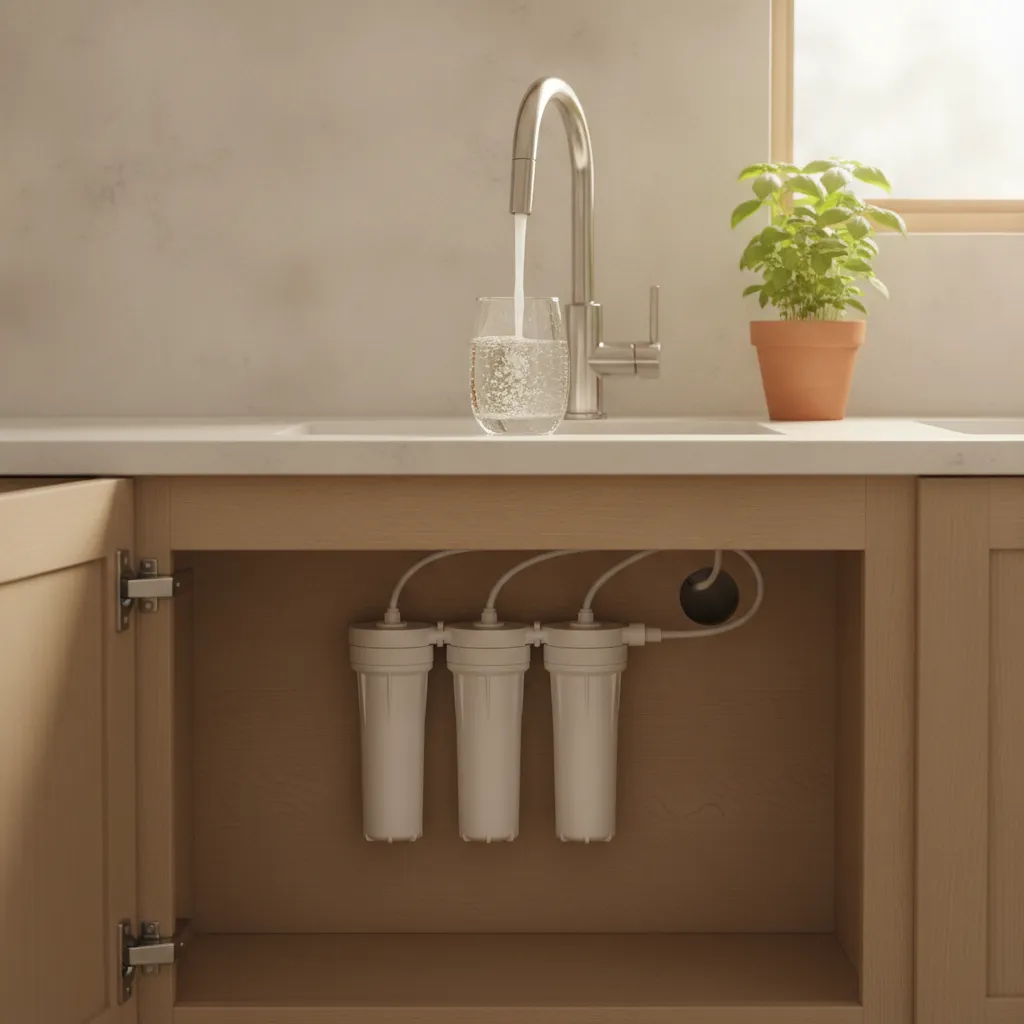
Brondell Coral UC300 Review 2026: Certified Lead & PFAS Filter
> Affiliate disclosure: FilterdWaterGuide.com earns a commission from qualifying purchases made through links in this article. This does not affect our recommendations. Products are evaluated on certification data and independent testing, not commission rates. We have no affiliate relationship with Brondell; the direct link to Brondell’s site is untracked, and the Amazon link is a standard Amazon Associates link. We do have an affiliate relationship with Aquasana, one of the brands the Coral is compared against, and we say so again where that comparison comes up.
You want a filter under the kitchen sink that’s certified for lead and PFAS by an accredited body, not just “tested,” and you’d rather not pay $200 for it. Short answer for this Brondell Coral UC300 review: it does that for about $144, with one $79.99 filter change a year. It has been sitting on Amazon, Lowe’s, and Walmart shelves for years, and it’s missing from most “best under-sink filter” lists, including ours.
Here’s what nobody tells you about this product: its certification paperwork is as strong as the systems that outrank it. The Water Quality Association’s Gold Seal program certifies it to NSF/ANSI 42, 53, and 401, and the 53 scope includes lead, PFOA/PFOS, mercury, cysts, asbestos, and a long list of VOCs. Brondell’s own Performance Data Sheet spells out every number. Consumer Reports has it in its under-sink test program. That’s not a product that deserves to be invisible.
It’s also not a product without limits. The flow rate is slow, it needs its own faucet hole, the warranty is a single year, and it does nothing for the contaminants that need reverse osmosis. I went through the data sheet, spec sheet, and price pages so you can decide whether those limits matter for your water.
Quick Verdict
The Brondell Coral UC300 earns 4.4 out of 5. It was $143.99 on sale at Brondell (list $179.99) when we checked in September 2026. For that you get a three-stage carbon system WQA-certified to NSF/ANSI 53 for lead at 99.2 to 99.7 percent reduction and PFOA/PFOS at 99.0 percent. It also carries chloramine under NSF/ANSI 42 at 98.6 percent and fifteen pharmaceutical and pesticide compounds under NSF/ANSI 401.
The filter set lasts 600 gallons or twelve months and costs $79.99. That works out to about 13 cents a gallon and one filter change a year, a lower cost of ownership than either of the Claryum-based under-sink systems we currently recommend.
What you need to know before you spend your money: it runs 0.5 gallons per minute through a dedicated faucet. The warranty is one year. The PFOA/PFOS test protocol’s pass line sits well above the EPA’s new drinking water limits. And it holds no certification at all for arsenic, fluoride, nitrate, or chromium-6. If your water test shows any of those four, keep reading but plan on a different technology.
Check on Amazon | Buy Direct from Brondell (no affiliate relationship)
Specs at a Glance
| Spec | Detail |
|---|---|
| Model | Brondell H2O+ Coral UC300, three-stage under-sink carbon system |
| Price (September 2026) | $143.99 sale / $179.99 list at brondell.com when we checked; $149.99 at Home Depot |
| Certifier | Water Quality Association (WQA Gold Seal), not NSF International |
| Certified standards | NSF/ANSI 42, 53, 401; NSF/ANSI/CAN 372; CSA B483.1 |
| Filter stages | Sediment filter, pre-carbon filter, carbon block filter (UF-35 set) |
| Rated capacity | 600 gallons |
| Filter life | 12 months (all three filters replaced together) |
| Replacement set | UF-35, $79.99 at Brondell; includes a battery for the faucet’s LED indicator |
| Rated service flow | 0.5 gallons per minute |
| Operating pressure | 35 to 100 psi |
| Feed water temperature | 39°F to 100°F |
| Dimensions | 9 in. W x 13.5 in. H x 3.75 in. D; 3.8 lb |
| Faucet | Chrome, 9-inch spout, LED filter-change indicator; needs a separate 7/16-inch hole |
| Power | None (the LED indicator runs on a battery) |
| Warranty | One year, parts and labor, manufacturing defects only; filters excluded |
| Made by | Brondell Inc., San Francisco |
What’s Certified, and Who Certified It
The question to ask about any under-sink filter isn’t “is it NSF certified?” It’s “which accredited body certified it, to which standard, and for which contaminants?” Those are three different questions, and the Coral answers all three cleanly.
The certifier is the Water Quality Association’s Gold Seal program. WQA is an accredited certification body that certifies products to the NSF/ANSI drinking water standards, the same job NSF International and IAPMO R&T do. A WQA certification is a real certification. It comes with ongoing factory audits and retesting, which is the difference between “certified” and “tested to NSF standards.” A one-time lab test has no one checking the product next year. A certification does.
What a WQA certification is not is an NSF International listing, so you won’t find the Coral in NSF’s own database at info.nsf.org. That absence confuses people, and some review sites have marked products “uncertified” on that basis. The correct wording is “WQA-certified to NSF/ANSI 53,” which is what Brondell’s spec sheet, product page, and Performance Data Sheet all say. Our certifications explainer walks through the certifying bodies in detail.
Here is the certified scope, taken from the Performance Data Sheet Brondell publishes for the UC300 (dated September 2021):
| Standard | What it covers | Coral UC300 certified claims (average reduction) |
|---|---|---|
| NSF/ANSI 42 | Aesthetic effects | Chlorine taste and odor 98.0%; chloramine 98.6%; Class I particulates (0.5 to under 1 micron) 99.8% |
| NSF/ANSI 53 | Health effects | Lead 99.2% at pH 8.5 and 99.7% at pH 6.5; PFOA/PFOS 99.0%; mercury 93.3% (pH 8.5) and 96.9% (pH 6.5); cysts 99.9%; MTBE 96.9%; turbidity 96.6%; asbestos 99.96%; VOCs 99.8% by chloroform surrogate (51 compounds listed, including trihalomethanes, benzene, atrazine, and lindane) |
| NSF/ANSI 401 | Emerging and incidental contaminants | 15 compounds at 93 to 100%, including BPA, ibuprofen, naproxen, estrone, carbamazepine, DEET, the herbicide metolachlor, and the flame retardants TCEP and TCPP |
| NSF/ANSI/CAN 372 | Lead-free materials | The system’s own wetted parts meet the lead-content limit. This says nothing about lead removal. |
| CSA B483.1 | Canadian plumbing requirements | Canadian market compliance |
Three things in that table deserve a closer look.
First, lead. The 53 lead test runs at 150 parts per billion of lead in the incoming water, at two pH levels, for the full rated capacity of the filter. A carbon block that reduces 99.2 percent of a 150 ppb challenge is bringing it down to roughly 1 ppb. For a house with a lead service line or old solder, that’s the number that matters. Our lead in drinking water guide explains why the pH matters too.
Second, chloramine. It’s listed under NSF/ANSI 42, the aesthetic standard, because the standard treats chloramine as a taste and odor issue. But a 98.6 percent chloramine claim isn’t something every carbon filter can make. Ordinary activated carbon handles free chlorine well and chloramine poorly. More than one in five Americans drink chloraminated water, according to the EPA. If your utility is one of them, the Coral is one of the cheaper certified answers. Our chloramine vs chlorine explainer covers why the difference matters.
Third, the “75 contaminants” number on the box. It’s accurate as a count of line items on the Performance Data Sheet, and 51 of those are the VOCs covered by a single chloroform surrogate test. That’s how the standard works, and it’s legitimate. It also means the headline number is mostly one test. The claims that will change your decision are the ones in the table: lead, PFOA/PFOS, chloramine, mercury, cysts, and the 401 list.
One disclosure of my own. WQA’s product database is a JavaScript application that our tools couldn’t open during this review. So the certification scope above rests on Brondell’s Performance Data Sheet, which names WQA as the certifier and reproduces the test data. Consumer Reports’ spec listing for the Coral separately marks it as certified for chlorine, lead, and PFAS reduction. Brondell links a newer 2025 data sheet from its product page that we also couldn’t open, so the percentages here are the 2021 sheet’s. Open the WQA row yourself at find.wqa.org before you buy. I’d say the same about any product.
The PFAS Number Needs Context
The 99.0 percent PFOA/PFOS figure is a certified claim, and I want to be careful about what it does and doesn’t tell you.
Under the NSF/ANSI 53 protocol the Coral was tested to, the incoming water is spiked to 1.5 micrograms per liter, which is 1,500 parts per trillion. The filter has to bring it to or below 0.07 micrograms per liter, or 70 parts per trillion, across its rated life. The Coral’s data sheet shows exactly that: 0.0015 mg/L in, a maximum of 0.00007 mg/L out. That 70 ppt pass line was set years before the EPA finalized its 2024 drinking water standards, which cap PFOA and PFOS at 4 ppt each.
What that means in practice: the certification proves the filter takes a very high PFOA/PFOS load down by 99 percent for 600 gallons. It doesn’t prove your tap water leaves the faucet under 4 ppt.
If your incoming water reads in the tens of ppt, 99 percent reduction gets you to well under 1 ppt, and the math works in your favor. If you’re near a contamination source with readings in the hundreds, the standard’s 70 ppt ceiling is not the EPA’s 4 ppt limit, and you should test your filtered water. One comparison matters here. The 2022 revision of the standard tightened the pass line to 20 ppt, and the current A.O. Smith AO-US-200 data sheet shows that newer 20 ppt line. The Coral data sheet we could open shows the older 70 ppt one. Both sit above the EPA’s 4 ppt, and neither proves sub-4 water at your tap, but the Claryum paperwork is the more current of the two. Our PFAS guide has the background, and the best PFAS filters roundup compares the certified options.
The certification also covers PFOA and PFOS specifically. It doesn’t cover the newer “Total PFAS” claim that adds PFHxS, PFNA, PFHpA, and PFBS. Brondell’s data sheet doesn’t list those, so I’m not crediting them.
What the Coral Does Not Do
The Coral is an all-carbon system. Carbon adsorption is excellent for organic chemicals, chlorine, and chloramine. With the right media in a good block, it handles lead and mercury too. It’s the wrong tool for dissolved inorganics. The Coral holds no certification, and Brondell makes no claim, for:
- Arsenic. Neither arsenic III nor arsenic V appears anywhere on the data sheet. If you live in the desert Southwest or on a well in the upper Midwest, read our arsenic guide before you buy any carbon filter.
- Fluoride. Not reduced. Carbon doesn’t touch it. Fluoride removal takes reverse osmosis certified to NSF/ANSI 58 or certified activated alumina; see our fluoride explainer.
- Nitrate and nitrite. Not reduced. Agricultural areas need RO or anion exchange; our nitrate guide explains why.
- Chromium-6. Not on the data sheet. Some carbon blocks carry a certified hexavalent chromium claim under 53. This one doesn’t.
- Bacteria and viruses. Brondell’s data sheet says, in the standard’s required language, not to use the system on water that is microbiologically unsafe without disinfection before or after it. The cyst claim covers Giardia and Cryptosporidium on disinfected municipal water, and that’s all.
- Total dissolved solids. The Coral leaves minerals in the water, which helps taste. Brondell’s own filter page warns that a TDS meter will still read the minerals and that a low TDS reading doesn’t mean water is safe. That’s a more honest sentence than I expected from a product page.
If your water test shows any contaminant in the first four bullets, the Coral isn’t your filter no matter how good its price is. Those are reverse osmosis jobs. Brondell sells its own under-sink RO, the Capella RC250, and our best reverse osmosis systems guide covers the certified options. Our RO vs under-sink comparison is the place to sort out which technology your water needs.
Test first. A Tap Score test or your utility’s Consumer Confidence Report will tell you which list you’re on, and our home water testing guide explains how to read either one.
Living With It
Flow rate. The rated service flow is 0.5 gallons per minute. That’s about two minutes to fill a gallon pitcher and a noticeable wait to fill a stockpot. It’s the same 0.5 GPM the Aquasana Claryum 2-Stage and A.O. Smith AO-US-200 deliver, and for the same reason: a carbon block with a certified lead and PFAS claim needs contact time, and the certification was earned at that flow. Consumer Reports scores under-sink filters on flow rate and clogging, but its overall score for the Coral is behind its paywall, so I can’t tell you how it ranked. The spec sheet flow is normal for its class.
The faucet hole. The Coral delivers water through its own chrome faucet, which needs a separate 7/16-inch hole in the sink deck or countertop. If your sink has a spare hole under a soap dispenser or sprayer cap, you’re fine. If it doesn’t, you’re drilling, or paying someone to. Renters, ask before you buy. Brondell doesn’t sell a direct-connect version of this model that runs through your existing faucet.
Installation. Brondell says an adjustable wrench and a Phillips screwdriver are the only tools for a standard install. The kit includes a pre-installed faucet hose, a metal T-valve for the cold-water supply, and quick-connect adapters. The system hangs on the cabinet wall with a 9-by-13.5-inch footprint less than four inches deep. No electricity and no drain line, since there’s no membrane and no wastewater. Brondell links a TaskRabbit page for people who’d rather not do it themselves.
Pressure. The operating window is 35 to 100 psi. The 100 psi ceiling is more forgiving than the A.O. Smith unit’s 80 psi limit, which matters in neighborhoods where overnight static pressure climbs. Below 35 psi, which happens on some well systems and upper floors, flow will drop further.
The LED indicator. The faucet base has a filter-change light on a timer battery. A replacement battery ships in every UF-35 set. This is a calendar reminder, not a usage meter. It doesn’t know how many gallons you’ve run.
Twelve months, or 600 gallons, whichever comes first. This is the spec that makes the Coral’s economics work, and it has a footnote worth reading. Brondell’s data sheet says the twelve-month cycle is “based on an average production of 2.6 gallons of drinking water per day.” Do that arithmetic and you get about 950 gallons a year, which is past the 600-gallon rating.
The rating, not the calendar, is the certified limit. A household that actually draws 2.6 gallons a day should be changing the set at about seven and a half months. A two-person household drinking and cooking with a gallon or so a day will hit the calendar first. Our filter replacement guide explains why gallon ratings and calendar ratings diverge.
Warranty. One year, defects only, filters excluded. That matches Aquasana’s and A.O. Smith’s one-year terms, and it’s still short for a plumbed product that will sit in a cabinet for a decade. A $15 leak sensor on the cabinet floor is cheap insurance regardless of brand.
What It Actually Costs
Follow the money on any filter and the sticker is the smallest number. The Coral’s advantage isn’t the $143.99 up front. It’s the once-a-year, $79.99 filter set.
| Brondell Coral UC300 | A.O. Smith AO-US-200 | Aquasana Claryum 2-Stage | |
|---|---|---|---|
| System (Sept 2026) | $143.99 sale; $179.99 list | about $111 Amazon; $139.99 MSRP | $124.99 sale; $249.99 MSRP |
| Certified scope | WQA 42/53/401: lead, PFOA/PFOS, chloramine, mercury, cysts, VOCs, 401 list | WQA 42/53/401: lead, PFOA/PFOS, chloramine, mercury, cysts, VOCs, 401 list | WQA 42/53/401: same Claryum cartridge as the A.O. Smith |
| Replacement set | $79.99, 600 gal, 12 months | $83.99, 500 gal, 6 months | $73.99, 500 gal, 6 months |
| Filter changes per year (calendar) | 1 | 2 | 2 |
| Annual filter cost | $79.99 | $167.98 | $147.98 |
| Cost per gallon (filters only) | $0.13 | $0.17 | $0.15 |
| Five-year total (system + 4 or 9 sets) | about $464 at sale price; about $500 at list | about $867 | about $791 |
| Rated flow | 0.5 GPM | 0.5 GPM | 0.5 GPM |
| Warranty | 1 year | 1 year | 1 year |
A.O. Smith and Aquasana figures are from our A.O. Smith AO-US-200 review, which put the two Claryum systems side by side. Subscription discounts on those two bring their annual filter costs down but don’t close the gap.
Read the five-year row twice. At Brondell’s September sale price the Coral costs a little more than half what the A.O. Smith costs to own over five years, and it’s a certified lead and PFOA/PFOS filter in the same class. Even at the $179.99 list price it comes in around $500.
The difference is almost entirely the 600-gallon, twelve-month cycle against a 500-gallon, six-month one. If you run more than 600 gallons a year through the tap, the gap narrows, because you’ll be buying a second UF-35 set. Most kitchen-faucet households don’t.
I couldn’t capture the Amazon price on the day I checked, so I used Brondell’s own sale price. Home Depot listed it at $149.99. Brondell’s outlet page had an open-box unit at $139.99, which isn’t enough savings to give up a fresh warranty for.
Coral vs. the Under-Sink Picks We Already Recommend
Our best under-sink filters guide currently leads with Aquasana’s Claryum systems, and the A.O. Smith review found the AO-US-200 to be the same cartridge at a lower entry price. Where does the Coral land against them?
On certified scope, it’s close to a wash. All three are WQA-certified to 42, 53, and 401 with lead, PFOA/PFOS, chloramine, mercury, cysts, and VOCs on the list. The A.O. Smith data sheet shows the newer 20 ppt PFOA/PFOS pass line; the Coral sheet we could open shows 70 ppt. The Aquasana Claryum 3-Stage Max Flow adds a third stage and runs about 0.72 GPM. That’s the one meaningful spec advantage in that family. If flow rate is your dealbreaker, that’s the upgrade.
On cost of ownership, the Coral wins, and it isn’t close, for the reasons in the table above.
On warranty, nobody wins. All three come with a single year.
On track record, Aquasana has the edge. Its under-sink systems have been covered by Wirecutter, so there’s more outside scrutiny of how they hold up. Brondell is better known for bidets than for water filters. That’s not a knock. It does mean fewer independent eyes on the product.
On installation, they’re equivalent: separate faucet, cold-line tee, cabinet mount, no drain.
Full disclosure, again, because it matters here: we earn a commission on Aquasana through its affiliate program and on any of these products through Amazon. We earn nothing from Brondell directly. If anything, the incentive runs against the Coral, and it still comes out ahead on the numbers I can verify.
Who It’s For, and Who Should Pass
Buy the Coral UC300 if you’re on municipal water, your concern is lead, PFOA/PFOS, chloramine, or the taste of your tap, you have or can drill a faucet hole, and you want the lowest running cost we’ve found among certified systems in this class. It’s a particularly good match for the chloraminated cities in our guides and for anyone whose utility’s Consumer Confidence Report shows lead detections at the tap.
Pass if your water test shows arsenic, fluoride, nitrate, or chromium-6, or you’re on an undisinfected well. None of those are carbon problems. Look at certified RO instead.
Pass if you can’t add a faucet hole. A direct-connect under-sink filter or a certified pitcher is your category.
Think twice if you fill big pots at the filtered tap every night. Half a gallon a minute is a real wait. The Aquasana Claryum 3-Stage Max Flow is the faster certified option.
Frequently Asked Questions
Is the Brondell Coral UC300 NSF certified? It’s certified by the Water Quality Association to NSF/ANSI 42, 53, and 401, plus NSF/ANSI/CAN 372 and CSA B483.1. That’s a genuine accredited certification to the NSF/ANSI standards, but it’s a WQA Gold Seal listing, not an NSF International listing, so you won’t find it in NSF’s database. Search find.wqa.org instead.
Does the Brondell Coral remove PFAS? It’s WQA-certified under NSF/ANSI 53 to reduce PFOA and PFOS by 99.0 percent, from a 1,500 ppt test concentration to at or below 70 ppt. It isn’t certified for the broader “Total PFAS” claim that includes PFHxS, PFNA, PFHpA, and PFBS. The 70 ppt pass line is higher than the EPA’s 4 ppt limits, so test your filtered water if your incoming levels are high.
Does the Coral UC300 remove lead? Yes. Brondell’s data sheet shows WQA-certified lead reduction under NSF/ANSI 53 of 99.2 percent at pH 8.5 and 99.7 percent at pH 6.5, tested at 150 ppb incoming lead across the 600-gallon rated capacity.
Does it remove fluoride or arsenic? No. The Coral is an all-carbon system and holds no certification or claim for fluoride, arsenic, nitrate, or chromium-6. Those require reverse osmosis or another certified technology.
How often do you change the Coral UC300 filters? Every 600 gallons or 12 months, whichever comes first. The UF-35 replacement set replaces all three filters at once and costs $79.99 at Brondell. The faucet’s LED reminder is on a timer, not a gallon counter, so a heavy-use household should change earlier.
Does the Coral UC300 need a separate faucet? Yes. It comes with a chrome faucet that needs its own 7/16-inch hole in the sink or counter. It can’t be plumbed inline through your existing kitchen faucet.
Is the Coral UC300 a reverse osmosis system? No. It’s a three-stage carbon filtration system with no membrane, no storage tank, and no drain line, and it leaves minerals in the water. Brondell’s under-sink RO is the Capella RC250.
Bottom Line
The Brondell Coral UC300 is the certified under-sink filter that fell through the cracks. It’s WQA-certified to NSF/ANSI 42, 53, and 401 with lead, PFOA/PFOS, chloramine, mercury, cysts, and a 15-compound 401 list, for about $144 on sale and $79.99 a year in filters.
Over five years it costs roughly half as much to own as the similarly certified Claryum systems we already recommend. Its limits are the ones any carbon filter has (arsenic, fluoride, nitrate, and chromium-6) plus a slow tap, a faucet hole, and a one-year warranty. If your water test points at lead, PFOA/PFOS, or chloramine and not at the RO list, this is the system I’d buy before either of the ones that outrank it on the shelf.
Check on Amazon | Buy Direct from Brondell (no affiliate relationship)
Sources
- Brondell, Coral UC300 Undercounter Water Filtration System Performance Data Sheet (PDF, 09/28/21) (certifier, standards, all reduction percentages, influent and effluent limits, 600-gallon capacity, 0.5 gpm, pressure and temperature range, 2.6 gal/day footnote)
- Brondell, Coral UC300 Spec Sheet (PDF) (dimensions, weight, warranty, faucet, install features)
- Brondell, Coral Three-Stage Under Sink Water Filtration System product page (price, certification statement, 7/16-inch faucet hole, tools, warranty terms, TaskRabbit note; accessed September 21, 2026)
- Brondell, Coral Three-Stage Filter Replacement Pack UF-35 product page (price, battery, 12-month/600-gallon cycle, TDS meter note; accessed September 21, 2026)
- Consumer Reports, Brondell Coral UC300 Three Stage under-sink water filter listing (tested model; certified for chlorine, lead, and PFAS reduction; rated capacity 600 gal)
- Water Quality Association, Gold Seal Certified Product Listings
- U.S. EPA, Per- and Polyfluoroalkyl Substances (PFAS) drinking water regulation (4.0 ppt MCLs for PFOA and PFOS)
- U.S. EPA, Chloramines in Drinking Water (more than one in five Americans use chloraminated water)
- FilterdWaterGuide, A.O. Smith AO-US-200 Review (comparison pricing for the AO-US-200 and Aquasana Claryum 2-Stage)