How to Test Your Water at Home: DIY Kits vs Lab Testing
LAST UPDATED: April 2026
Water quality testing divides into two distinct approaches: DIY test kits (measuring $10-$50, yielding results in minutes) and certified laboratory analysis ($50-$200+, requiring 3-10 business days). DIY kits serve adequately for screening purposes. Laboratory testing is the only pathway to obtain accurate, legally defensible results for health-significant contaminants including lead, PFAS, arsenic, and bacterial pathogens. This guide examines both approaches so you can select the method aligned with your risk profile.
Approximately 15 million US households depend on private wells. These systems receive none of the regular testing mandated for municipal supplies. Municipal users face different exposure pathways: lead leaches into tap water after treatment, through corroded service lines and aged plumbing that utilities do not monitor. If your specific tap water quality remains uncertain, our analysis of US tap water safety presents the current national data.
> KEY TAKEAWAYS: > – DIY test strips work for screening chlorine, pH, hardness, and nitrates — but they cannot reliably detect lead, PFAS, arsenic, or bacteria. > – Certified lab testing provides the scientifically rigorous approach. Tap Score and state-certified laboratories deliver accurate results with plain-language interpretation. > – Well owners should test annually for bacteria, nitrates, and pH at minimum — and run a comprehensive panel every 3-5 years. > – Your test results should drive filter selection. Not the reverse. > – On municipal water? Review your utility’s free Consumer Confidence Report (CCR) before purchasing any home water test kit.
Step 1: Start with Your Consumer Confidence Report (Municipal Water Only)
For municipal system users: obtain your annual Consumer Confidence Report (CCR) before purchasing any home water test kit. Every community water system in the US must publish a CCR by July 1 annually.
Your CCR documents:
- Every regulated contaminant tested during the preceding year
- Whether your utility incurred any violations
- Measured contaminant levels compared to EPA Maximum Contaminant Levels (MCLs)
Access your report at EPA’s CCR database or through your water utility’s website. Cross-reference your findings with the Environmental Working Group’s Tap Water Database (ewg.org/tapwater). EWG applies health-based limits, not merely legal thresholds — a material distinction for contaminants like PFAS, where enforceable standards remain substantially looser than contemporary health research supports.
The CCR has a critical limitation: it does not document water quality changes occurring between the treatment plant and your tap. Lead contamination originates almost exclusively in household plumbing infrastructure and distribution piping, not in source water. If your home predates 1986 or contains brass fixtures, testing your own tap provides essential data the CCR cannot supply. The CCR reflects system-wide averages; your individual exposure may exceed those figures substantially.
Step 2: Choose Your Water Quality Testing Approach
Option A: DIY Home Water Test Kits ($10–$50)
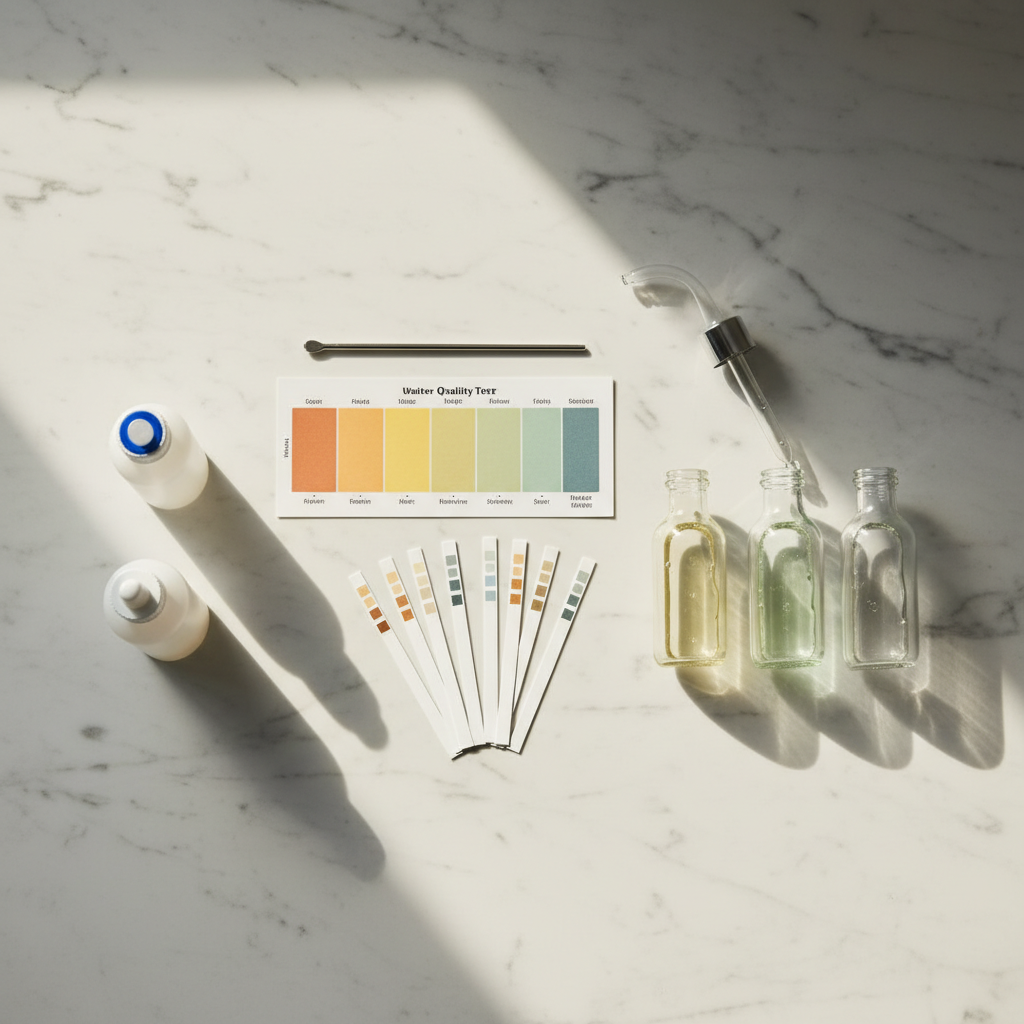
Test strips and liquid kit reagents produce color shifts indicating specific contaminant presence.
What DIY kits reliably detect:
- Chlorine and chloramine residual
- pH
- Total hardness (calcium and magnesium combined)
- Nitrates and nitrites
- Iron (qualitative screening)
- Total dissolved solids (TDS) — via digital meters
What they cannot quantify:
- Lead — substantial false-negative rates occur at actionable concentrations
- PFAS — colorimetric methods lack sensitivity at parts-per-trillion detection thresholds
- Arsenic — insufficient sensitivity near the 10 ppb EPA MCL
- Bacteria — visual tests exist but lag far behind laboratory culture methods in reliability
- Microplastics — no DIY kit can detect or quantify microplastic contamination. Only high-end laboratory panels with specialized filtration and microscopy analysis can measure microplastic particle counts. Consumer interest in microplastics is growing in 2026, but the testing infrastructure remains limited to advanced labs like Tap Score’s extended panels.
- Specific compound identification within broader contaminant categories
Recommended DIY kits:
- Safe Home BASIC Drinking Water Test Kit (~$20): Covers 10 parameters including chlorine, pH, hardness, iron, and nitrates. Provides initial screening data. Available on Amazon.
- HM Digital TDS-3 Meter (~$18): Measures total dissolved solids in seconds. Elevated TDS alone does not indicate unsafe water, but a significant departure from your baseline warrants investigation. Available on Amazon.
- LaMotte 3491-01 Water Quality Test Kit (~$40): Delivers more precise colorimetric results across a wider parameter range. Field professionals in water treatment use this model for preliminary assessment.
Critical caveat: a negative result on a DIY kit does not confirm the absence of all contaminants. Lead at 15 ppb — the EPA’s action level threshold — remains beyond the reliable detection range of most strips. A clean test result offers no assurance that lead exposure is absent.
Option B: Certified Lab Water Testing ($50–$300+)
State-certified laboratories employ EPA-approved analytical methods — the identical protocols used for regulatory compliance determinations.
The procedure is straightforward: order a testing kit, collect your sample following provided instructions, return the sealed container via prepaid mail, receive results electronically with interpretive guidance.
Key evaluation criteria for laboratory selection:
- State accreditation or certification status — seek explicit “accredited” or “certified” language, not vague “professional-grade” claims
- Transparent result interpretation: intelligible findings with context, not raw data spreadsheets
- EPA-protocol testing for the specific contaminants you aim to assess
NSF Certification Distinction: When selecting filters based on your results, understand the difference between NSF certified and NSF tested. “NSF Certified” means NSF International conducted independent, ongoing verification. “NSF Tested” or “tested to NSF standards” often reflects a single manufacturer-conducted test without third-party oversight. Consult the actual NSF certified product database to verify claims.
The Best Water Testing Services in 2026
Tap Score (Most Accessible)
Tap Score (by SimpleLab) operates the most user-friendly certified testing service for homeowners. They partner with a network of state-accredited laboratories distributed across the US. Their result reports merit particular attention — each finding includes a clear explanation of what the measurement means and what follow-up action (if any) is evidence-supported.
Popular testing panels:
| Test Panel | Price | Coverage |
|---|---|---|
| Essential City Water Test | $99 | 50+ parameters including lead, chlorine, DBPs, hardness |
| Advanced City Water Test | $169 | 100+ parameters including PFAS, arsenic, chromium-6 |
| Essential Well Water Test | $169 | Bacteria, lead, iron, hardness, nitrates, 50+ parameters |
| Advanced Well Water Test | $289 | Comprehensive panel, 100+ parameters including PFAS, VOCs, pesticides |
Engineering trade-offs: Results require 7-10 business days after sample receipt. Expedited results incur additional fees. If you need to screen for a particular industrial chemical, contact Tap Score first to confirm the analyte appears on the panel. Account for 1-3 days in each direction for shipping, placing typical turnaround at approximately 2 weeks from order to results.
State Health Department Labs
Many state health departments offer well water testing for free or at minimal cost — particularly for bacteria, nitrates, and lead screening. If your state provides this service, it represents the most economical pathway. Search “[your state] drinking water testing program” or contact your county extension office.
Service availability varies substantially. Some states operate comprehensive analytical panels; others limit screening to essential parameters. Result interpretation support may be minimal relative to commercial offerings.
National Testing Laboratories (NTL)
NTL conducts EPA-certified analysis with an extensive panel range. Their WaterCheck series covers 100+ analytes — PFAS, heavy metals, pesticides — at approximately $155 baseline pricing. This represents a substantive alternative if you want additional comparison to Tap Score results.
Engineering trade-off: NTL result reports do not match Tap Score’s interpretive polish or clarity. You receive the analytical data, but interpretation may require independent research.
Visit National Testing Laboratories
What Should You Test For?
Testing strategy depends on your water source.
If You’re on Municipal Water
Begin with your CCR. If detections appear — even below the MCL — consider targeted laboratory testing for those specific contaminants. Test for lead independent of CCR results if:
- Your home predates 1986
- You reside in an older multi-unit building
- You have young children or are pregnant
Free lead testing under the Lead and Copper Rule Revisions (LCRI): Under the EPA’s revised Lead and Copper Rule, many municipalities now offer free lead test kits to homes built before 1986. Before spending $99+ on a lab panel specifically for lead, call your local water department and ask whether free lead testing is available in your service area. This is an underused resource — most homeowners don’t know it exists.
Proximity to a military installation, airport, industrial facility, or documented PFAS contamination area? Add PFAS to your panel. The EWG PFAS contamination map identifies locations with confirmed contamination.
If You’re on a Private Well
The EPA and state health departments recommend well owners test minimally for:
- Total coliform bacteria (annually)
- Nitrates (annually — essential if infants under 6 months reside in household)
- pH (annually)
- Total dissolved solids (annually)
- Lead (if plumbing or pressure tank age warrants concern)
Every 3-5 years, or if you detect taste, odor, or appearance changes, conduct comprehensive testing including iron, manganese, arsenic, hardness, and PFAS.
New flooding events near your well, expanded agricultural activity, or nearby construction warrant immediate testing. Do not defer to the annual schedule.
Contaminant-Specific Testing Reference
| Observable Change | Test for… |
|---|---|
| Rotten egg odor | Hydrogen sulfide, sulfate, bacteria |
| Metallic taste | Lead, copper, iron, manganese, TDS |
| Cloudiness or milky appearance | Sediment, TDS, coliform bacteria |
| Slippery tactile sensation | High hardness (calcium and magnesium concentrations) |
| Orange/red or black staining on fixtures | Iron (orange/red) or manganese (black); copper produces blue-green |
| No detectable taste, odor, or appearance change | PFAS, arsenic, nitrates — all are organoleptically imperceptible |
How to Collect a Water Sample Correctly
Sample collection technique directly impacts analytical reliability. Improper technique yields inaccurate data — or worse, false negatives that create unjustified confidence in water safety. Adhere precisely to your laboratory’s instructions. General protocols:
For first-draw lead samples:
- Do not use the tap for a minimum of 6-8 hours prior to collection (overnight is standard)
- Do not pre-flush or run the tap before sampling
- Use the bottle your lab provided — do not substitute
- Collect the very first water exiting the tap
For general water quality assessment:
- Remove any aerator or fixture-mounted filter
- Permit cold water to run 2-3 minutes, clearing stagnant pipe water
- Fill your collection bottle to the marked line — do not pre-rinse the bottle
- Seal and label immediately; refrigerate until shipping
For bacterial analysis:
- Use the sterile bottle your laboratory provides
- Sterilize the tap opening using a flame or alcohol swab
- Run the tap 1-2 minutes before collection
- Fill without contacting the bottle’s interior surface
- Refrigerate and ship the same day when possible
What to Do with Your Results
Once you have quantitative data, filter selection should follow your specific contamination profile. Our contaminant-specific guides address each:
- Lead: NSF Standard 53 certification is the requirement. Our Best Under-Sink Water Filters 2026 guide identifies models carrying NSF 53 certification for lead reduction.
- PFAS: NSF 53 certification for PFAS (P473 incorporated into NSF 53 in 2019) identifies appropriate systems. Do Brita Filters Remove PFAS? provides detailed analysis.
- Hydrogen sulfide, iron, manganese (well water): Oxidation filtration represents the standard approach. See How to Remove Sulfur Smell from Well Water.
- Chlorine, disinfection byproducts, taste and odor: Activated carbon adsorption is effective. See Best Under-Sink Water Filters 2026.
- Filter maintenance: Filters degrade in performance over time. How Often Should You Change Your Water Filter? documents replacement intervals by filter type.
If your results indicate no concerning detections, basic activated carbon filtration for taste improvement may suffice. Avoid overbuying treatment capacity beyond your demonstrated needs.
Frequently Asked Questions
How accurate are home water test kits?
For pH, chlorine residual, and hardness at typical concentrations, DIY strips demonstrate reasonable accuracy. For contaminants that pose health risk at trace concentrations — lead, PFAS, arsenic, bacteria — accuracy is insufficient for decision-making. A strip reading “no lead detected” cannot exclude contamination at the EPA’s 15 ppb action level. If the measurement result will inform a treatment decision, laboratory analysis is necessary.
How often should I test my well water?
Minimum annual testing for bacteria, nitrates, and pH. A comprehensive panel every 3-5 years is evidence-supported. Test immediately if you detect taste, odor, or appearance changes; experience well flooding; observe new farming or construction activity nearby; or document unexplained gastrointestinal illness in household members.
Does a water filter eliminate the need for testing?
No. Filters target specific contaminants. Without testing data, you cannot determine which contamination pathways exist, whether your selected filter type addresses your actual exposure, or whether the filter continues performing as originally installed. Test before filter selection. Test after installation to confirm performance. Conduct ongoing monitoring to verify sustained effectiveness.
Can I use tap water for baby formula without testing?
If your municipal CCR documents no lead violations and your home is recent construction, risk is reduced. Risk is not zero: lead can leach from plumbing downstream of utility treatment. If you harbor any concern, or you inhabit a pre-1986 home, conduct lab testing. Until results are available, consider NSF Standard 53-certified filtered water or purchased bottled water for formula preparation.
What is TDS and should I worry about high TDS?
Total Dissolved Solids (TDS) quantifies all dissolved substances in water — minerals, salts, metals, and other solutes. High TDS by itself does not establish unsafe water. Many premium mineral waters intentionally maintain high TDS. The relevant signal is change: if your TDS reading increases substantially from your established baseline, novel contamination has entered your water supply. The EPA’s secondary standard is 500 mg/L, established primarily for organoleptic (taste) criteria, not toxicological safety.
Related Articles
- Is Tap Water Safe to Drink in the US? What 2026 Data Shows
- How to Remove Sulfur Smell from Well Water
- Best Under-Sink Water Filters 2026
- How Often Should You Change Your Water Filter?
- Do Brita Filters Remove PFAS?
Sources Cited
- U.S. Environmental Protection Agency. “Private Drinking Water Wells.” epa.gov/privatewells
- U.S. Environmental Protection Agency. Consumer Confidence Reports. epa.gov/ccr
- Environmental Working Group. EWG Tap Water Database. ewg.org/tapwater
- Environmental Working Group. PFAS Contamination Interactive Map. ewg.org/interactive-maps/pfas_contamination
- NSF International. NSF Standards 42 and 53 (PFAS testing formerly under P473, now incorporated into NSF 53). nsf.org
- NSF International. Certified Drinking Water Treatment Units. info.nsf.org/Certified/DWTU
- SimpleLab / Tap Score. Water Testing Panels. mytapscore.com
- Penn State Extension. “Drinking Water — Testing Your Water.” extension.psu.edu