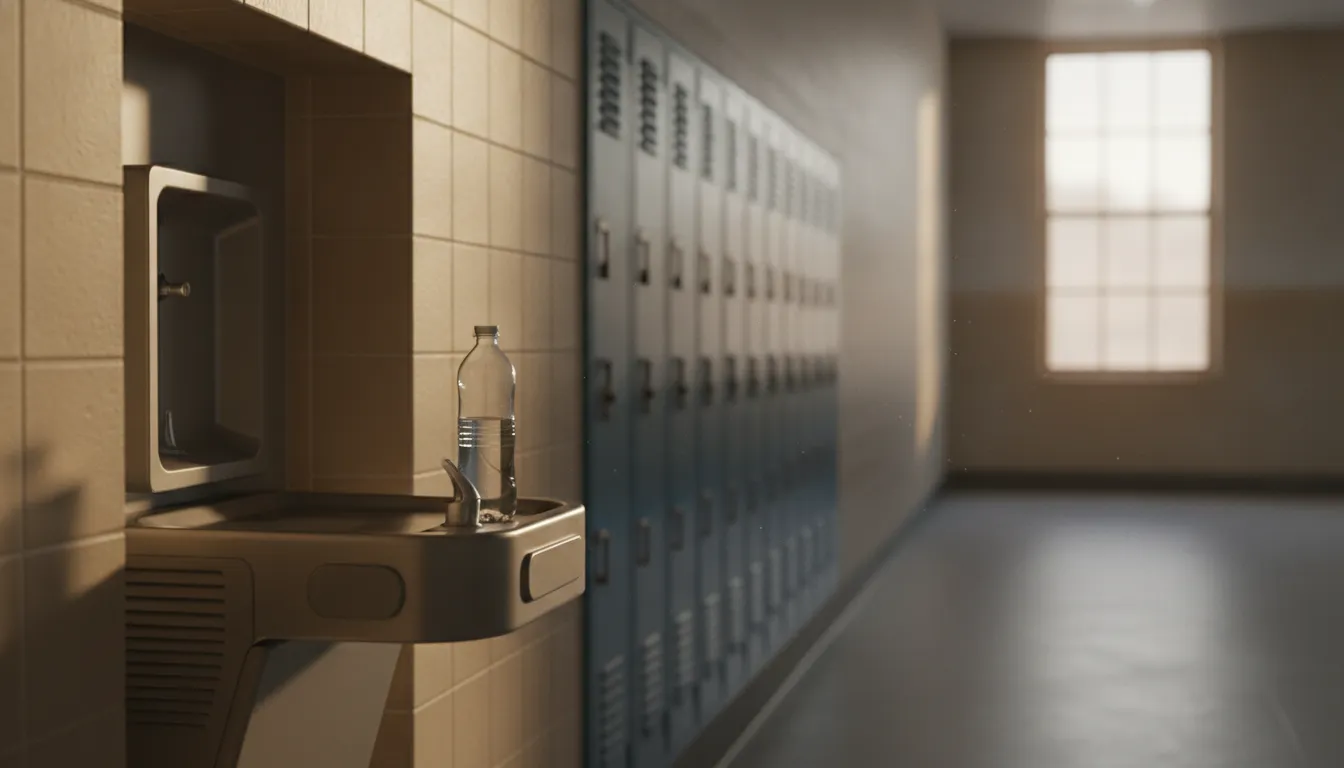
Lead in School Drinking Water: A Parent’s Guide (2026)
> Affiliate disclosure: FilterdWaterGuide.com earns a commission on some of the products linked below (Amazon and other retailers). It does not change which products qualify. Every filter named in this article holds a lead-reduction certification from NSF International, WQA Gold Seal, or IAPMO R&T, and we say which one. Brita has no affiliate program with us. It’s here anyway because its filter earned it.
There is no federal law requiring most US schools to test their drinking water for lead. The EPA’s authority under the Safe Drinking Water Act stops at the water utility. The roughly 98,000 public schools and 500,000 child care facilities that buy water from a utility sit outside it. Only the estimated 8,000 schools and child care centers that run their own water supply are regulated directly.
That is the sentence that surprises most parents, so I’ll say it again in plain terms: unless your state has passed its own law, whether your kid’s school has ever tested its fountains is a local decision. When the Government Accountability Office surveyed districts in 2017, an estimated 41 percent, serving 12 million students, had not tested in the previous year. Of the 43 percent that had, 37 percent found elevated lead.
The school year has started, and your child is drinking from those fountains five days a week. This article covers why school plumbing is a particular problem, what the rules actually require (including a real federal change coming in 2027), how to find out what your school knows, and what protects a kid in the meantime. The short answer to that last part: a filter certified to NSF/ANSI 53 for lead, at home, filling the bottle they carry.
KEY TAKEAWAYS
- Most schools are not required to test. The EPA regulates water utilities, not the school buildings they serve. Testing is voluntary under federal law unless your state mandates it.
- School plumbing is unusually prone to lead. Water sits in pipes and fountains overnight, over weekends, and all summer. Stagnation is what pulls lead out of brass fixtures and old solder.
- The federal action level is a utility number, not a safety number. The American Academy of Pediatrics recommends schools act at 1 ppb. The CDC states there is no known safe level of lead for children.
- Starting November 2027, the EPA’s Lead and Copper Rule Improvements require water utilities to offer lead sampling at elementary schools and child care facilities. But schools can decline, and secondary schools are sampled only on request.
- What works now: a pitcher or faucet filter certified for lead reduction (NSF/ANSI 53) at home, and a refillable bottle. We could not verify a lead certification on any portable filter bottle, so don’t count on one.
Why School Water Is a Special Case
Lead almost never comes from the water source. It comes from the plumbing between the water main and the mouth of the fountain: lead service lines, lead solder used before 1986, and brass fixtures that were legally “lead free” while containing up to 8 percent lead until the definition tightened to 0.25 percent in January 2014. If you’ve read our lead in drinking water guide, you know this part.
What makes schools different is how water moves through them, and how it doesn’t.
Stagnation is the whole story
Lead leaches into water while the water sits still against a lead-containing surface. The longer it sits, the more it picks up. That is why the EPA’s own school sampling protocol calls for a first-draw sample after 8 to 18 hours of stagnation. It is designed to catch the worst case, and the worst case in a school is routine.
A home tap gets used at 7 a.m. A school fountain may not run from 3 p.m. Friday until 8 a.m. Monday. It sits for the entire summer. It sits over winter break. Then a line of second-graders drinks the first water out of it. A home with the same plumbing would flush that stagnant slug down the drain while someone brushed their teeth.
Old buildings, old fixtures, many outlets
Many American school buildings predate the 1986 lead-solder ban. A single campus can have dozens of consumption outlets: fountains, classroom sinks, the nurse’s office, the kitchen. Each one is its own little plumbing system with its own fixture, its own solder joints, and its own history. A school can test ten fountains and get ten different results. That is not a sign the testing was wrong. It is a sign that lead in buildings is a fixture-by-fixture problem.
Kids absorb more
Children absorb a larger fraction of ingested lead than adults do, and their developing nervous systems are the target organ. The CDC’s blood lead reference value, the threshold it uses to flag children with higher-than-typical exposure, is 3.5 micrograms per deciliter, and the agency is explicit that no level is considered safe. School water is not usually the largest source of a child’s lead exposure (paint and dust generally are). But it is one of the few sources a parent can do something about this week.
For more on what lead does and how it gets into water in the first place, see Lead in Drinking Water: Sources, Risks, and Removal.
What the Rules Actually Require for Lead in School Drinking Water
Here’s what nobody tells you when a school sends home a reassuring letter: “meets all federal standards” is often a statement about the water utility, not about the building.
Federal: the utility is regulated, the school mostly isn’t
The Safe Drinking Water Act regulates public water systems. A school served by the city is a customer of a public water system, not a system itself. The EPA’s Lead and Copper Rule Improvements fact sheet for schools states this directly: the agency “does not have the authority” under that section of the law to require schools and child care facilities that are not public water systems to comply.
What the EPA offers instead is guidance and money. The guidance is the 3Ts program (Training, Testing, and Taking Action), a voluntary framework schools can use to build their own sampling programs. The money is the Voluntary School and Child Care Lead Testing and Reduction Grant Program, created by the 2016 WIIN Act and expanded by the 2021 Bipartisan Infrastructure Law to cover remediation. It had released over $105 million to states as of the EPA’s October 2024 fact sheet. Grants help. They do not compel anyone to test.
What changes in November 2027
The 2024 Lead and Copper Rule Improvements (LCRI) create the first federal requirement that touches schools. It is worth understanding precisely, because it is narrower than the headlines.
Starting November 1, 2027, every community water system must build a list of the schools and licensed child care facilities it serves, provide them with annual lead education, and offer to sample them. The utility must sample at least 20 percent of its elementary schools and 20 percent of its child care facilities each year for five years. It collects five samples per school (two fountains, a kitchen faucet, a classroom outlet, and the nurse’s office where available) and two per child care facility. Results go to the school, the local and state health departments, and the state within 30 days.
Three limits matter for parents:
- Schools can say no. A school that declines, or doesn’t respond to two outreach attempts, counts toward the utility’s 20 percent. The utility has done its job. Your school has not been tested.
- Secondary schools are on request only. Middle and high schools get sampled if they ask.
- After five years, it’s all on request. The 20-percent-per-year push is a one-time sweep. From year six on, sampling happens only if the facility requests it.
The rule also lets states waive utility sampling where a state law already requires equivalent school testing. That brings us to the part that matters most.
State laws are where the real requirements live
A growing number of states have gone further than the federal floor, and some have gone much further. Two examples worth knowing, because they represent the two models:
New York requires every public school to test every potable outlet for lead at least every three years. In December 2022, the state lowered its school action level from 15 ppb to 5 ppb. An outlet above that must be taken out of service until it is fixed and retested. Results are public.
Michigan took a different approach with its 2023 Filter First law. Rather than testing first and fixing what fails, schools and child care centers must put certified lead filters on every fixture used for drinking or cooking (filtered bottle-filling stations, faucet-mounted filters, or approved pitchers) and then sample the filtered water to confirm it is at or below 5 ppb. Child care centers had to be on filtered water by October 24, 2025, and schools by the end of the 2025–26 school year. The state put $50 million in federal funds toward reimbursing the hardware.
Filter First is the model the American Academy of Pediatrics’ position points toward. The AAP has recommended that school water not exceed 1 ppb, a level no test-and-fix program built around a 5 or 15 ppb trigger will reliably deliver. If your state has neither model, your school’s testing program is whatever your district decided to do.
Your state’s health or environmental department website is the place to check. Search “[your state] lead testing schools drinking water.” Most states with a program publish results by school.
How to Find Out What Your School Knows
You do not need to be confrontational about this. Most school facilities staff are not hiding anything. They are working from whatever the district told them to do. But you do need to ask specific questions, because vague ones get vague answers.
The question you should actually be asking is not “is the water safe?” It is: “When was each drinking outlet in the building last sampled for lead, what were the results, and what was done about any outlet above the action level?”
Break it into pieces:
- Has the school tested? When? A test from 2016 (the year many districts scrambled after Flint) tells you almost nothing about fixtures a decade older now.
- Every outlet, or a few? Because lead is a fixture-by-fixture problem, a “building average” or a sample from the main entrance fountain is not representative.
- What protocol? First-draw after stagnation is the protective protocol. A sample taken after flushing measures the best case, not the case your child encounters Monday morning.
- What action level did the district use? 15 ppb (the old federal utility number), 5 ppb (New York, and Michigan’s filtered threshold), or 1 ppb (AAP)? An outlet at 8 ppb is “fine” under the first standard and a problem under the other two.
- What was done? Replacing a fountain, installing a certified filter, or taking an outlet out of service are all real fixes. “Flushing every morning” is a management practice that depends on someone doing it every morning.
Ask for the lab reports, not a summary. Schools that received WIIN grant funding or operate under a state program will have them. If you’re told the district has never tested, that is your answer. The LCRI sampling offer arriving in late 2027 is the next lever. A school can decline it, and a parent-teacher organization asking why is exactly the kind of pressure that changes that decision.
What Protects Your Child Right Now
I want to be careful here, because “lead in school water” is the sort of headline that sells products. Some of what is sold for this problem does not do what the packaging implies.
Fill the bottle at home from a lead-certified filter
The most reliable intervention is the boring one. A refillable bottle, filled each morning from a filter at home that holds a certification for lead reduction under NSF/ANSI 53 from one of the three accredited certifiers: NSF International, WQA Gold Seal, or IAPMO R&T. A certification means the certifier verified the reduction claim and audits the factory on an ongoing basis. “Tested to NSF standards” on a box is a one-time lab result the manufacturer chose to publish. It is not the same thing, and the difference is the whole reason this site exists.
Pitchers we can verify for lead, with the certifier named:
| Filter | Certifier and standard | Lead certified? | PFAS certified? | Things to know before you spend your money |
|---|---|---|---|---|
| **Brita Elite (OB06 filter)** | NSF International, NSF/ANSI 53 (lead); IAPMO R&T, NSF/ANSI 53 (PFOA/PFOS) | Yes | PFOA/PFOS only | Fits standard Brita pitchers. PFAS cert covers PFOA and PFOS specifically; independent testing of total PFAS reduction has been modest. No affiliate relationship with us. |
| **PUR PLUS pitcher (PPF951K)** | NSF International and WQA Gold Seal, NSF/ANSI 42/53/401 | Yes | No | Do not buy PUR for PFAS. Filter lasts about 40 gallons, roughly two months. |
| **ZeroWater 5-stage** | IAPMO R&T, NSF/ANSI 42/53 | Yes | PFOA/PFOS | Flat, mineral-free taste; some kids won’t drink it. Filter life is short on hard, high-mineral water, so the per-gallon cost runs high. |
Check the Brita Elite on Amazon · Check the PUR PLUS pitcher on Amazon · Check the ZeroWater 10-Cup on Amazon
If you would rather not manage a pitcher, the PUR PLUS faucet mount (PFM400H) is NSF International-listed to NSF/ANSI 42 and 53 for lead, and the Culligan FM-25 is IAPMO R&T-certified to 42/53 (Check the Culligan FM-25 on Amazon). Both screw onto a standard kitchen faucet in a few minutes and cost less than a pediatric copay. Neither fits a pull-down sprayer faucet, and both slow your flow noticeably. Our faucet filter guide covers the trade-offs.
Two filters parents ask about that do not belong on this list. Clearly Filtered, whose certified scope is WQA NSF/ANSI 42 (chlorine) and 372 (materials); its lead figures are manufacturer-tested, not certified. And the Brita Standard filter, which is not certified for lead at all. A note on that “372” you’ll see on many boxes: NSF/ANSI 372 certifies that the filter’s own parts are low-lead. It says nothing about whether the filter removes lead from water.
For the full ranked list including under-sink and reverse osmosis options, see Best Water Filters for Lead Removal. For a comparison of the two most-searched pitchers, see ZeroWater vs Clearly Filtered.
Filter bottles: we couldn’t verify one
Follow the money on this one. Filtered water bottles are marketed hard to parents in August, and the language is almost always “removes” or “reduces” lead, backed by a lab test the company commissioned. When we went looking for a portable bottle filter holding an NSF/ANSI 53 lead certification from NSF, WQA, or IAPMO, we could not verify one. The Brita bottle filter is WQA-certified to NSF/ANSI 42 only (chlorine taste and odor). Epic’s Nano bottle filter is NSF-certified to 42 and 372 (materials), with lead listed as tested, not certified. LifeStraw’s Go bottle targets bacteria and parasites and carries no lead certification. None of those does anything certified for lead.
That does not mean every bottle filter is useless. It means the lead claim on the package is unverified by anyone independent, and a $30 bottle is not the place to accept that. Fill a plain bottle from a certified pitcher instead. It is cheaper and it is certain.
What “flushing” does and doesn’t do
Running a fountain for 30 seconds to a couple of minutes before drinking does clear the stagnant water sitting in the fixture and the nearest pipe. The EPA’s 3Ts guidance lists flushing as a legitimate short-term control, and some schools rely on it. Its weakness is obvious. It works only if it happens, every morning, at every outlet, and it does nothing about lead that leaches during the day between uses. If flushing is your school’s entire plan, treat it as a stopgap and send the bottle.
Bottled water is not automatically the answer
Bottled water is FDA-regulated under a different framework than tap water and is tested less often. When Consumer Reports tested 47 bottled waters in 2020, heavy metals including lead came in under federal limits in nearly every brand, one brand was flagged for arsenic, and 43 of the 47 had detectable PFAS. A school handing out bottled water after a failed test is doing the right thing in an emergency. As a permanent household strategy it costs more than a certified pitcher and comes with less verification.
When to Consider a Blood Lead Test
If your school has reported an outlet well above 5 ppb that your child used regularly, or if you live in an older home with its own lead risk on top of that, it is reasonable to ask your pediatrician about a blood lead test. This is a routine, inexpensive screen. Medicaid requires it at 12 and 24 months, and pediatricians order it for older children based on risk. Elevated results are handled by identifying and removing sources, which is exactly why having the school’s actual lab data matters. A pediatrician cannot act on “the district says it’s fine.”
Frequently Asked Questions
Are schools required to test their water for lead? Not under federal law, in most cases. The EPA regulates the water utility, not the school building it serves. Only the roughly 8,000 schools and child care centers that operate their own water supply are regulated directly. Some states, New York and Michigan among them, require testing or filtration at every school. Starting November 2027, water utilities must offer to sample elementary schools and child care facilities under the Lead and Copper Rule Improvements, but a school can decline.
What level of lead in school water is considered safe? No level. The CDC and the American Academy of Pediatrics both hold that there is no known safe level of lead exposure for children. The AAP recommends schools act on any outlet above 1 ppb. Regulatory action levels (15 ppb under the old federal rule, 10 ppb under the 2024 rule, 5 ppb in New York and in Michigan’s filtered-water standard) are triggers for remediation, not measures of safety.
Why does school water have more lead than home water? Stagnation. Lead leaches from brass fixtures and old solder while water sits still, and school outlets sit unused overnight, over weekends, and all summer. First-draw samples after 8 to 18 hours of stagnation are the protocol the EPA uses precisely because they capture what a child drinks first thing Monday morning.
Do filtered water bottles remove lead? We could not verify a portable bottle filter certified for lead reduction under NSF/ANSI 53 by NSF International, WQA, or IAPMO R&T. Most certified bottle filters carry NSF/ANSI 42, which covers chlorine taste and odor, not lead. Claims beyond that are manufacturer-tested, not certified. Fill a regular bottle from a lead-certified pitcher or faucet filter at home.
What should I ask my child’s school? When each drinking outlet was last tested, whether every outlet was tested or only a few, whether samples were first-draw after stagnation, which action level the district used, and what was done about any outlet that exceeded it. Ask for the lab reports rather than a summary letter.
Related Articles
- Lead in Drinking Water: Sources, Risks, and Removal Guide
- Best Water Filters for Lead Removal 2026
- Do PUR Filters Remove Lead?
- How to Test Your Water at Home
- Best Water Filter Pitchers 2026
Sources Cited
- U.S. EPA. Final Lead and Copper Rule Improvements, Technical Fact Sheet: Lead in Schools and Child Care Facilities. EPA 816-F-24-016, October 2024.
- U.S. EPA. Lead in Drinking Water in Schools and Childcare Facilities (estimates of regulated vs. unregulated schools and child care facilities).
- U.S. EPA. 3Ts for Reducing Lead in Drinking Water in Schools and Child Care Facilities, Module 5: sampling protocol.
- U.S. Government Accountability Office. K-12 Education: Lead Testing of School Drinking Water Would Benefit from Improved Federal Guidance. GAO-18-382, July 2018.
- New York State Department of Health. Lead Testing of School Drinking Water (10 NYCRR Subpart 67-4; Public Health Law §1110 revisions effective December 22, 2022).
- Michigan Department of Environment, Great Lakes, and Energy. Filter First program page and $50 million grant announcement, December 2024.
- American Academy of Pediatrics. Policy statement, Prevention of Childhood Lead Toxicity (2016, reaffirmed 2021).
- CDC. Blood Lead Reference Value.
- Medicaid.gov. Lead Screening (EPSDT).
- Consumer Reports. Bottled water testing, September 2020.
- NSF International certified product listings (info.nsf.org/Certified/DWTU); WQA Gold Seal product database (find.wqa.org); IAPMO R&T product listing directory (pld.iapmo.org).