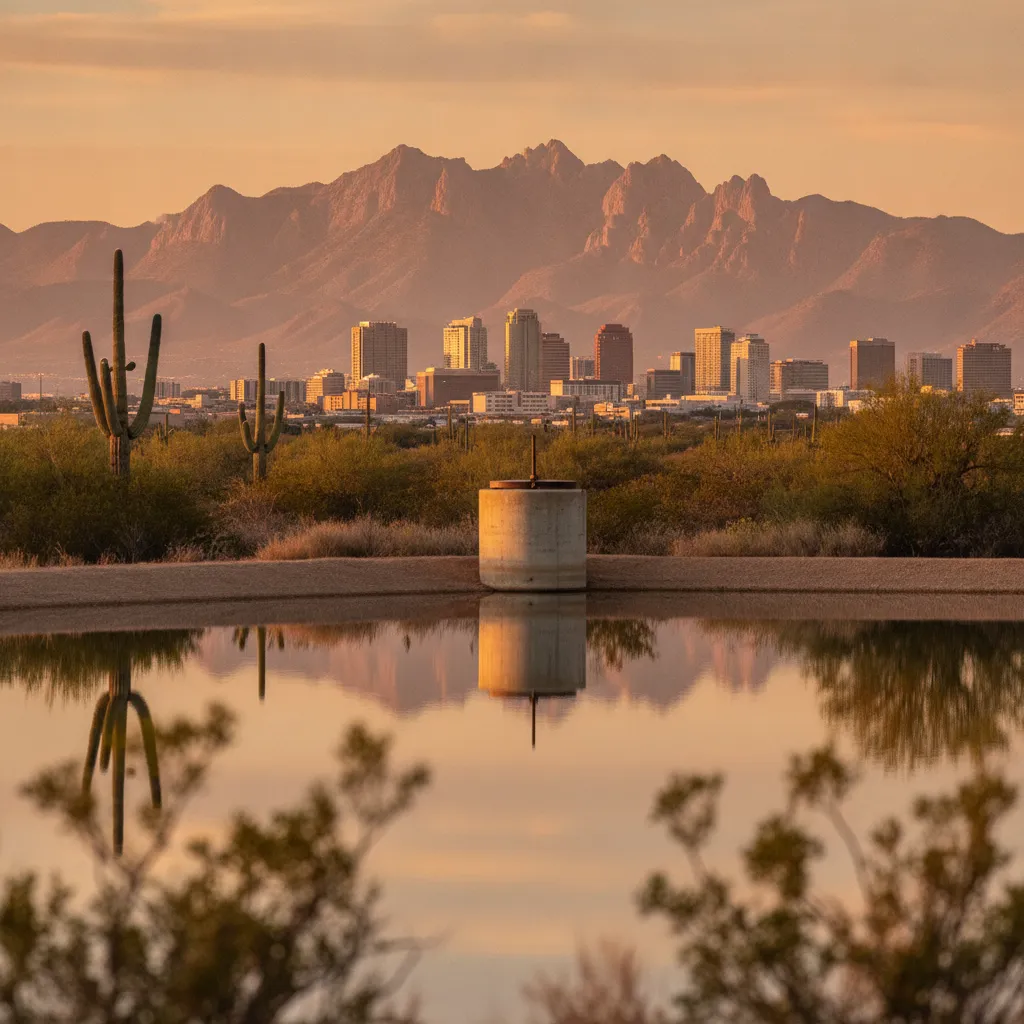
Tucson Water Quality Report 2026: What’s in Your Tap Water
QUICK SUMMARY:
- Overall Rating: Fair — meets every federal MCL, but ten contaminants exceed EWG’s stricter health guidelines, and the utility is actively managing a PFAS contamination zone on the city’s south side
- Top Contaminants of Concern: Arsenic, disinfection byproducts (TTHMs/HAAs), chromium-6, uranium and radium, nitrate — plus PFAS in the aquifer (kept out of served water by well shutdowns)
- Recommended Filter Type: Reverse osmosis at the tap — see our best reverse osmosis systems guide
- Water Hardness: Hard to very hard, per Tucson Water’s own classification — it varies by neighborhood
> Affiliate disclosure: FilterdWaterGuide.com earns a commission when you buy through some links in this article, at no extra cost to you. Our recommendations are based on certification data and independent testing — never on commission rates.
Tucson is one of the largest cities in the United States that still runs almost entirely on groundwater. That single fact shapes everything about its water quality — the good and the bad. The aquifer under the city is an EPA-designated sole source aquifer, meaning there is no practical backup supply if it becomes contaminated. And on Tucson’s south side, part of it already is.
Here’s what the data actually shows. Tucson Water’s 2024 Consumer Confidence Report (the annual disclosure every utility must publish) recorded no health-based MCL violations. At the same time, the EWG Tap Water Database lists 10 contaminants above its health-based guidelines, and the utility has pulled 22 production wells out of service because of PFAS, with eight more on emergency-only status. Both statements are true. The distinction matters, and this report walks through it.
Where Does Tucson Get Its Water?
Tucson Water serves roughly 733,000 people across more than 241,000 households and businesses. Historically the city pumped native groundwater from its Central Well Field. Since 2001, it has shifted most of its supply to a more renewable source: Colorado River water delivered through the Central Arizona Project (CAP) canal.
The interesting part is what happens next. Rather than treating river water at a surface plant, Tucson banks it underground. CAP water is spread into recharge basins at three facilities west of the city — CAVSARP, SAVSARP, and the Pima Mine Road project — where it percolates into the aquifer, blends with native groundwater, and is pumped back out through recovery wells. Per the 2024 report, about 78% of delivered water is this recovered recharged Colorado River water; the remaining 22% comes from the Central Well Field.
This “bank it underground” strategy buffers Tucson against Colorado River shortages and lets soil filtration polish the river water naturally. It also means your tap water chemistry varies by neighborhood — some zones get mostly recovered CAP water, others a stronger groundwater blend. Tucson Water’s online Water Quality Dashboard reports results by sample area.
The PFAS Story: A Superfund Site, an EPA Order, and 22 Wells Offline
Tucson’s most consequential water issue is the one most residents never taste. PFAS (per- and polyfluoroalkyl substances, a family of persistent synthetic chemicals used in firefighting foam and consumer products) have contaminated groundwater near Tucson International Airport, Morris Air National Guard Base, Air Force Plant 44, and Davis-Monthan Air Force Base — largely from decades of aqueous film-forming foam (AFFF) use.
This is not a new problem bolted onto a clean aquifer. The same area has been a federal Superfund site since 1983, when trichloroethylene (TCE, an industrial degreasing solvent) was found in the aquifer southwest of the airport. The Tucson Airport Remediation Project (TARP) has pumped and treated that plume continuously since 1994, later adding advanced oxidation for 1,4-dioxane (a solvent stabilizer the EPA classifies as a likely human carcinogen). PFAS is the third act of a forty-year cleanup.
The regulatory response escalated sharply in 2024. On May 29, 2024, the EPA issued an emergency order under the Safe Drinking Water Act directing the U.S. Air Force and the Arizona Air National Guard to address PFAS threatening Tucson’s drinking water supply. Sampling at the site had found PFOS as high as 30,000 ppt and PFOA as high as 2,400 ppt, against a federal limit of 4 ppt for each. The Air Force initially challenged the order, then reversed course; in October 2024, the EPA accepted its compliance plan, which includes mapping the contamination, running treatment pilot studies, and reimbursing Tucson Water for PFAS treatment costs at TARP. Construction of a $25 million advanced oxidation facility to pretreat PFAS ahead of TARP — funded through the Arizona Department of Environmental Quality — began in January 2025, with completion expected by August 2026.
What does this mean for the water at your tap? Tucson Water’s position, backed by its published testing, is that served water remains PFAS-free. Since 2018 the utility has voluntarily removed wells from service at any detectable level of PFOA or PFOS — a stricter operational trigger than the EPA’s 2024 limits of 4 ppt (parts per trillion). As of mid-2025, 22 wells were out of regular service due to PFAS and 8 more were restricted to emergency use. The utility’s UCMR5 monitoring (the EPA’s fifth Unregulated Contaminant Monitoring Rule, covering 29 PFAS compounds) found no PFAS in active wells, and PFOA and PFOS appear in the EWG database’s “tested but not detected” list for the main system.
That claim requires context, though. The protection depends on keeping contaminated wells offline, which shrinks the city’s usable supply — treated TARP water that once served homes has at times been discharged to the Santa Cruz River instead. The small Silverbell West satellite system, a separate public water system, has had fluctuating PFAS detections, and its customers receive point-of-use treatment devices. If your household is on the south side, near the airport, or on a private well, independent testing is due diligence.
What Contaminants Are in Tucson Tap Water?
The table below combines the EWG Tap Water Database entry for the City of Tucson main system (utility averages, data through 2024) with Tucson Water’s 2024 Consumer Confidence Report (highest single results). An average and a maximum answer different questions — the average describes typical exposure, the maximum describes the worst sampling point in the system.
| Contaminant | Utility Average (EWG) | Highest Result (CCR) | EPA MCL | EWG Guideline | Health Concern |
|---|---|---|---|---|---|
| Arsenic | 2.04 ppb | 6.64 ppb | 10 ppb | 0.004 ppb | Cancer, skin damage |
| Total trihalomethanes (TTHMs) | 9.39 ppb | 26.3 ppb (LRAA) | 80 ppb | 0.15 ppb | Cancer risk |
| Haloacetic acids (HAA9) | 3.93 ppb | — (CCR reports HAA5 at 2.2 ppb LRAA) | none | 0.06 ppb | Cancer risk |
| Chromium-6 (hexavalent) | 0.649 ppb | — | none (federal) | 0.02 ppb | Cancer |
| Nitrate | 1.68 ppm | 7.2 ppm | 10 ppm | 0.14 ppm | Infant methemoglobinemia |
| Uranium | 2.23 pCi/L | 15 ppb (max) | 30 µg/L (≈20 pCi/L) | 0.43 pCi/L | Cancer, kidney toxicity |
| Combined radium | — | 2.5 pCi/L | 5 pCi/L | 0.05 pCi/L | Cancer |
| Trichloroethylene (TCE) | 0.019 ppb | 1.16 ppb | 5 ppb | 0.4 ppb | Cancer, immune harm |
| Lead (90th percentile, 2023 data) | — | 0.65 ppb | 15 ppb action level | 0 | Neurological damage |
| PFOA / PFOS | not detected | not detected | 4 ppt | — | Cancer, immune effects |
A note on reading this: an EPA MCL (maximum contaminant level, the enforceable legal limit) reflects health science negotiated against treatment cost and feasibility, and most MCLs have not been tightened in decades. EWG guidelines are pure health benchmarks, mostly drawn from California public health goals. Tucson’s water is legal everywhere on this table. Whether “legal” satisfies you is the actual purchasing decision.
Three patterns stand out.
First, the geology. Arsenic, chromium-6, uranium, and radium are naturally occurring in Southwest desert aquifers — the same profile we documented in Phoenix, El Paso, and Albuquerque. Tucson’s arsenic average of 2.04 ppb sits about 510 times above the EWG guideline, and the 2024 maximum of 6.64 ppb is two-thirds of the federal limit. These are dissolved inorganics. A carbon pitcher does not remove them; reverse osmosis does.
Second, the disinfection byproducts. Chlorination (Tucson maintains a 1.0 ppm annual average of residual chlorine) reacts with organic matter to form TTHMs and haloacetic acids. The 2024 locational running annual average of 26.3 ppb for TTHMs is well under the 80 ppb MCL but far above health-based benchmarks. Recharged river water carries more organic precursor material than native groundwater, which is part of the trade-off of the CAP strategy.
Third, nitrate variability. The system average of 1.68 ppm is unremarkable, but the 2024 maximum hit 7.2 ppm. Tucson’s own report notes that households caring for infants should consult a health provider when nitrate exceeds 5 ppm. If you are mixing formula, this is the number to check on your zone’s dashboard — our nitrate in drinking water guide explains why infants under six months are the sensitive population.
Lead is good news. Tucson Water has replaced more than 1,000 lead service lines — 866 since 1999, plus another 142 through its Get the Lead Out program — and its October 2024 service-line inventory identified no lead lines to date. The 2023 90th-percentile result was 0.65 ppb with zero sites above the action level. Two caveats keep this honest: the utility notes that information on all service lines is not yet available, particularly on privately owned portions, and older homes can still have leaded fixtures and solder — see our lead in drinking water guide. But Tucson does not have a Chicago-style service line problem.
Tucson Water Hardness
Tucson Water classifies its own water as hard to very hard, and it varies by zone because the supply blend does. The utility does not publish a citywide grains-per-gallon figure, and third-party estimates scatter widely enough — roughly 8 to 22 GPG depending on the source — that no single number deserves your trust. The only figure that describes your address is a test of your own tap. (One GPG equals 17.1 mg/L of calcium carbonate; on the standard scale, 7–10 GPG is “hard” and above 10 GPG is “very hard.”)
Practically, hard water means scale on fixtures, shortened water heater life, and soap that does not lather well. Hardness is a nuisance mineral issue, not a health hazard. If scale is your main complaint, a softener addresses it; a drinking-water filter does not. Our hard water guide covers how to confirm your zone’s hardness and what actually fixes it.
Hardness also has one filtration consequence worth knowing: reverse osmosis membranes scale faster in very hard water, which can shorten membrane life below the manufacturer’s rating. Factor that into replacement costs.
Best Water Filters for Tucson Residents
Tucson’s headline contaminants — arsenic, chromium-6, uranium, nitrate — are dissolved inorganics, and its emerging concern is PFAS. That combination points clearly at reverse osmosis for drinking and cooking water. The picks below are seeded from our certification-verified merit roster, matched to Tucson’s specific profile. The certifier and standard are named for each, because “certified” and “tested to” are not the same claim. A certification means ongoing oversight — factory audits, annual re-testing, unannounced inspections — from an accredited body. “Tested to NSF standards” means a lab measured a unit once. Only the former earns a contaminant-removal claim.
Under-Sink RO: Waterdrop G3P800
The G3P800 is certified by IAPMO R&T (an ANSI-accredited certification body — this certification will not appear in NSF International’s own database) to NSF/ANSI standards 42, 53, 58, and 372. NSF/ANSI 58 is the reverse osmosis performance standard; the RO membrane’s rejection mechanism addresses the dissolved inorganics that define Tucson’s profile, and the carbon stages address chlorine taste and disinfection byproducts. One scope note in the interest of precision: the core NSF 58 certification centers on TDS reduction — check the current IAPMO listing if you need a certified claim for a specific contaminant such as arsenic. Consumer Reports and Wirecutter have both covered the G3P800 favorably as a tankless unit with strong flow.
The engineering trade-offs are real. It needs an electrical outlet under the sink, which many cabinets lack. Annual filter costs run well above a basic tank RO — figure $150+/year. And like all RO units it sends concentrate water to the drain, a modest but genuine cost in a desert city drawing on a shrinking Colorado River allocation. Installation uses a compression-fitting feed adapter rather than a saddle valve, which is the right approach — saddle valves are increasingly barred by plumbing codes due to leak risk.
Buy Direct from Waterdrop | Check on Amazon
Countertop RO (renters): AquaTru Classic
Nearly half of Tucson households rent, and the AquaTru Classic requires no plumbing at all — fill the tank, done. It is certified by IAPMO R&T to NSF/ANSI 42, 53, 58, and 401, and its certified contaminant list specifically names arsenic, chromium-6, nitrate, lead, and PFOA/PFOS. That list reads like it was written for Tucson’s water. For a renter near the south-side contamination zone, or any household wanting certified PFAS removal as insurance, this is the strongest merit match available in a no-install format.
The trade-offs: the four-gallon-per-day workflow means refilling the tank daily for a family, replacement filter sets cost roughly $100–130 per year, and the unit claims a chunk of counter space. Like all RO systems, it strips beneficial minerals along with contaminants — remineralization is optional, not automatic. There is no FilterdWaterGuide affiliate relationship driving this pick; it earns its slot on certification scope.
Whole-House Comfort Layer: SpringWell CF+
If chlorine taste and disinfection byproducts at every tap bother you, a whole-house catalytic carbon unit is the fix. The SpringWell CF+ uses certified components — media and tank tested and certified to NSF/ANSI 61 and 372, which are materials-safety standards, not performance standards. The assembled system’s contaminant reduction is manufacturer-tested to NSF standards, not certified. We state that plainly because the distinction matters: this is a taste, odor, and DBP-reduction layer, not a certified health-protection device.
Critically, carbon does not remove arsenic, chromium-6, uranium, radium, or nitrate. In Tucson, a whole-house carbon unit is a comfort upgrade layered on top of point-of-use RO — never a substitute for it. The other trade-offs: at roughly $1,000-plus installed it is a significant spend for a non-certified system, and it does nothing for hardness, so scale-driven buyers will still need a softener.
How to Test Your Tucson Tap Water
System-wide averages are exactly that — averages. Tucson Water’s own dashboard reports by sample zone, and the spread between zones (nitrate ND to 7.2 ppm; arsenic ND to 6.64 ppb) is wide enough that your address materially changes your numbers.
Two sensible tiers. For a certified-lab picture of arsenic, uranium, nitrate, and metals from your own tap, Get a Tap Score Test — we have no affiliate relationship with them. For a quick screening baseline, the Safe Home 12-in-1 test strips cost under $20, though strips indicate rather than quantify. Near the airport-area plume or on Silverbell West, ask the lab to add a PFAS panel. Our home water testing guide walks through interpreting results.
Frequently Asked Questions
Is Tucson tap water safe to drink?
By the federal definition, yes — Tucson Water met every enforceable health-based standard in its 2024 reporting, with no health-based MCL violations. (It did receive a missed monitoring violation that year, when a well was out of service for rehabilitation; the samples were later collected, all came back nondetect, and the violation was closed in March 2025.) By stricter health-based benchmarks, the picture is mixed: the EWG database flags 10 contaminants above its guidelines, led by arsenic, disinfection byproducts, chromium-6, and uranium. All are at legal levels. Households with infants, immunocompromised members, or south-side addresses have the strongest case for point-of-use filtration.
Does Tucson water have PFAS?
The groundwater near Tucson International Airport contains significant PFAS contamination from decades of firefighting foam use, and it is the subject of a 2024 EPA emergency order against the Air Force and Air National Guard. The water Tucson Water actually serves, however, tested PFAS-free in UCMR5 monitoring — the utility has removed 22 wells from service and holds itself to a stricter trigger than the EPA’s 4 ppt limits. The protection is real but operational: it depends on keeping contaminated wells offline while treatment facilities are built through 2026.
How hard is Tucson water?
Hard to very hard — that is Tucson Water’s own classification, and it varies by neighborhood with the blend of recovered Colorado River water and native groundwater. The utility does not publish a citywide grains-per-gallon number, and outside estimates disagree, so test your own tap if the exact figure matters for sizing a softener. Expect scale buildup on fixtures and appliances either way. A water softener addresses hardness; drinking-water filters and RO units do not soften the whole house.
Do I need a water filter in Tucson?
Need is individual, but the case here is stronger than in most compliant cities. Tucson’s defining contaminants — arsenic, chromium-6, uranium, nitrate — are dissolved inorganics that only reverse osmosis (or similar membrane/ion-exchange treatment) meaningfully removes, and carbon pitchers do little against them. An RO unit at the kitchen tap, certified by NSF International, WQA, or IAPMO to NSF/ANSI 58, matches the water profile. Test first if you want to size the decision to your zone.
Sources Cited
- EWG Tap Water Database — City of Tucson (AZ0410112), data through 2024
- Tucson Water 2024 Annual Water Quality Report (Consumer Confidence Report), Main System
- U.S. EPA — Tucson International Airport Area Site: Emergency Administrative Order for Response Action (PWS-AO-2024-10), May 29, 2024; compliance determination, October 2024
- U.S. EPA — Per- and Polyfluoroalkyl Substances (PFAS) drinking water regulations
- Arizona Luminaria — “New facility, more wells offline as Tucson intensifies PFAS cleanup efforts,” June 23, 2025
- Arizona Department of Environmental Quality — Tucson PFAS program
- IAPMO R&T Product Listing Directory — Waterdrop, AquaTru certifications
- NSF International Certified Product Listings