This article contains affiliate links. If you purchase through these links, we may earn a commission at no additional cost to you. Read our full affiliate disclosure.
RO vs Under Sink Water Filter: Which One Should You Install in 2026?
Short answer: Reverse osmosis vs under sink filter comes down to your contaminant list. RO is the answer when your water has dissolved solids — arsenic, nitrate, fluoride, chromium-6, sodium from a softener, high TDS. An NSF 53–certified under-sink carbon block is the answer when your concerns are chlorine, lead, PFAS, VOCs, and pharmaceuticals on a city water connection.
This question shows up about twice a week from anyone who’s just read their Tap Score results or the EPA’s 2024 PFAS rule. Both systems go under the same cabinet. Both cost real money. They are not interchangeable.
That’s the spec-sheet answer. The field answer is messier. Below is what each system actually does, what it costs you over five years, and the install realities that don’t show up on the product page.
Quick Answer Table
| Factor | Reverse Osmosis | Under-Sink Carbon Block |
|---|---|---|
| Best for | Dissolved solids: arsenic, nitrate, fluoride, chromium-6, high TDS, softener sodium | Chlorine, lead, PFAS, VOCs, pharmaceuticals on city water |
| Typical NSF certs | NSF 58 (RO performance), often 42, 53, 372 | NSF 42, 53 (lead + PFAS), 401 |
| Upfront cost | $200–$1,050 | $100–$300 |
| Annual filter cost | $80–$150 | $130–$200 (two cartridge changes per year) |
| Install difficulty | Moderate-to-high (drain saddle, dedicated faucet, tank or tankless unit) | Easy-to-moderate (cold line tap, dedicated or inline faucet) |
| Water waste | 1:1 to 3:1 (clean:waste) on modern tankless; 1:3 or worse on older units | None — full flow filtration |
| Mineral content | Removes virtually everything, including beneficial minerals | Leaves minerals intact |
| Flow rate at tap | Tank-fed: instant. Tankless: 6–10 sec to fill a glass | 0.5–1.0 GPM |
| Annual maintenance | Pre/post filters every 6–12 months; membrane every 2–3 years | Cartridge every 6–12 months |
How Reverse Osmosis Actually Works
Reverse osmosis forces water through a semipermeable membrane at household pressure. The membrane has pores around 0.0001 microns — small enough to block dissolved minerals, heavy metals, fluoride, arsenic, nitrate, and most contaminants that carbon alone can’t touch. Anything that doesn’t fit through gets flushed down the drain line.
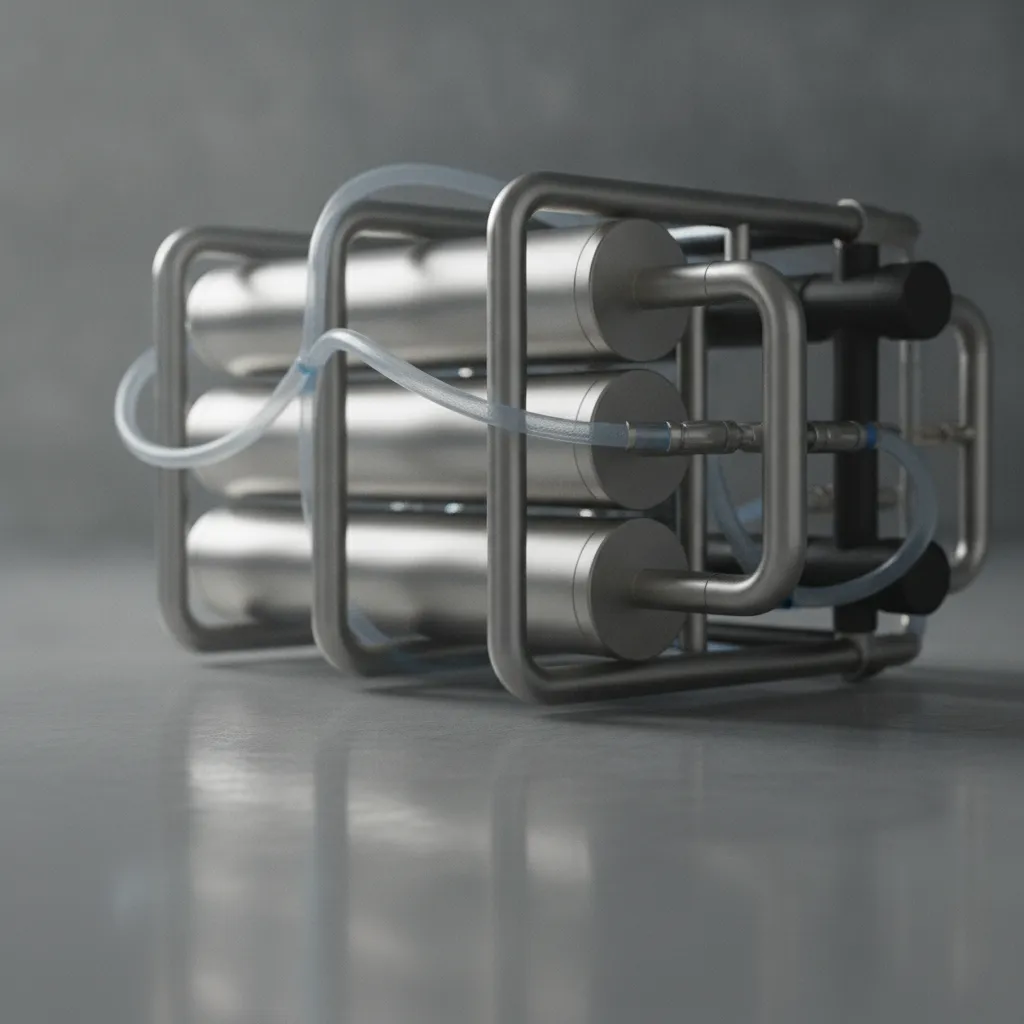
A typical RO system runs four to six stages. Sediment pre-filter, one or two carbon blocks, the RO membrane, then a post-filter and sometimes a remineralization stage. The whole stack lives under your sink, plumbed to a dedicated faucet, with a drain saddle on the sink trap and either a pressurized tank or a tankless permeate pump.
The membrane is the part that does the heavy lifting. NSF/ANSI 58 is the certification standard for RO systems — it verifies actual reduction performance for contaminants like TDS, arsenic, hexavalent chromium, lead, fluoride, nitrate, and radium. Systems with full NSF 58 certification, like the Waterdrop G3P800 and APEC ROES-50, have been tested as complete units, not just as a membrane plus a pile of unverified cartridges. The distinction matters because plenty of cheap RO units carry component-level certifications and still underperform when assembled.
How a Standard Under-Sink Filter Works
A standard under-sink filter — sometimes called a point-of-use carbon block system — pushes your cold water through one or two carbon cartridges and out a dedicated faucet (or, on some direct-connect models, back into your regular kitchen faucet). No membrane, no drain line, no tank, no electricity.
The right carbon block, properly certified, handles a surprising amount. NSF/ANSI 42 covers chlorine taste, odor, and basic aesthetics. NSF/ANSI 53 covers health contaminants — lead, cysts, VOCs, mercury, and (since 2019) PFOA and PFOS. NSF/ANSI 401 covers emerging contaminants like pharmaceuticals, BPA, and pesticides.
A quick correction on terminology: NSF P473, the old separate PFAS protocol, was absorbed into NSF 53 in 2019. A 2026 filter “certified to NSF 53 for PFOA/PFOS” is the current correct framing. Check the NSF certified product database directly — it lists which specific contaminants each filter is verified against under its NSF 53 certification.
What a carbon block can’t do: remove dissolved minerals. If your water has high arsenic, fluoride, nitrate, sodium from a softener, or TDS above 500 ppm, a carbon block won’t help. That’s an RO job.
Contaminant Head-to-Head: What Each One Actually Removes
This is where the marketing gets blurry. Here’s what the data actually shows for each technology when the system holds full NSF certification.
| Contaminant | RO (NSF 58 certified) | Under-Sink Carbon Block (NSF 42/53/401 certified) |
|---|---|---|
| Chlorine | Yes | Yes |
| Chloramines | Yes (with catalytic carbon stage) | Yes (catalytic carbon models only) |
| Lead | Yes — NSF 58 | Yes — NSF 53 |
| PFOA / PFOS | Yes — NSF 58 (most certified systems) | Yes — NSF 53 (verify model-specific listing) |
| VOCs | Yes (carbon stages handle these) | Yes — NSF 53 |
| Pharmaceuticals / hormones | Yes (carbon stages) | Yes — NSF 401 |
| Cysts (Giardia, Crypto) | Yes — NSF 58 | Yes — NSF 53 |
| Arsenic (V) | Yes — NSF 58 | No |
| Fluoride | Yes — NSF 58 | No (standard carbon does not remove fluoride) |
| Nitrate | Yes — NSF 58 | No |
| Hexavalent chromium (Cr-6) | Yes — NSF 58 | No (requires RO or ion exchange — carbon does not remove Cr-6) |
| TDS reduction | 90–99% | Negligible (carbon does not reduce dissolved solids) |
| Beneficial minerals | Removed (consider remineralization stage) | Preserved |
If your contaminant list lives mostly in the top half of that table, an under-sink carbon block does the job. If it pushes into the bottom half — arsenic, fluoride, nitrate, high TDS — you need RO. That’s the whole decision in one paragraph.
Installation Reality
The patterns when these systems go wrong are predictable.
Under-Sink Carbon Block Install
A standard dedicated-faucet under-sink system needs three things: a hole in the countertop or sink deck for the faucet, a tap into your cold water line, and somewhere to mount the cartridge housing. On a typical sink with a pre-drilled spare hole (most do — look for a blank cap), the whole job takes 30 to 60 minutes with a basic wrench set.
The supply connection is where amateurs get into trouble. Always use a compression fitting on the cold line, not a saddle valve. Saddle valves pierce the supply line with a tiny needle, and they leak. Local plumbing codes in 2026 are moving against them in most jurisdictions, and any plumber who finds one on a callback is going to look at you sideways. The Aquasana Claryum 2-Stage and most reputable systems ship with a compression adapter kit. Use it.
Direct-connect models like the Waterdrop 10UA skip the dedicated faucet entirely — they hook into the cold line with quick-connect push-in fittings and filter everything coming out of your existing kitchen faucet. Easier install, but you lose the “filtered tap on demand” feature, and you’re filtering water you’ll never drink (handwashing, dishwashing). For most renters, that’s a fair trade.
RO System Install
An RO install is a different animal. Everything an under-sink filter requires, plus:
- Mounting a pressurized storage tank (tank-based systems) — about 14 inches tall, takes up a quarter of your under-sink real estate.
- Drilling a drain saddle into the sink trap for the brine line, or splicing into the disposal — this is where untrained installers cause leaks.
- A drinking-water faucet hole — same as a carbon system, but mandatory (no direct-connect option exists for RO).
- A check valve and air gap if your local code requires one (most do).
Plan on 60 to 120 minutes for a tank-based RO, or about 45 minutes for a tankless unit that skips the tank step. A confident DIYer can do this. If you’ve never sweated a fitting or used Teflon tape, call a plumber — the drain saddle is where you don’t want to learn on your own kitchen.
One more thing on RO installs: measure your under-sink space before you order. A 14-inch tank won’t fit alongside a garbage disposal in most cabinets. Tankless units fix this. Tank units don’t.
Cost: Upfront and 5-Year
The sticker price isn’t the real number. The real number is what you pay over five years including filter replacements. Here’s the math at typical 2026 pricing.
| System | Upfront | Annual Filters | Membrane (every 2–3 yrs) | 5-Year Total |
|---|---|---|---|---|
| Aquasana Claryum 2-Stage (under-sink) | ~$125–250 | ~$130–$150 (2 sets/yr) | N/A | ~$680–$1,000 |
| Aquasana Claryum 3-Stage (under-sink, 3-stage) | ~$175–370 | ~$168–$184 (2 sets/yr) | N/A | ~$890–$1,100 |
| APEC ROES-50 (tank RO) | ~$200 | ~$60 | ~$45 once | ~$545 |
| Waterdrop G2 (tankless RO) | ~$420 | ~$110 | ~$130 once | ~$1,100 |
| Waterdrop G3P800 (premium tankless RO) | ~$880 | ~$145 | included Y1 | ~$1,600 |
Two things to notice. First, the Aquasana under-sink cartridges are rated at six months / 500 gallons — so two replacement sets per year, not one. That doubles the annual filter line compared to what the product page emphasizes. Second, a budget tank RO like the APEC ROES-50 actually lands cheaper over five years than a mid-tier under-sink filter once you factor that in. A premium tankless RO still runs about twice what a basic under-sink does — but the gap is narrower than the upfront price suggests. If RO isn’t solving a contaminant problem you actually have, you’re paying for capability you’ll never use.
One hidden cost on RO worth flagging: water waste. Older tank systems waste two to four gallons down the drain for every gallon of clean water. Modern tankless units like the Waterdrop G3P800 hit a 3:1 pure-to-drain ratio, which is much better but still not zero. If you’re on a metered water bill or a well with a tired pump, that adds up. Under-sink carbon filters waste nothing.
Maintenance Reality
Carbon filters are simpler to live with. One or two cartridges, swapped every 6 to 12 months, takes about ten minutes — no tools, no draining the line.
RO systems have more moving parts. Pre-filters and post-filters every 6 to 12 months. The RO membrane every 2 to 3 years ($40 to $130). A pressurized tank that occasionally needs re-pressurizing with a bike pump if production slows.
Forget to change a carbon filter and you get worse-tasting water. Forget to change an RO pre-filter and you can foul a membrane — turning a $30 maintenance job into a $130 one. See our guide on how often to change your water filter for system-specific timing.
When to Choose Reverse Osmosis
Pick RO if any of these describe your situation:
- Your water test shows arsenic, nitrate, fluoride, chromium-6, or radium above EPA limits or above your comfort level
- You have a water softener and want to remove the sodium it adds before drinking
- You’re on a private well with TDS above 500 ppm or contaminants no carbon filter can touch
- You live in a city with industrial legacy contamination — places like Phoenix (arsenic), San Diego (PFAS from bases), or anywhere with chromium-6 in the supply
- You want the broadest single-system contaminant coverage and don’t mind the cost or install effort
If you fit any of those, see Best Reverse Osmosis Systems 2026 for the full picks.
When to Choose an Under-Sink Carbon Block
Pick a standard under-sink filter if:
- You’re on municipal city water and your main concerns are chlorine, lead, PFAS, VOCs, and pharmaceuticals
- Your water test shows mostly chlorine, chloramines, and trace lead — typical for older homes on a modern city system
- You don’t want the install complexity or footprint of an RO unit
- You want to keep beneficial minerals in your drinking water
- You’re renting and need an install your landlord will sign off on (direct-connect models help here)
For specific picks, see Best Under Sink Water Filters 2026.
Top Picks: One of Each
If the choice is between one of each in a customer’s kitchen tomorrow, here’s where to land.
Reverse Osmosis Pick: Waterdrop G3P800
Why it gets the nod: Carries NSF 42, 53, 58, and 372 certifications as a complete system — not just component-level claims — verified through IAPMO. Quality Water Lab’s hands-on testing confirmed strong reduction performance across the certified contaminant list. The 800 GPD tankless production rate fills a glass in about eight seconds, so you don’t notice the wait the way you do with tank-based units. The 3:1 pure-to-drain ratio cuts waste roughly in half compared to older RO designs.
Where it breaks:
- At $880 to $1,050 plus ~$145/year in filters, the 5-year cost lands near $1,600 — roughly twice what a good under-sink filter runs once you account for both cartridge changes per year on the under-sink side.
- One-year warranty is short for a system at this price point. At this premium, three to five years of coverage would be more reasonable.
Buy Direct from Waterdrop | Check on Amazon
Under-Sink Pick: Aquasana Claryum 2-Stage
Why it gets the nod: NSF 42, 53 (including lead and PFAS — verified through the NSF database), and 401 certifications at unit level. Wirecutter’s long-running top pick in this category. Twist-and-pull cartridge change with no tools. Compression-fitting install kit included in the box. Aquasana refreshed the SKU from AQ-5200 to AQ-6200 in late 2025 — same Claryum tech, new model number.
Where it breaks:
- 0.5 GPM flow rate is on the slow side compared to a full kitchen faucet. Fine for filling a glass or a pot, but you won’t be filtering rinse water at speed.
- Cartridges are rated at six months / 500 gallons, which means two replacement sets per year — budget ~$130–$150/year, not the single-pack price the product page leads with.
Buy Direct from Aquasana | Check on Amazon
What About Whole-House Filtration?
A common question: should you skip both of these and put in a whole-house system instead? Whole-house filters handle sediment, chlorine, and protect appliances, but they don’t reliably remove lead or PFAS at the kitchen tap, and they do nothing for dissolved solids. The best 2026 setups pair a whole-house carbon filter with a point-of-use RO or under-sink filter at the kitchen sink. For sizing, see Best Whole House Water Filters 2026.
Frequently Asked Questions
Is reverse osmosis water bad for you because it removes minerals?
Not really. RO removes calcium, magnesium, and other minerals along with the contaminants. Most people get the majority of their daily mineral intake from food, not water, so the difference is small. If you want minerals back in your drinking water, choose an RO system with a remineralization post-filter stage — several models including the iSpring RCC7AK and Aquasana SmartFlow RO add minerals back after the membrane. Otherwise, eating a balanced diet covers it.
Will an under-sink filter remove PFAS?
It depends on the specific filter. A carbon block certified to NSF/ANSI 53 with PFOA/PFOS listed as covered contaminants will reduce PFAS. The Aquasana Claryum 2-Stage, Epic Smart Shield, and several other carbon block systems carry this certification. A generic carbon filter without that specific NSF 53 listing — including most refrigerator filters and basic under-sink units — will not reliably remove PFAS. Always check the NSF database for the specific model. See Best Water Filters for PFAS Removal for the verified picks.
How much water does an RO system waste?
Older tank-based RO systems waste two to four gallons for every gallon of clean water produced. Modern tankless systems like the Waterdrop G3P800 and G2 hit a 3:1 pure-to-drain ratio — about one gallon wasted per three gallons cleaned. Some of the latest premium units claim 2:1 or better. If you’re on a private well with limited pump capacity or paying high municipal water rates, factor this into the math. Under-sink carbon filters waste zero water.
Can I install either of these myself?
Most under-sink carbon filters are a confident-DIYer install — about 30 to 60 minutes if your sink has a pre-drilled spare faucet hole. Direct-connect models like the Waterdrop 10UA are even simpler. RO systems are a step up in complexity because of the drain saddle on the sink trap and, on tank-based units, the pressurized storage tank. If you’ve never worked under a sink before, a tankless RO is more manageable than a tank-based one. For a first install on a system that involves a drain saddle, hiring a plumber for $150–$250 buys you a leak check and peace of mind.
Do I need both an under-sink filter and an RO system?
No — for most homes, one or the other does the job. The exception is if you’re on well water with multiple contaminant types and want a sediment pre-filter feeding into your RO system, but reputable RO units already include a sediment stage. The other exception is whole-house filtration paired with a point-of-use system, where the whole-house unit handles chlorine and sediment for showers and laundry, and the point-of-use system handles drinking water. Don’t stack two point-of-use systems back-to-back — you’re paying for redundant carbon stages.
Which one lasts longer overall?
Under-sink carbon filters typically have fewer parts and last 10 to 15 years with regular cartridge changes. RO systems have more components — pumps, membranes, tanks, multiple cartridges — and typically need a more comprehensive overhaul around year 8 to 12, especially on tankless units where electric components eventually wear out. That said, both technologies are mature. A well-maintained system of either type will outlast the average kitchen renovation.
Final Verdict
If you’re standing in front of a recent water test report and the words “arsenic,” “fluoride,” “nitrate,” or “high TDS” appear with numbers you don’t like, reverse osmosis is the answer — and the Waterdrop G3P800 is the system that earns the premium. If your concerns are chlorine, lead, PFAS, and the contaminants a properly certified carbon block actually handles, the Aquasana Claryum 2-Stage does the job at less than a quarter of the cost.
The honest truth: most homes on municipal water don’t need RO. They need a good carbon block with verified NSF 53 certification. Test your water first, match the system to the actual contaminant list, and don’t pay for capability you won’t use. For broader category guidance, see Best Under Sink Water Filters 2026 and Best Reverse Osmosis Systems 2026.
Sources
- NSF International Certified Drinking Water Treatment Units Database
- EPA — PFAS National Primary Drinking Water Regulations (2024 final rule)
- Wirecutter — Best Reverse Osmosis Water Filter
- Wirecutter — Best Under-Sink Water Filter
- Consumer Reports — Best Reverse Osmosis Water Filters
- EWG Tap Water Database
- Tap Score / SimpleLab independent testing data