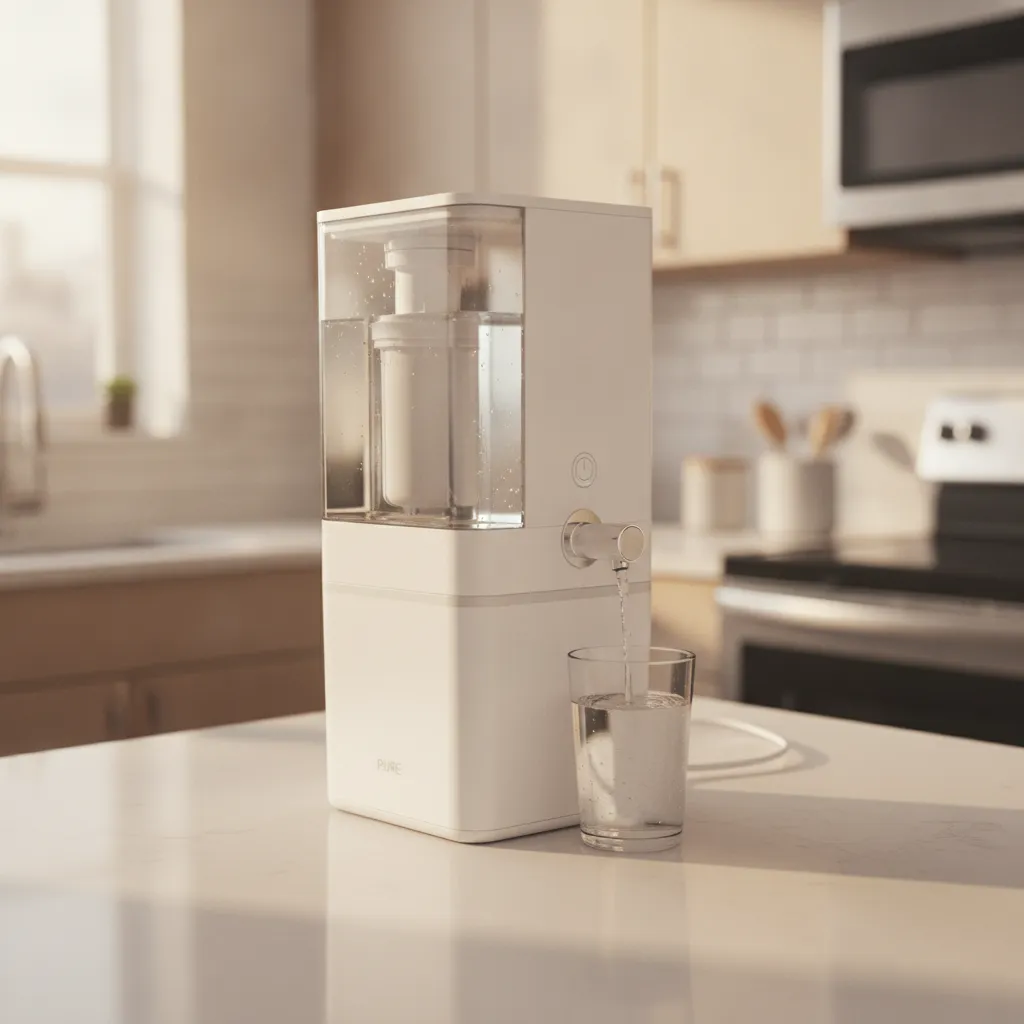
AquaTru Classic Review 2026: The Certified Countertop RO
> Affiliate disclosure: FilterdWaterGuide.com earns a commission from qualifying purchases made through some links in this article, including Amazon links. We have no affiliate relationship with AquaTru itself — if you buy direct from their site through our link, we earn nothing. Products are evaluated on certification data and independent testing, not commission rates.
If you rent your home, you’ve probably already discovered the dirty secret of the water filter industry: almost everything that actually works wants to be plumbed into your sink. Under-sink systems, whole-house systems, even most reverse osmosis units assume you own your pipes and can drill a hole in your countertop. If you can’t — or won’t — you get pointed at pitchers.
The AquaTru Classic is the product that breaks that trade-off, and it’s why the question I get asked about it deserves a longer answer than a star rating. This is a full reverse osmosis system that sits on your counter, plugs into a wall outlet, and touches your plumbing exactly never. It holds certification paperwork that most installed systems can’t match.
I’m going to walk you through what that paperwork actually says, what living with this machine involves — because there is a routine, and AquaTru’s marketing doesn’t dwell on it — and the real cost math over five years.
Quick Verdict
The AquaTru Classic earns 4.5/5. It has the broadest third-party certification coverage of any countertop RO system we’ve evaluated — IAPMO-certified to NSF/ANSI 42, 53, 58, and 401, covering 84 contaminants including lead, PFOA/PFOS, arsenic, chromium-6, fluoride, and nitrate. The half point comes off for the hands-on refill-and-dump routine the tank design requires, and a 1-year warranty that’s thin for an appliance in this price bracket.
Check on Amazon | Buy Direct from AquaTru (no affiliate relationship)
Specs at a Glance
| Spec | Detail |
|---|---|
| Price | $359 direct as of August 2026, against a $525 list price — AquaTru discounts it often, and Amazon pricing moves independently |
| Type | Countertop reverse osmosis — no plumbing, no installation |
| Filtration | 4-stage: mechanical pre-filter + carbon, RO membrane, VOC carbon block |
| Certifications | IAPMO R&T-certified to NSF/ANSI 42, 53, 58, 401 |
| Certified reductions include | Lead, PFOA/PFOS, arsenic, chromium-6, fluoride, nitrate (84 contaminants total) |
| Tap water tank | 1 gallon |
| Clean water tank | 0.75 gallons |
| Filter life | Pre/carbon ~6 months; VOC filter ~1 year; RO membrane ~2 years or 1,200 gallons |
| Annual filter cost | ~$110/year at AquaTru’s own prices |
| Power | Standard 120V outlet |
| Weight | ~17 lbs |
| Warranty | 1 year, plus a 30-day money-back guarantee |
The Certifications — And the Wording Trap to Watch For
Here’s what nobody tells you about “NSF certified” countertop filters: most of them aren’t certified by anyone. The phrase you’ll see over and over is “tested to NSF standards,” which means a lab ran a test once, on the manufacturer’s dime, with no follow-up. Certification is different. It means an ANSI-accredited certification body listed the product, audits the factory, and re-tests it on an ongoing basis. One is a receipt. The other is oversight.
The AquaTru Classic is certified — by IAPMO R&T, one of the three legitimate ANSI-accredited certifiers, to NSF/ANSI standards 42, 53, 58, and 401 as a system, covering 84 contaminants. You can pull the performance data sheet from AquaTru’s own product page, and the listing lives in IAPMO’s database at pld.iapmo.org, not NSF’s. That last part matters: if you search NSF International’s database for AquaTru and come up empty, that’s not a red flag. NSF didn’t do the certifying; IAPMO did. Both bodies certify to the same NSF/ANSI standards with the same ongoing oversight. AquaTru’s own badge says “Certified to NSF Standards,” which is technically accurate and predictably confusing — the precise statement is “IAPMO-certified to NSF/ANSI standards.”
What the four standards cover, in plain terms: 42 is aesthetics (chlorine, taste, odor), 53 is health contaminants (lead, PFOA/PFOS, chromium-6 — the PFAS protocol formerly called P473 was folded into standard 53 in 2019, so some certifiers still print “P473” on paperwork), 58 is reverse osmosis performance itself (arsenic, fluoride, nitrate, TDS), and 401 is emerging contaminants like pharmaceutical residues.
The question you should actually be asking about any filter is: certified for the specific thing in my water? For the Classic, the certified list includes the contaminants that drive most people to RO in the first place — lead, PFOA/PFOS at the heart of the EPA’s 2024 limits of 4 parts per trillion, arsenic, chromium-6, fluoride, and nitrate. If you haven’t tested your water yet, start there before spending several hundred dollars on anything: Get a Tap Score Test, or read our home water testing guide and our test kit rankings.
Independent results back the paperwork up. Quality Water Lab commissioned an independent Tap Score lab analysis of the Classic and reported all 14 PFAS analytes tested came back “not detected” after filtration, with lead eliminated to non-detect levels as well. That’s one lab, one test — anecdotal on its own — but it points in the same direction as the certification data, and that’s exactly what you want to see.
What Living With It Is Actually Like
Now for the part the ads skip. The Classic is not an install-and-forget appliance. It’s a small manual workflow, and you should know that before you buy.
You fill the 1-gallon tap water tank from your faucet and slide it into the machine. The system pushes that water through its four stages into a 0.75-gallon clean tank, which takes several minutes per cycle. You dispense from the clean tank with a push button. When the tap tank runs low, you refill it. For a couple, that’s once or twice a day. For a family that cooks with filtered water, expect to refill more often — one reviewer on AquaTru’s own site put it plainly: “refilling 5 times a day is tedious.”
There’s a second chore, and this one matters more: reverse osmosis works by rejecting concentrated contaminants, and in the Classic’s design, that concentrate stays behind in the tap water tank rather than draining away. The upside is efficiency — an installed RO system sends waste water down the drain continuously, while the Classic recycles its feed water and wastes far less. The downside is that the leftover water in the tap tank is more contaminated than what came out of your faucet, and you need to dump and rinse it regularly rather than topping it off forever. AquaTru’s own customer Q&A gets this question constantly. It’s not a flaw, exactly. It’s how the machine achieves its efficiency. But it’s your job now.
Two more practical notes. It needs a wall outlet, so your counter layout matters. And it’s a presence — roughly 14 by 14 inches of footprint and 17 pounds. (AquaTru’s own product page lists two different dimension sets, 12×14×14 and 15.5×14.5×16.5 inches; either way, this is a small appliance, not a pitcher.) If counter space is the constraint, our countertop filter guide covers smaller options.
What It Costs Over Five Years
The sticker moves around. AquaTru lists the Classic at $359 direct as of August 2026 against a $525 list price, and it runs promotions constantly — check both AquaTru and Amazon before you buy, because they rarely match. Here’s the part that doesn’t move, at AquaTru’s own filter prices as of August 2026:
| Item | Price | Schedule |
|---|---|---|
| One-Year Filter Combo (2× pre/carbon + 1× VOC) | $79.95 | Yearly |
| RO membrane | $59.95 | Every 2 years |
That works out to roughly $110 per year in filters, or about $550 over five years. Total five-year cost of ownership lands between $900 and $1,075, depending on what you paid for the machine. For comparison, our top under-sink RO pick, the Waterdrop G3P800, runs $1,500–1,600 over the same period — but delivers tankless on-demand water through a dedicated faucet. You’re trading convenience for a lower price and zero installation.
One honest cost caveat: filter life estimates assume typical municipal water. Heavy chlorine or sediment loads shorten the pre/carbon filter’s real-world life, and the filter-life indicator on the machine tracks usage, not calendar promises.
The Alkaline Filter Option — Skip the Health Claims
AquaTru sells the Classic with a choice of final-stage filter: the standard VOC carbon filter or an “Alkaline Mineral Boost” version that adds calcium and magnesium back and raises pH. Follow the money here: alkaline water is a marketing category, not a health treatment, and no credible clinical evidence supports the wellness claims attached to it across the industry. That said, there’s a legitimate non-health reason some people choose remineralization — RO strips minerals along with contaminants, and completely demineralized water tastes flat to some palates. If your family won’t drink it, it isn’t protecting anyone. Buy the mineral filter for taste if you want it. Don’t buy it for your health.
Who It’s For — and Who Should Pass
Buy the Classic if: you rent; you can’t or don’t want to modify plumbing; your water test shows contaminants RO handles well (lead, PFAS, arsenic, chromium-6, fluoride, nitrate); and someone in your household will keep up the refill-and-dump routine. It’s the strongest certified option in our apartment filter guide category, and it moves with you when your lease ends.
Pass if: you own your home and drink enough water that daily refills will wear thin — an installed under-sink RO like the Waterdrop G3P800 is the better long-term fit. If you have no electrical outlet to spare or want zero moving parts, a certified gravity or pitcher option is the fallback — see our PFAS filter guide for certified picks at lower price points.
FAQ
Is the AquaTru Classic NSF certified? It is certified by IAPMO R&T — an ANSI-accredited certification body — to NSF/ANSI standards 42, 53, 58, and 401. It will not appear in NSF International’s own database because NSF is not the certifier; the listing is in IAPMO’s database. The certification is equivalent in rigor: ongoing factory audits and re-testing, not a one-time lab test.
Does the AquaTru Classic remove PFAS? It is certified under NSF/ANSI 53 for PFOA/PFOS reduction (the protocol formerly labeled P473). An independent Tap Score lab test commissioned by Quality Water Lab additionally found all 14 PFAS analytes tested were non-detect after filtration.
How much do replacement filters cost? About $110 per year at AquaTru’s direct prices: a $79.95 one-year combo pack (two pre/carbon filters plus one VOC filter) and a $59.95 RO membrane that lasts two years or 1,200 gallons.
Does it require installation or plumbing? No. It sits on a counter and plugs into a standard 120V outlet. You fill its 1-gallon tank by hand from your faucet. There is no connection to your plumbing at any point.
Why do I have to empty the tap water tank? The rejected concentrate from the RO process stays in the tap water tank instead of going down a drain. That makes the system far less wasteful than installed RO, but the leftover water is more concentrated with contaminants than your tap water — dump and rinse the tank regularly instead of only topping it off.
Bottom Line
The AquaTru Classic is the rare countertop filter where the certification paperwork is stronger than the marketing. IAPMO-certified to NSF/ANSI 42, 53, 58, and 401 across 84 contaminants, backed by consistent independent lab results, at a five-year cost around $900–$1,075 — no other no-installation system we’ve evaluated matches that combination. You’re signing up for a daily relationship with a water appliance, and the 1-year warranty should be longer. But if your living situation rules out installed filtration and your water test says RO is the right tool, this is the one I’d put on my own counter.
Check on Amazon | Buy Direct from AquaTru (no affiliate relationship)