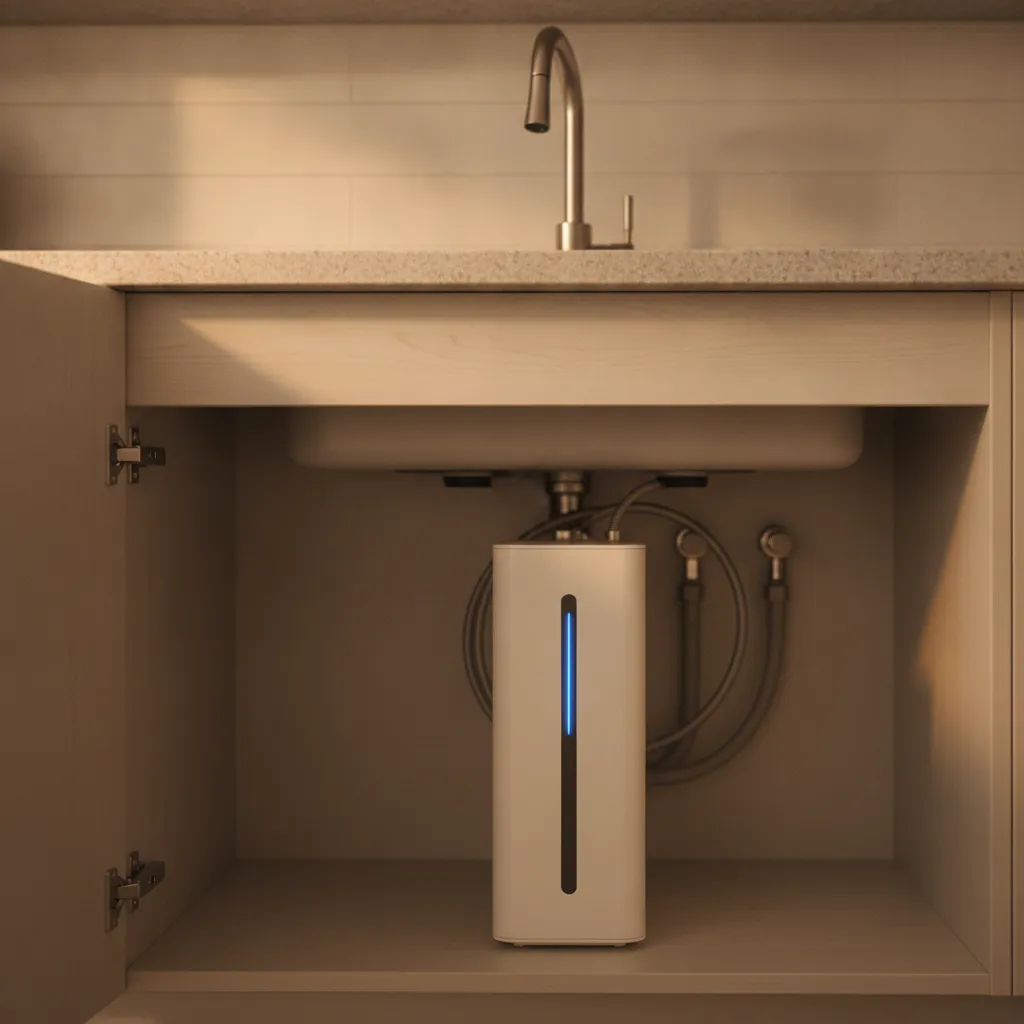
Waterdrop G3P800 Review 2026: Is the Top-Pick RO Worth It?
> Affiliate disclosure: FilterdWaterGuide.com earns a commission from qualifying purchases made through links in this article. This does not affect our recommendations — products are evaluated based on certification data and independent testing results, not commission rates.
You’re looking at a four-figure reverse osmosis system and wondering what that money actually buys you. Fair question. The EPA’s 2024 PFAS limits — 4 parts per trillion for PFOA and PFOS — sent a lot of homeowners shopping for RO, and the Waterdrop G3P800 sits at the top of most shortlists, including ours. It’s our current Best Overall RO pick.
This review is the long version of why — and the parts that should give you pause before you spend that kind of money. The short version: the certification paperwork is the real deal, the tankless speed is the real deal, and the ongoing costs are higher than the sticker price suggests.
Quick Verdict
The G3P800 is the most capable tankless RO system we’ve evaluated, with full-system certification coverage most competitors can’t match. It earns 4.5/5. The half-point comes off for cost of ownership and a warranty that’s thin for the price.
Buy Direct from Waterdrop | Check on Amazon
Specs at a Glance
| Spec | Detail |
|---|---|
| Price | List ~$999; street ~$760–$1,050 depending on variant and promotions |
| Type | Tankless under-sink reverse osmosis |
| Production rate | 800 GPD — fills a glass in about 8 seconds |
| Pure-to-drain ratio | 3:1 (3 gallons clean per 1 gallon to drain) |
| Certifications | IAPMO R&T-certified to NSF/ANSI 42, 53, 58, 372 |
| Certified reduction claims | TDS (58), lead, chromium-6 and PFOA/PFOS (53), chlorine/taste/odor (42) |
| Also reduced (not certified claims) | Fluoride, arsenic, nitrate |
| Filter life | CF filter ~12 months; RO membrane ~24 months |
| Extras | Built-in UV sterilization, smart faucet with filter-life display |
| Warranty | 1 year |
| Power | Requires an electrical outlet under the sink |
The Certifications — What’s Actually on Paper
Here’s what actually matters with this system, and it’s the part most reviews get wrong.
The G3P800 is certified by IAPMO R&T — an ANSI-accredited certification body — to NSF/ANSI standards 42, 53, 58, and 372 as a complete system. That’s not the same as “NSF certified,” and you won’t find the G3P800 in NSF International’s own database, because NSF didn’t do the certifying. IAPMO did. The certification is just as legitimate — IAPMO runs the same ongoing oversight: factory audits, re-testing, the works. You can look the listing up at pld.iapmo.org.
Why you should care: most RO systems at any price carry NSF/ANSI 58 only (TDS reduction), or worse, component-level certs on individual cartridges. Full-system 42, 53, and 58 together means the whole unit — not just one filter inside it — has third-party paperwork behind its chlorine, health-contaminant, and RO performance claims. Standard 372 covers lead-free materials. That’s materials safety, not removal performance — don’t let any marketer tell you otherwise.
Now the part worth reading twice. The certified reduction claims are the ones named on the system’s performance data sheet: TDS under Standard 58, and lead, chromium-6 and PFOA/PFOS under Standard 53. Waterdrop and most retailers also advertise fluoride, arsenic and nitrate reduction. Those are real — an RO membrane rejects them by physics, and independent lab testing backs it up — but they aren’t separately certified claims, so treat them as expected performance rather than documented proof. If arsenic is your specific problem — common in desert-state well and municipal water — see our arsenic filter guide for how RO stacks up against other approaches.
Before you buy anything, though: test first. A water test tells you whether you need RO at all. Plenty of homes don’t.
Performance: The Tankless Speed Is Real
On paper, 800 gallons per day. In the field, what that number means is: no storage tank, no waiting. The G3P800 filters on demand and fills a glass in about 8 seconds. Older tank-style systems store a few gallons in a pressurized bladder and take hours to refill once you’ve drained it — cook a big pot of pasta and you’re waiting. Tankless doesn’t have that problem.
The 3:1 pure-to-drain ratio matters too. Older tank systems send 3–4 gallons to the drain for every clean gallon produced. The G3P800 flips that — 3 clean gallons per 1 drained. If you’re on metered water or in a drought-prone area, that difference shows up on your bill.
Independent hands-on testing from Quality Water Lab confirmed strong performance across the board. The built-in UV sterilization is a nice extra for boil-advisory areas — but it is not a substitute for proper well water disinfection if bacteria is a known problem in your supply.
Installation Reality
This is where tankless bites some people. Two things to check before you order:
You need an electrical outlet under the sink. The G3P800’s pump and UV don’t run on hope. No outlet in the cabinet means an electrician visit before the system goes in. Check now — open the cabinet and look.
Use a compression fitting, not a saddle valve. Local plumbing codes are increasingly banning saddle valves because they leak over time. If a kit includes one, spend the extra few dollars on a compression fitting.
Beyond that, installation is standard under-sink RO work: cold-line tap, drain connection, and a faucet hole if your sink doesn’t have a spare. Most homeowners can handle it in an afternoon with push-fit connections; drilling the faucet hole is the part people hire out, and a plumber visit for that runs $100–200. The tankless form factor means it takes up far less cabinet space than a tank system — a genuine win in condos and smaller kitchens. If you’re still deciding between RO and a simpler carbon system, our RO vs under-sink comparison walks through that decision.
What It Costs to Own — the Part the Box Doesn’t Say
The sticker price is the down payment. Here’s what actually happens over five years.
Replacement filters run about $145 per year. The CF pre-filter goes roughly every 12 months and the RO membrane roughly every 24 — and note that Waterdrop’s 1-year combo pack (the G3-2CFCB) covers the pre-filter and carbon block only. The RO membrane is a separate, model-specific purchase. These are proprietary cartridges: no generic third-party replacements, so you’re buying from Waterdrop at Waterdrop’s prices for the life of the system.
Add it up and 5-year ownership lands somewhere between $1,500 and $1,600 — roughly double what a budget workhorse like the APEC ROES-50 costs over the same period. That doesn’t make the G3P800 a bad buy; it makes it a premium buy. Just walk in knowing the real number. And whatever system you choose, actually replace the filters on schedule — an RO system with an expired membrane is worse than no system at all. Our guide on how often to change your water filter covers the schedules.
Where It Falls Short
- 5-year cost of ownership runs $1,500–1,600. Upfront price plus ~$145/year in proprietary filters puts this at about twice the total cost of the APEC ROES-50. You’re paying for certification breadth and speed — make sure you need both.
- The 1-year warranty is thin. At this price, 3–5 years of coverage would build a lot more confidence. A four-figure appliance with a 1-year warranty is asking for trust it hasn’t paper-backed.
- It needs power. No under-sink outlet, no G3P800 — factor an electrician into the budget if your cabinet is bare.
- Membrane sold separately from the filter combo. Easy to miss when you’re pricing replacements; budget for it.
- Fluoride and arsenic aren’t certified claims. The membrane handles both, but if you need documented third-party proof for those two specifically, this system’s paperwork doesn’t name them.
Who Should Buy It — and Who Shouldn’t
Buy the G3P800 if: your water test shows dissolved contaminants RO handles — lead, PFAS, chromium, arsenic, fluoride — and you want the broadest full-system certification coverage available with tankless speed. For a busy household that drinks and cooks with filtered water all day, the on-demand flow is worth the premium.
Skip it if: you’re on a budget — the APEC ROES-50 delivers WQA-certified NSF/ANSI 58 performance for a fraction of the 5-year cost. Or if you want tankless without the four-figure commitment — the Waterdrop G2 runs about half the price, though its certification is limited to NSF/ANSI 58 and 372, so the contaminant-specific paperwork is thinner. Both are covered in our full RO roundup.
FAQ
Does the Waterdrop G3P800 remove PFAS?
Yes, with real paperwork behind it. The G3P800 is IAPMO-certified to NSF/ANSI 53 with PFOA/PFOS on the certified reduction list — that’s the current standard for PFAS reduction claims (the old P473 protocol was folded into NSF 53 in 2019). Most RO systems will reduce PFAS by the nature of the membrane, but certified proof is what separates a claim from a spec sheet.
Is the G3P800 certified for lead?
Yes. Lead reduction is covered under its IAPMO R&T certification to NSF/ANSI 53 as a complete system. If you have a lead service line or pre-1986 plumbing, that contaminant-specific certification is exactly the paperwork you want.
Is the G3P800 “NSF certified”?
Technically, no — and the distinction matters. It’s certified by IAPMO R&T, an ANSI-accredited certifier, to NSF/ANSI standards 42, 53, 58, and 372. The standards are NSF standards; the certifying body is IAPMO. You won’t find it in NSF International’s database, but the IAPMO listing carries the same ongoing oversight.
Does it remove fluoride and arsenic?
It reduces both — that’s what an RO membrane does. But neither is a named claim on its certification listing, unlike lead and PFOA/PFOS. If you want documented third-party proof for fluoride or arsenic specifically, ask the manufacturer for the performance data sheet before you buy.
Does it need electricity?
Yes. Like all tankless RO systems, the G3P800 needs an electrical outlet under the sink for its pump and UV. If your cabinet doesn’t have one, add an electrician visit to the budget.
How much do replacement filters cost?
Plan on about $145 per year. The CF pre-filter changes roughly every 12 months, the RO membrane roughly every 24. Waterdrop’s 1-year combo pack covers the pre-filters only — the membrane is a separate model-specific purchase. Over 5 years, total ownership runs $1,500–1,600.
Is the G3P800 worth it over the Waterdrop G2?
If you need the certification breadth, yes. The G2 costs about half as much and shares the tankless design, but it’s certified to NSF/ANSI 58 and 372 only — no contaminant-specific 53 certification for lead or PFAS. If your water test shows those contaminants and you want documented proof of removal, the G3P800 is the one with the paperwork.
Final Verdict
The Waterdrop G3P800 keeps its spot as our top RO pick: full-system IAPMO certification to NSF/ANSI 42, 53, and 58, genuine tankless speed, and 3:1 water efficiency. 4.5/5. The deductions are honest ones — a 5-year cost of $1,500–1,600 and a 1-year warranty that doesn’t match the price tag. If those numbers work for you, this is the strongest certified RO package on the market. If they don’t, our RO systems guide has certified picks from $200 up.
Sources
- IAPMO R&T Product Listing Directory
- Quality Water Lab: Waterdrop G3P800 Review (Lab-Tested)
- EPA National Primary Drinking Water Regulation for PFAS (2024)
- FilterdWaterGuide product merit roster — certification verification notes, 2026-06-30