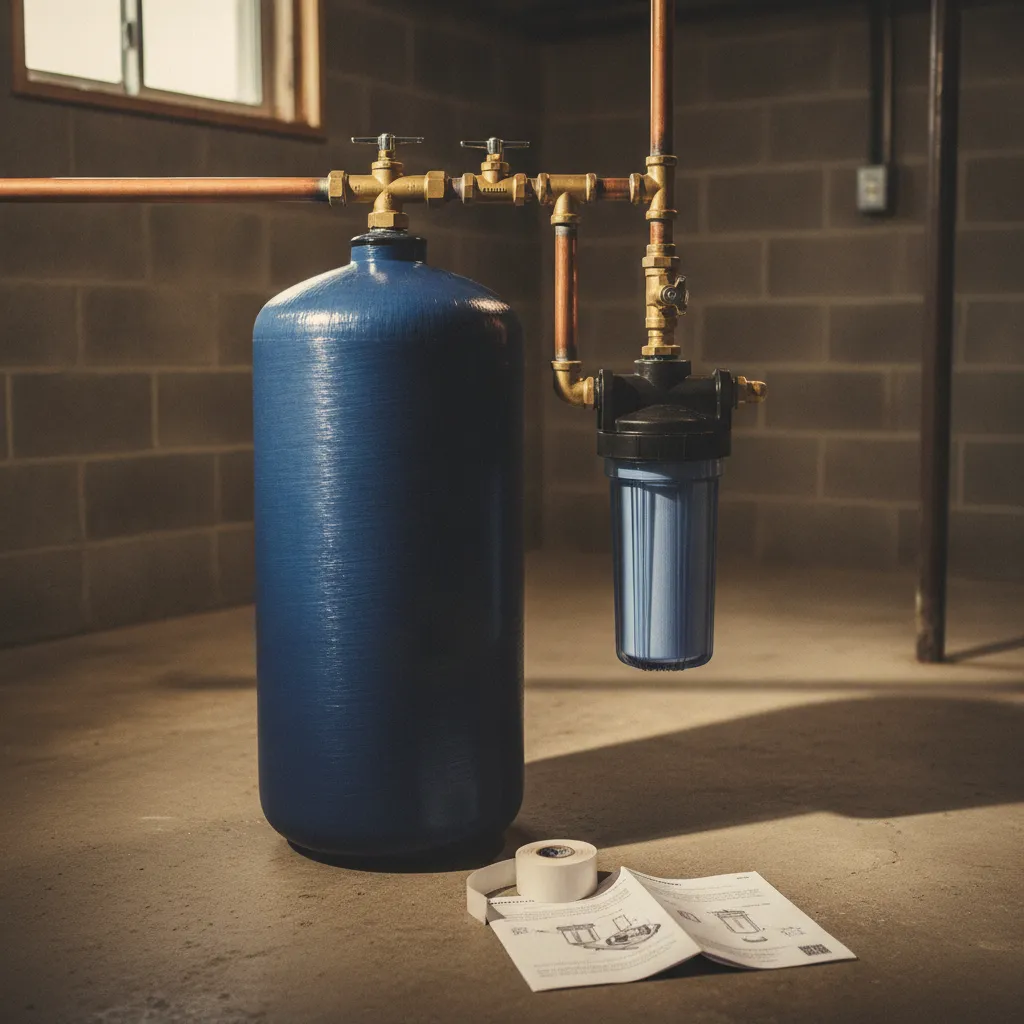
SpringWell CF Review 2026: Good Tank, No Certification
> Affiliate disclosure: FilterdWaterGuide.com earns a commission from qualifying purchases made through links on this site. This does not affect our recommendations. Products are evaluated on certification data and independent testing, not commission rates. SpringWell’s affiliate program has not yet approved this site, and the CF tank systems are not sold under a listing we can verify on Amazon, so every SpringWell link in this review is a plain, untracked link. We currently earn nothing if you buy this system.
Your water smells like a pool, your skin is dry after every shower, and someone told you a whole-house filter fixes both. The SpringWell CF is the system that comes up first. It’s our Best Overall pick in the whole-house filter guide, and this SpringWell CF review is the long version of why. It’s also the honest version, because there’s one thing SpringWell’s product page doesn’t say out loud: this system is not certified to remove anything.
That’s not a dealbreaker for most homes. But you should know exactly what you’re buying before you spend $1,100 and a Saturday.
Quick Verdict
The SpringWell CF is the best whole-house carbon system for city water on chloramine that we’ve evaluated. Catalytic carbon plus KDF, an up-flow tank with no cartridges to swap, three real sizing tiers, and a lifetime warranty on the parts that matter. It earns 4.3/5. The points come off for the missing performance certification and for the install parts SpringWell makes you buy separately.
Check current price at SpringWell
Specs at a Glance
| Spec | CF1 | CF4 | CF+ |
|---|---|---|---|
| Sized for | 1–3 bathrooms | 4–6 bathrooms | 7+ bathrooms |
| Service flow rate | 9 GPM | 12 GPM | 20 GPM |
| Tank size | 9″ × 48″ (52″ with head) | 10″ × 54″ (58″ with head) | 13″ × 54″ (58″ with head) |
| Connection | 1″ | 1″ | 1.5″ |
| Media capacity | 1,000,000 gallons | 1,000,000 gallons | 1,000,000 gallons |
| Pre-filter | 5-micron sediment, change every 6–9 months | same | same |
| Operating pressure | 25–80 PSI | 25–80 PSI | 25–80 PSI |
| Price (Sept 2026, SpringWell direct) | ~$1,000–1,200 | ~$1,200–1,400 | ~$1,700+ |
| Warranty | Lifetime on tanks, valves, fittings, housings, heads | same | same |
| Performance certification | None | None | None |
Prices move. SpringWell runs a rolling “15% off” promotion on its site more or less continuously, so the number you see at checkout is the real number, not the crossed-out one. In September 2026 the CF1 listed at about $1,160 before that discount.
What’s Actually in the Tank
Here’s what actually happens inside the CF. Water enters at the bottom of the tank and pushes up through two media beds. SpringWell calls this ActivFlo. The practical point is that up-flow keeps the media loose, so water can’t cut channels through it and skip contact time the way it can in a down-flow tank.
KDF-55. A copper-zinc alloy bed. It pulls chlorine and some heavy metals through a redox reaction and keeps bacteria from setting up shop in the tank. That second job matters on a system that sits full of warm, wet carbon for a decade.
Catalytic coconut-shell carbon. This is the reason to buy this unit over a cheaper one. Standard activated carbon handles chlorine fine. It barely touches chloramine, which more than one in five Americans now get in their tap water, per EPA. Catalytic carbon is treated to break the chloramine bond, and it also grabs the organics that carbon is good at: trihalomethanes (TTHMs), VOCs, pesticides, herbicides.
If your utility’s Consumer Confidence Report says “chloramine,” a plain carbon tank is the wrong purchase. Chloramine vs. chlorine walks through why.
5-micron sediment filter. A separate blue housing after the tank. It catches sand, silt, and rust so your fixtures don’t. This is the only part you change on a schedule.
There’s no backwash cycle, no control head to program, no drain line, no electricity. Water pressure does all the work.
The Certification Question, Answered Plainly
SpringWell’s product page says the KDF media is certified. It says nothing about the system being certified. That’s the whole story, and you should read it exactly that way.
We check three certifier databases before we credit any product with a removal claim: NSF International, WQA Gold Seal, and IAPMO R&T. We re-ran the NSF search for this review in September 2026 and it returned no SpringWell listings at all. Water Filter Guru, which installed a CF1 and ran lab tests on it, checked the same three databases and came to the same conclusion: no performance certification for any reduction claim.
What that means in plain terms:
- “Certified media” is not a certified system. Take SpringWell’s “certified KDF media” line at face value and it still only tells you the media supplier’s material passed a listing. It tells you nothing about how much chloramine leaves your tap after passing through this particular tank at 9 GPM.
- Tested-to is not certified. SpringWell can run its own lab tests, and other review sites can run theirs. Neither is the same as an ANSI-accredited certifier auditing the factory, re-testing annually, and putting the model number in a public database.
- You’ll see review sites list “NSF 42 / NSF 53” for this system. We found at least one affiliate site doing exactly that in 2026. It’s wrong. Neither standard appears on any certifier listing for the CF.
So when SpringWell says “removes PFAS, PFOA and PFOS,” treat it as a manufacturer claim, not a verified one. Catalytic carbon does adsorb some PFAS compounds. How much, at what flow, and for how many gallons is exactly what NSF/ANSI 53 certification would tell you, and the CF doesn’t have it. If PFAS is why you’re shopping, the certified answer is a point-of-use unit at the kitchen tap. Our PFAS filter guide covers the ones that hold real paperwork.
If certified whole-house lead and PFAS reduction is the actual requirement, the Aquasana OptimH2O is the unit with IAPMO R&T certification to NSF/ANSI 53 for both. It’s also about half the flow rate. That’s the trade.
Independent Test Results
Since there’s no certification data, the best evidence available is independent lab testing. Water Filter Guru put a CF1 on a two-bathroom home in Arvada, Colorado, and ran Tap Score before-and-after samples. Their published numbers:
| Contaminant | Before | After | Change |
|---|---|---|---|
| Total THMs | 29.12 ppb | 0 | −100% |
| Chloroform | 20.8 ppb | 0 | −100% |
| Bromodichloromethane | 8.32 ppb | 0 | −100% |
| Lead | 18.2 ppb | 0.7 ppb | −96% |
| Copper | 0.222 ppm | 0.053 ppm | −76% |
| Zinc | 0.917 ppm | 0.255 ppm | −72% |
| Fluoride | 0.6 ppm | 0.5 ppm | −17% |
| Chlorine (test strip) | ~1 ppm | not detected | n/a |
A few things to keep straight about that table. It’s one house, one water supply, one sample set. The disinfection byproduct result is the one that matters most for a carbon system, and it’s clean. The lead number looks good, but their water had no chloramine, no PFAS, and no pesticides, so none of those claims got tested.
And a whole-house filter can’t remove lead that enters after the filter, which is the case for most lead in US homes: the service line and the fixtures. If lead is your problem, read the lead removal guide before you assume a whole-house unit solves it.
That said, for what a catalytic carbon tank is supposed to do, the independent data lines up with the design.
Flow Rate: On Paper vs. in the Field
On paper, the CF1 is 9 GPM, the CF4 is 12, and the CF+ is 20. In the field, those are service flow numbers through the tank, and what you feel at the shower depends on your main line and how many fixtures are running.
Bathroom count is a proxy, not the rule. SpringWell’s own size guide says as much: what matters is how many things run at once. A two-bathroom house with a big soaker tub, a rain head, and a family that showers at the same time is a CF4 house. The price gap between CF1 and CF4 is small relative to living with pressure drop for ten years.
Water Filter Guru measured no change in flow or pressure after installing the CF1 on their two-bath home. That matches what a 9 GPM tank on a 1″ connection should do. Your operating pressure needs to be between 25 and 80 PSI. Above 80, put a pressure regulator ahead of it.
Installation Reality
This is a main-line install. You’re cutting into the pipe that feeds the whole house. Here’s what the box doesn’t fully prepare you for.
The 48-hour soak is not optional. SpringWell’s own instructions say the carbon has to sit in water for a minimum of 48 hours before you flush it and put it in service. Plan the install for a weekend after the tank arrives, not the day it lands. If you hire a plumber, tell them this up front or you’ll pay for two visits.
The bypass valve is an add-on. SpringWell’s checkout adds it for about $79 and lets you remove it. Don’t remove it. Without a bypass, every sediment filter change means shutting off water to the whole house. The manual’s alternative is a plumber-built three-valve bypass loop, which costs more than $79 in fittings and labor.
You’ll buy parts. Not in the box: PVC nipples, a shut-off valve, 1″ corrugated connectors, and plumber’s tape. Water Filter Guru had to make a hardware store run. Read the manual’s parts list and make that run before you start.
The tank head is permanent. Once it threads onto the internal riser, it doesn’t come off. If you cross-thread it or install it crooked, that’s a call to SpringWell, not a redo.
It’s tall and heavy. The CF1 stands 52 inches with the head and ships with media loaded. You need floor space near your point of entry and a second person to move it. If your main comes in through a crawlspace or a tight closet, measure first. Water Filter Guru had to reroute plumbing to a room where it fit.
Well water needs a phone call. The manual says not to install on a well without talking to SpringWell first, and the warranty requires pre-treatment for water with hydrogen sulfide, iron, manganese, or oil. This is a city-water system. Well owners should start with the well water filtration guide.
Use compression or threaded fittings, not a saddle valve. Not relevant to the main-line connection itself, but if you add a point-of-use filter downstream, plumbing codes are moving against saddle valves. Skip them.
A pro install runs about $200 for a simple job, per Water Filter Guru’s experience, and about two hours. Add time if your plumbing needs rerouting.
What It Costs to Own
Whole-house systems get sold on the sticker. Here’s the ten-year picture for a CF1.
| Item | Cost |
|---|---|
| CF1 system (Sept 2026) | ~$1,000–1,200 depending on the promotion running |
| Bypass valve | ~$79 |
| Install parts (nipples, shut-off, connectors, tape) | hardware-store run, not included |
| Professional install (optional) | ~$200 |
| Sediment pre-filters, 6–9 month interval | ~$40/year per Water Filter Guru’s estimate |
| Media replacement | $0 within the 1,000,000-gallon rating |
Call it roughly $1,300–1,500 plus fittings to get it running with a plumber, then about $40 a year. Over ten years that’s in the neighborhood of $1,700–1,900, or around $15 a month. Water Filter Guru calculated the ongoing cost at $0.0013 per gallon. A cartridge-based whole-house system costs less up front and more every year; the replacement filter guide has those numbers if you want to compare.
One discrepancy to flag. SpringWell’s product page says the media lasts “10 years or 1 million gallons.” SpringWell’s written warranty guarantees chlorine and chloramine reduction for 6 years or 1 million gallons. Go with the 6-year number for budgeting. A family of four using around 300 gallons a day hits a million gallons in about nine years, so the gallon cap and the year cap land in the same neighborhood either way. When the media is spent, you’re buying a replacement media kit or a new tank; SpringWell sells both.
Warranty and Returns: Read the Fine Print
The lifetime warranty is real and covers tanks, housings, valves, bypasses, fittings, and heads against defects. It does not cover damage from improper installation, freezing, or installing on water outside the system’s specs. Two conditions worth knowing:
- Warranty is tied to the original owner at the original address. Move the tank to a new house and it’s gone.
- Failing to change the sediment filter on schedule counts as improper maintenance and voids coverage. Keep receipts.
Returns are six months, uninstalled and in original packaging, with a 10% restocking fee on approved non-defective returns. That fee can rise to 25% for refused deliveries or returns that need extra handling.
Once it’s installed, the “6-month money-back guarantee” becomes a “Performance Promise”: SpringWell will troubleshoot and send parts, but installed systems don’t come back for a refund unless SpringWell agrees it’s defective. That’s a reasonable policy. It’s just not what the badge on the product page implies. The full terms are on SpringWell’s shipping and returns page.
Where It Breaks
No performance certification. Covered above, but it’s the headline weakness on a site that verifies certifications for a living. A $1,100 system from an established brand should have an NSF/ANSI 42 listing at minimum. It doesn’t.
Doesn’t touch hardness. Carbon and KDF don’t soften water. If you have scale on the fixtures, you need a softener too. SpringWell sells a combo; our water softener guide covers what’s certified to NSF/ANSI 44 and what isn’t. The hard water guide explains how to read your grains-per-gallon number.
Not a fluoride, nitrate, or arsenic solution. 17% fluoride reduction in independent testing is incidental, not a feature. Those contaminants need reverse osmosis or specialty media at the tap.
Parts sold separately. Bypass, shut-off valve, connectors, tape. For a “complete system” at this price, the bypass at least should be in the box.
The docs don’t match each other. The product page says 10-year media. The warranty says 6. Neither gap is large. Both should be fixed.
Who Should Buy It, and Who Shouldn’t
Buy the CF if: you’re on city water, your CCR says chloramine or your water tastes and smells like chlorine, you want every tap and shower covered, and you don’t want to change cartridges. Pair it with a certified point-of-use filter at the kitchen sink if PFAS or lead is on your report. Whole-house vs. under-sink explains why the two-stage approach is usually right.
Skip it if: you need a certified removal claim for a specific health contaminant (lead, PFAS, arsenic), you’re on a well, or your only concern is drinking water. An under-sink unit does the drinking-water job for a third of the price with actual certification behind it.
Size up if: you’re between tiers. The CF4 costs a couple hundred more than the CF1 and you’ll never think about pressure again.
Before any of it: test your water. A Tap Score panel tells you whether a carbon tank is the right tool or whether you’re solving the wrong problem for $1,100.
FAQ
Is the SpringWell CF NSF certified?
No. The system is not listed by NSF International, WQA Gold Seal, or IAPMO R&T for any contaminant-reduction standard. SpringWell describes the KDF media as certified, which covers the material, not the system’s performance. Treat all removal claims as manufacturer claims.
Does the SpringWell CF remove chloramine?
That’s what it’s built for. Catalytic carbon breaks down chloramine where standard carbon can’t, and SpringWell’s written warranty guarantees chlorine and chloramine reduction below detection limits for 6 years or 1,000,000 gallons. There is no third-party certification behind the claim, but the chemistry and the warranty both point the same direction.
Does the SpringWell CF remove PFAS?
SpringWell says yes. No certifier has verified it. Catalytic carbon does adsorb some PFAS, but without NSF/ANSI 53 certification there’s no audited number for how much or for how long. For PFAS, add a certified under-sink or countertop unit at the tap you drink from.
CF1 vs. CF4: which one do I need?
CF1 is rated 9 GPM for 1–3 bathrooms; CF4 is 12 GPM for 4–6. Count fixtures that run at the same time, not bathrooms. If two showers and a washer overlap in your house, get the CF4.
How often do you change the SpringWell CF filter?
The sediment pre-filter every 6–9 months. The carbon and KDF media is rated for 1,000,000 gallons; SpringWell’s site says 10 years, its warranty guarantees 6. Budget for 6.
Can I install the SpringWell CF myself?
If you’re comfortable cutting into your main line, yes. Plan for the 48-hour media soak, buy the bypass valve, and pick up the fittings the box doesn’t include. If not, a plumber does it in about two hours.
Does the SpringWell CF soften water?
No. Carbon and KDF don’t remove calcium or magnesium. You need a separate softener or SpringWell’s combo system for hard water.
Final Verdict
The SpringWell CF does the job a whole-house carbon tank is supposed to do, and it does it with less maintenance than anything cartridge-based. Independent lab testing backs the chloramine and disinfection-byproduct chemistry, the sizing tiers are honest, and the warranty on the hardware is as good as the category gets. That’s why it holds the top spot in our whole-house guide.
What it doesn’t have is certification. If you’re buying it to make your showers stop smelling like a pool and your water taste like water, that gap won’t matter to you. If you’re buying it because a marketing page said “removes PFAS,” it should.
4.3/5.
Check current price at SpringWell
Sources
- SpringWell Water, Whole House Water Filter System product page (specs, pricing, media-life claim; accessed September 2026)
- SpringWell Water, Warranty Information (lifetime coverage terms, non-transferability, maintenance clause, 6-year / 1,000,000-gallon chlorine and chloramine performance guarantee; accessed September 2026)
- SpringWell Water, Shipping & Returns (6-month window, 10% and up-to-25% restocking fees, installed-system policy, Performance Promise; accessed September 2026)
- SpringWell Water, How to Soak Your Media Before Installation and CF1/CF4 Installation Instructions (48-hour soak, parts not included)
- Water Filter Guru, SpringWell CF Whole House Water Filter System Review (Tap Score before/after results, certification database check, install experience, cost-per-gallon)
- NSF International, Certified Drinking Water Treatment Units database (searched for “SpringWell,” September 2026: no listings)
- US EPA, Chloramines in Drinking Water (share of Americans on chloraminated water)