This article contains affiliate links. If you purchase through these links, we may earn a commission at no additional cost to you. Read our full affiliate disclosure.
Whole House vs Under Sink Water Filter: Which One Should You Install in 2026?
Short answer: A whole-house filter treats every drop entering your home — kitchen, bath, laundry, hose bibs — and wins on chlorine, chloramine, sediment, and shower/bath exposure. An under-sink filter treats one fixture and wins on lead, PFAS, and pharmaceuticals at the drinking tap. They solve different problems, and for most homes with real contamination concerns, the right answer is both.
This question comes up constantly — usually from someone who just read the EPA’s 2024 PFAS rule, pulled their utility’s Consumer Confidence Report, or noticed the kid’s bathtub water smells like a pool. They want to know whether to drop $1,500 on a whole-house system or $250 on something under the kitchen sink.
Below is what each system does, what it costs you over five years, and the install realities that don’t show up on the spec sheet. The wrong pick is more common than you’d think.
Quick Answer Table
| Factor | Whole House Filter | Under-Sink Filter |
|---|---|---|
| What it treats | Every fixture in the home — kitchen, bath, laundry, hose bibs | One fixture (typically kitchen cold) |
| Best for | Chlorine taste site-wide, sediment, iron/manganese, hard water with a softener pairing, well water | Targeted drinking + cooking water for lead, PFAS, VOCs, pharmaceuticals |
| Typical NSF certs | NSF 42, 61, 372; some carry NSF 53 components | NSF 42, 53, 401, 372 |
| Upfront cost | $700–$2,000 (system) + $200–$600 install if you hire it out | $100–$400 (system) + $0–$150 install |
| Annual filter cost | $80–$300 (one to two cartridge changes per year) | $80–$200 (one to two cartridge changes per year) |
| Install difficulty | High — cuts into the main line, needs bypass loop, often a plumber | Easy-to-moderate — taps the cold line under one sink |
| Skin and respiratory exposure | Treats it — showering, bathing, laundry | Does nothing for shower or bath water |
| Footprint | 3–5 ft of main line space, usually basement or garage | A shoebox-sized housing under the kitchen sink |
| Lifespan | 5–10 years on the housing; cartridges replaced yearly | 5–10 years on the housing; cartridges replaced 1–2x per year |
What a Whole House Filter Actually Does
A whole-house filter, sometimes called point-of-entry filtration, installs on your main supply line right after the meter and shutoff. Everything downstream gets treated water — kitchen, bathrooms, washing machine, dishwasher, exterior spigots, ice maker, the works.
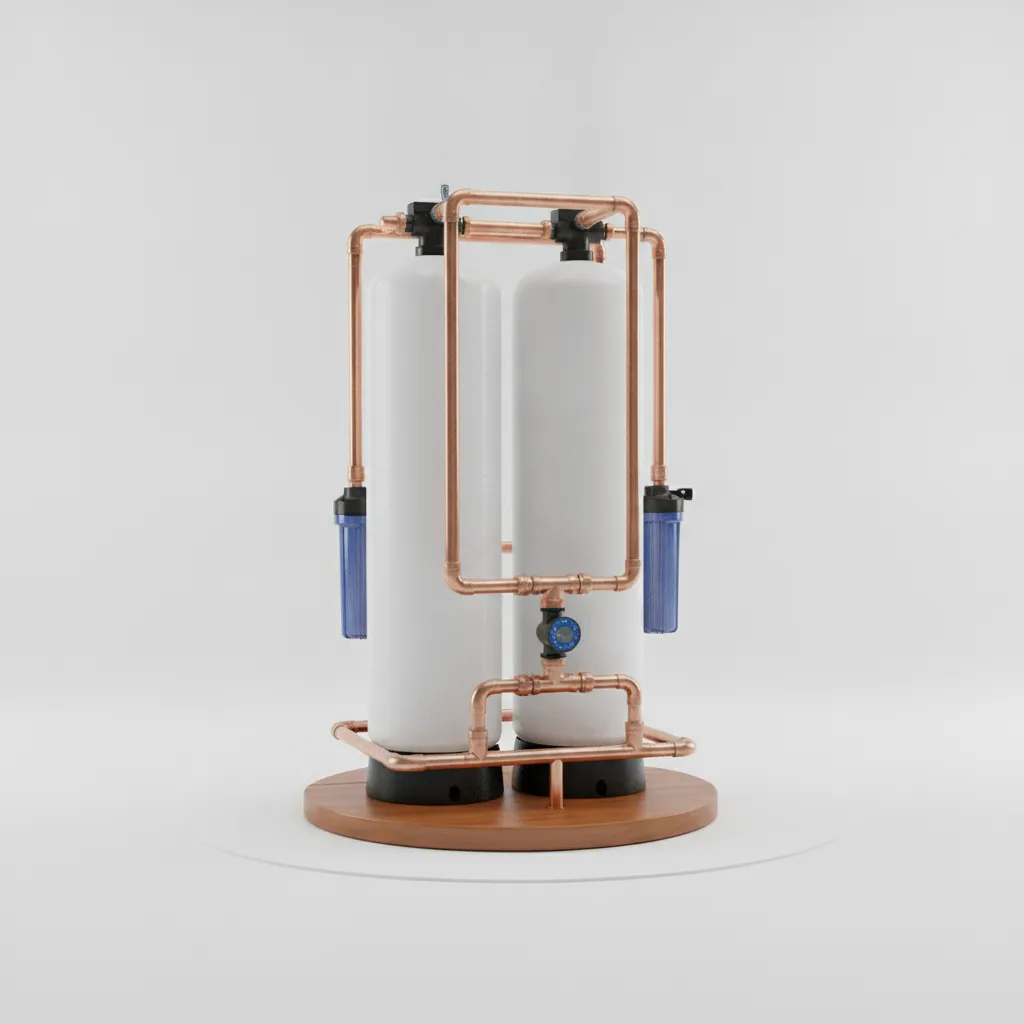
Most whole-house systems are big carbon tanks. Water enters the tank, flows through a bed of activated carbon (often catalytic carbon for chloramine-heavy systems), and exits cleaner. Some setups add a sediment pre-filter, a KDF stage for chlorine, and a salt-free conditioner or softener if you have hard water. The whole stack lives in your basement, garage, or utility room.
What a typical municipal-water whole-house system handles well: chlorine, chloramine, sediment, basic VOC reduction, and the taste/odor problems people notice at every tap. The SpringWell CF+ — one of the more common units in this category — uses components carrying NSF/ANSI 42 certification for chlorine reduction and NSF 61 certified materials. Iron and sulfur on well water need a separate dedicated stage (covered in our best well water filtration systems guide).
What whole-house carbon does NOT do reliably: lead removal at NSF 53 contact times, deep PFAS reduction, or fluoride removal. Carbon at point-of-entry sees water moving fast through a large bed. The contact time isn’t the same as a slow-flow point-of-use cartridge. If your goal is PFAS or lead at the drinking faucet, a whole-house system alone won’t get you there — and any brand that claims otherwise without specific NSF 53 certification on the assembled system is overselling.
What an Under-Sink Filter Actually Does
An under-sink filter is point-of-use. It pushes the cold water for one fixture — almost always your kitchen sink — through one or two carbon block cartridges and out either a dedicated faucet or your existing tap. No tank, no main-line cuts, no electricity.
The right carbon block, properly certified, does a lot. NSF/ANSI 42 covers chlorine taste and odor. NSF/ANSI 53 covers health contaminants: lead, cysts, VOCs, mercury, and (since 2019) PFOA and PFOS. NSF/ANSI 401 covers emerging contaminants like pharmaceuticals, BPA, and certain pesticides.
A quick correction on terminology that trips up a lot of buyers: NSF P473, the old standalone PFAS protocol, was absorbed into NSF 53 in 2019. A filter “NSF 53 certified for PFOA and PFOS” is the current correct framing. Don’t trust marketing that still lists P473 as a separate standard — check the NSF certified product database directly to see which contaminants each filter is verified against.
The trade-off is obvious: an under-sink filter only treats the water you drink and cook with at one tap. Your shower, bath, washing machine, and ice maker on the fridge are untreated. For most municipal-water households whose main concern is what they’re drinking, that’s fine. For households worried about chlorine skin irritation, eczema flare-ups, or chloramine-fed bath water, point-of-use alone doesn’t cover the bases.
Contaminant Head-to-Head: What Each One Actually Removes
This is where the marketing gets blurry, so let’s pin it down with what the data actually shows for each technology when the system holds full NSF certification.
| Contaminant | Whole House (NSF 42/61 certified) | Under-Sink Carbon Block (NSF 42/53/401 certified) |
|---|---|---|
| Chlorine | Yes — at every fixture | Yes — at the treated tap only |
| Chloramines | Yes (catalytic carbon models) | Yes (catalytic carbon models only) |
| Sediment | Yes (with pre-filter stage) | Limited — depends on pre-filter |
| Lead | No reliable certification at point-of-entry contact times | Yes — NSF 53 |
| PFOA / PFOS | Limited — verify model-specific NSF 53 listing | Yes — NSF 53 (verify model-specific listing) |
| VOCs | Partial — at most fixtures | Yes — NSF 53 |
| Pharmaceuticals / BPA | No certification at this scale | Yes — NSF 401 |
| Cysts (Giardia, Crypto) | Requires a separate sub-micron stage | Yes — NSF 53 |
| Arsenic (V) | No (requires RO or specialty media) | No (requires RO — see our [RO vs under sink comparison](/ro-vs-under-sink-filter-comparison)) |
| Iron / Manganese | Yes (with dedicated air-injection or oxidation stage on well water) | No |
| Hard water minerals | No (requires softener or salt-free conditioner — separate unit) | No |
| Shower / bath exposure | Treats it | No effect |
Pattern to notice: whole-house wins on coverage and bath/shower exposure. Under-sink wins on lead, PFAS, and pharmaceuticals at the drinking tap. Neither is a substitute for the other — they solve different problems.
Installation Reality
This is where the most expensive mistakes happen.
Under-Sink Install
A standard dedicated-faucet under-sink filter needs three things: a hole in the countertop or sink deck for the small filtered-water faucet, a tap into the cold line, and somewhere to mount the cartridge housing. On a typical sink with a pre-drilled accessory hole — most have one, look for a blank cap next to the sprayer — the whole job runs 30 to 60 minutes with a basic wrench set.
The supply connection is where amateurs get into trouble. Always use a compression fitting on the cold line, never a saddle valve. Saddle valves pierce the supply with a tiny needle, and they leak. Mechanical piercing saddle valves on potable water lines have been barred for decades under the Uniform Plumbing Code (UPC Chapter 6) and the International Plumbing Code (IPC Section 605.9) — this isn’t a new restriction, but a long-standing prohibition that still routinely gets ignored by DIY installs. Any plumber called for a leak callback is going to flag a saddle valve immediately. Reputable kits — Aquasana, Epic, APEC — ship with a compression adapter. Use it.
Direct-connect models hook into the cold line with push-in quick-connect fittings and filter everything coming out of your existing kitchen faucet. Easier install, no extra faucet, but you lose the dedicated drinking tap and you’re filtering water you won’t drink. For renters who can’t drill the counter, that’s a fair trade.
Whole House Install
A whole-house install is a different animal. You’re cutting into the main supply line, building a bypass loop with three shutoff valves (so you can service the filter without killing water to the house), and mounting a 50-pound tank to a wall or framing. The unit needs to fit before the first branch line — meaning before the line splits off to the water heater, hose bibs, and upstairs fixtures.
A few things that trip up DIYers:
- You need a bypass loop. Two ball valves on either side of the filter plus a third valve across the bypass leg. Without it, every cartridge change means shutting off water to the whole house.
- Main line size matters. A 3/4-inch main line on a two-story, three-bathroom house, with a system rated for that household size, is going to drop pressure when two showers run. SpringWell’s CF1 (the 9 GPM entry-level model) is the right sizing for 1–3 bathroom homes; the larger CF+ at 20 GPM is built for 7+ bathroom homes or light commercial use. Match the rated flow to your peak demand. With a 3/4-inch main and two simultaneous showers, an undersized unit hits its ceiling and you’ll feel it at the showerhead.
- Soldering, PEX crimps, or push-fit connections. A confident DIYer with PEX experience can do this. Anyone who’s never sweated a copper joint or used a PEX crimp tool should call a plumber. Budget $400 to $800 for professional install in most US metros.
Time-wise, plan on a full Saturday for a competent DIYer, or 3-5 hours for a licensed plumber. Most of the difficulty is in the planning — deciding where to cut the existing copper and how to route the bypass — not the plumbing itself.
Five-Year Cost Comparison
Here’s the math people don’t run before they buy.
Whole House — 5-Year Total (Municipal Water, Carbon System)
| Line Item | Cost |
|---|---|
| SpringWell CF+ unit (or comparable) | $1,000 |
| Professional install (if hired) | $600 |
| Replacement pre-filter sediment cartridges (4 per year x 5) | $200 |
| Replacement catalytic carbon tank media (year 5) | $250 |
| **5-year total (installed by plumber)** | **~$2,050** |
| **5-year total (DIY install)** | **~$1,450** |
Under-Sink — 5-Year Total
| Line Item | Cost |
|---|---|
| Aquasana Claryum 3-Stage (or comparable NSF 53 system) | $250 |
| Self-install kit (already included) | $0 |
| Replacement cartridges (2 sets per year x 5) | $750 |
| **5-year total** | **~$1,000** |
The under-sink wins on raw cost. But it only treats one tap. If you’d otherwise be buying bottled water for the whole family, the under-sink pays for itself in under 18 months. The whole-house pays for itself if you factor in the laundry, bath, and shower water you’d otherwise be living with unfiltered.
Who Should Pick Which
The patterns are clear. Here’s how to sort it.
Pick a Whole House Filter If:
- Your water smells like chlorine or chloramine in the shower, and you’re tired of it.
- You have well water with iron, sulfur, manganese, or sediment issues (pair with a dedicated treatment stage).
- Someone in the household has chlorine-aggravated eczema or respiratory sensitivity to chloramine vapor.
- You want every fixture treated, including laundry (reduces chlorine wear on clothing) and the ice maker.
- You’re not specifically targeting lead or PFAS as the main concern. If you are, add an under-sink filter for the kitchen on top of the whole-house system — that’s the gold-standard setup.
Pick an Under-Sink Filter If:
- Your main concern is what you and your family drink and cook with — lead, PFAS, VOCs, pharmaceuticals.
- You live in an older home with a lead service line or lead solder joints — point-of-use is where NSF 53 lead certification is verified.
- You rent, or you’re not staying in the house long enough to justify a whole-house investment.
- Your budget is under $400 and you want the certified protection where it matters most.
- You’ve tested your water with a home test kit or Tap Score lab analysis and the contaminants of concern are ones a certified carbon block handles.
The Honest “Both” Recommendation
The setup worth recommending most often for homes with municipal water and any real contamination concern: a whole-house carbon system for shower/bath/laundry coverage, plus a certified under-sink filter at the kitchen for drinking and cooking water. Total install runs $1,200 to $2,500. It covers every realistic exposure path without overpaying for a single unit trying to do everything.
That’s also where the NSF certifications stack correctly. You’re not asking a whole-house system to do NSF 53 lead removal it isn’t certified for, and you’re not asking a single under-sink unit to cover skin and respiratory exposure it physically can’t reach.
Recommended Systems for Each Side
These are the units worth recommending most often in each category. Read the certification details carefully — there’s an important distinction below.
Whole House Pick: SpringWell CF+
The SpringWell CF+ is built from components that carry NSF/ANSI 42 and NSF/ANSI 53 component-level certifications, plus NSF/ANSI 61 certified materials throughout the wetted assembly. Important distinction: the assembled CF+ system itself does not hold a full system-level NSF certification — it’s a component-certified build, not a unit-tested system. Pair that caveat with the catalytic carbon media, which handles chloramine (most large US cities use chloramine for secondary disinfection), not just free chlorine.
Spec snapshot: 20 GPM rated flow (built for 7+ bathroom homes; SpringWell’s CF1 at 9 GPM is the right pick for 1–3 bathroom houses), 1,000,000-gallon capacity on main carbon stage, lifetime warranty on the tank, KDF-55 inclusion for additional chlorine reduction.
Where it breaks:
- Component-level NSF certifications, not a system-level NSF certification. That doesn’t mean the system underperforms, but it does mean you can’t point to a single NSF Drinking Water Treatment Units listing for the assembled unit. Buyers who want full-system NSF certification should know that going in.
- The mounting bracket on older revisions was thin plastic and has a track record of failing within two years. Budget $15 for a stainless replacement bracket from the hardware store.
- The sediment pre-filter housing is a separate purchase; the bundled kit doesn’t include it by default. Plan for $80 to add a proper pre-filter housing if you’re on well water or any system with visible sediment.
For the full ranking and comparison with iSpring WGB32B and other competitors, see our best whole house water filters guide.
Under-Sink Pick: Aquasana Claryum 3-Stage Max Flow
The Aquasana Claryum 3-Stage Max Flow (model AQ-6300, formerly AQ-5300+) is NSF certified to NSF/ANSI 42, 53, 401, and 372 — a fuller certification stack than most competitors at this price. The NSF 53 certification specifically covers lead reduction and PFOA/PFOS, which is what you want a point-of-use system handling. Independent testing referenced in Wirecutter’s under-sink coverage backs the contaminant claims.
Spec snapshot: Three-stage Claryum Max Flow cartridge system, 800-gallon filter life (about six months at average household use), 0.72 GPM flow rate, dedicated faucet included.
Where it breaks:
- Cartridges are proprietary — you’re locked into Aquasana’s replacement supply chain at roughly $80 per change. There’s no generic alternative cartridge that fits the housing.
- Flow rate at 0.72 GPM is still noticeably slower than your unfiltered cold tap. Plan on the rinse cycle taking 20 to 30 seconds longer than a standard kitchen faucet.
Buy Direct from Aquasana | Check on Amazon
For the full under-sink ranking including Epic Pure, APEC, and Frizzlife, see our best under sink water filters guide.
Test First, Buy Second
Before you spend a dollar on either system, get your water tested. The right filter is the one that targets the contaminants you actually have, not the ones the marketing department wants you to worry about.
A home test kit or a lab-grade Tap Score analysis costs $20 to $200 and tells you what you’re dealing with. Once you know your water’s profile — chlorine level, total hardness, presence of PFAS, lead at the tap — the buying decision gets a lot simpler.
For municipal water, pull your utility’s Consumer Confidence Report (federally required, usually online). For well water, the home test plus a lab kit is non-negotiable.
FAQ
Do I need both a whole house filter and an under-sink filter?
It depends on what you’re worried about. If your concerns are chlorine, chloramine, sediment, or shower/bath exposure, a whole-house system alone handles it. If your concern is lead or PFAS at the drinking tap, an under-sink filter alone is enough. If you have both concerns — which most homeowners on older municipal infrastructure do — the layered setup (whole house plus under-sink) is the gold standard. Total installed cost lands between $1,200 and $2,500.
Does a whole house filter remove PFAS?
Some claim to, but verify the NSF 53 certification on the assembled system before you buy. Carbon at point-of-entry sees much shorter contact times than a slow-flow point-of-use cartridge, which is why point-of-use NSF 53 filters are the more reliable PFAS solution. For deep PFAS reduction at the drinking tap, pair a whole-house system with a PFAS-certified under-sink filter or a reverse osmosis unit.
Can I install a whole house filter myself?
If you have plumbing experience — soldering copper, crimping PEX, working with main shutoffs — yes. A confident DIYer can install most whole-house systems in a full Saturday. If you’ve never cut into a main line or built a bypass loop, hire a licensed plumber. A botched main-line install costs more to fix than the install itself. Expect $400 to $800 for professional install in most US metros.
How often do I change filters on each system?
Whole house: pre-filter sediment cartridges every 3 to 6 months depending on water quality, main carbon media every 5 to 10 years depending on volume and capacity rating. Under-sink: cartridges every 6 to 12 months for most NSF 53 certified systems, often closer to 6 months in households with above-average usage. For the full breakdown by system type, see our guide on how often to change your water filter.
Will a whole house filter affect my water pressure?
A properly sized system shouldn’t drop pressure noticeably under normal use. The pressure drop spec on most quality units (SpringWell CF+, Aquasana Rhino) runs 5 to 15 PSI under flow, which most households won’t feel. The problem is undersized systems on a 3/4-inch main line with multiple simultaneous fixtures running. Size the system to your peak demand (number of bathrooms plus laundry plus dishwasher), not just your main line diameter, and you’ll be fine.
Is a whole house filter worth it on a city water connection?
If you notice the chlorine taste or smell at the shower or bath, yes. If you only ever drink water from the kitchen tap and don’t notice any taste/odor at other fixtures, an under-sink filter does the job for a quarter of the cost. The whole-house investment makes sense when the exposure path extends beyond drinking water — bathing, laundry, and the small amount of vapor you inhale during a hot shower all benefit.
Final Verdict
One answer for one homeowner: test your water first. Then match the filter to the contaminants you actually have, not the ones the marketing wants you to worry about.
For most municipal-water households whose main concern is what comes out of the kitchen tap, a properly certified under-sink filter like the Aquasana Claryum 3-Stage Max Flow does the job at around $250 and a 45-minute install. For households dealing with chlorine or chloramine site-wide, well water issues, or skin/respiratory exposure, the SpringWell CF+ whole-house system is the cleaner answer, and pairing it with a kitchen-side under-sink is the layered setup worth installing.
The honest mistake to avoid: buying a single system to do both jobs. They don’t overlap as much as the marketing suggests, and the right answer for most contamination concerns is two stages — one at the main, one at the sink — not one oversized unit doing neither job well.
Related Articles
- Best Whole House Water Filters 2026
- Best Under Sink Water Filters 2026
- RO vs Under Sink Filter Comparison
- How to Test Your Water at Home
- How Often to Change Your Water Filter
Sources
- NSF International Certified Drinking Water Treatment Units Database
- EPA 2024 PFAS National Primary Drinking Water Regulation
- IAPMO Uniform Plumbing Code (2024 edition) — saddle valve provisions
- Wirecutter — under-sink water filter testing coverage
- Consumer Reports — whole-house carbon filtration field reviews
- EWG Tap Water Database