MultiPure Aquaperform Review 2026: Certified Arsenic V, No RO
> Affiliate disclosure: FilterdWaterGuide.com earns a commission from qualifying purchases made through links in this article. This does not affect our recommendations. Products are evaluated on certification data and independent testing, not commission rates. We have no affiliate relationship with MultiPure. Every link to MultiPure in this review is a plain, untagged URL. We make nothing if you buy one. It’s here because the certification says it belongs here.
Your water test came back with an arsenic number, or a lead number, or a PFAS number, and every guide you’ve read says the answer is reverse osmosis. You don’t want RO. You don’t want a tank in the cabinet, a drain line, or three gallons down the sink for every one you drink. You want a carbon filter that actually holds a certification for the thing you’re worried about.
The MultiPure Aquaperform (model MP880) is that filter. It’s the Best Non-RO pick in our arsenic guide, and this MultiPure Aquaperform review is the long version of why, including the parts MultiPure’s product page glosses over.
Quick Verdict
The Aquaperform is a stainless steel carbon block that’s listed in NSF International’s own database, certified to NSF/ANSI 42, 53, and 401, with arsenic V, lead, mercury, PFOA/PFOS, cysts, VOCs, microcystin, and microplastics all named on the listing. That’s a wider certified list than almost any non-RO unit you can buy. It costs $695 for the bare system, about $765 as a below-sink install with a faucet, and $150 a year in filters.
It earns 4.4/5. The points come off for a 1.0 GPM flow rate, a filter that’s pricier per year than the competition, and an arsenic claim with more fine print than the marketing lets on.
Buy from MultiPure — no affiliate relationship
Specs at a Glance
| Spec | Aquaperform (MP880) |
|---|---|
| Type | Solid carbon block, under-sink or countertop |
| Replacement filter | CB11As |
| Filter capacity | 600 gallons or 12 months, whichever comes first |
| Flow rate | 1.0 GPM |
| Housing | Stainless steel, 11″ H × 5.75″ D, 6.6 lb with filter |
| Fittings | 1/8″ NPT inlet and outlet |
| Particle retention | 0.5 micron (nominal) |
| Operating pressure | 30–100 psi |
| Operating temperature | 32–100°F, cold water only |
| Certification | NSF International, NSF/ANSI 42, 53, 401 |
| Price (Sept 2026, MultiPure direct) | $695 base; +$45 to +$90 for install kits |
| Replacement filter price | $150 (15% off on autoship) |
| Housing warranty | Lifetime, conditioned on annual genuine filter replacement |
| Returns | 90 days, customer pays return shipping |
What’s Actually in the Housing
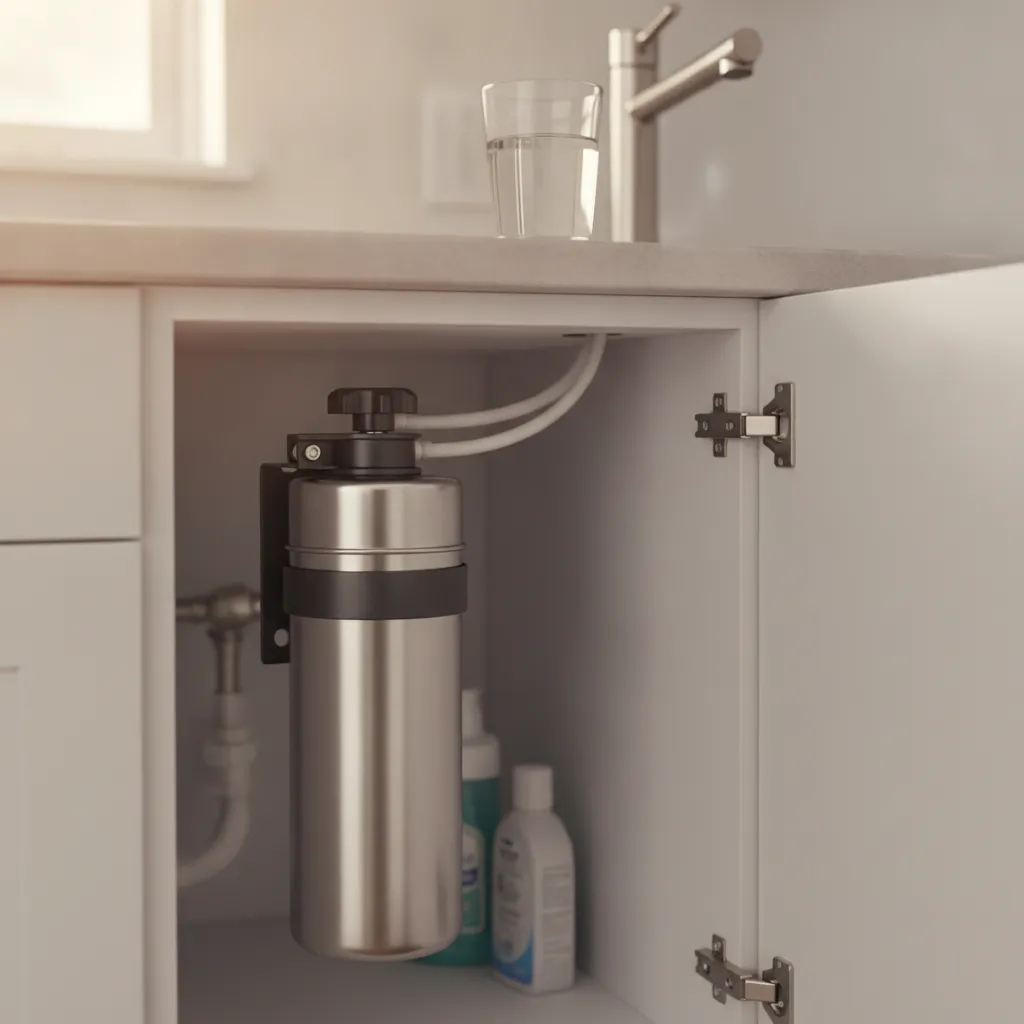
Here’s what actually happens inside. Water enters the bottom of a stainless steel canister, passes through a white sediment pre-wrap, then gets forced through a compressed solid carbon block from the outside in. That’s it. One cartridge, no stages, no membrane, no tank, no electricity.
The carbon block does two jobs. The dense pore structure physically traps particles down to a nominal 0.5 micron, which is how it earns the cyst, asbestos, turbidity, and microplastics claims. The carbon surface adsorbs chlorine, chloramine, VOCs, and disinfection byproducts, which is what carbon is good at.
What makes the Aquaperform different from MultiPure’s cheaper Aquaversa is a media blend inside the block that also grabs arsenic V, PFOA/PFOS, and microcystin. Same housing, different cartridge, different certified list.
Because there’s no membrane, the water keeps its minerals. That means no flat RO taste, no remineralization stage, and no reject water. It also means it does nothing for hardness, nitrate, fluoride, or TDS. If your problem is on that list, this is the wrong tool, and RO vs. under-sink explains which one is right.
The Certification, Line by Line
We check three certifier databases before we credit any product with a removal claim: NSF International, WQA Gold Seal, and IAPMO R&T. Most of the under-sink units we recommend are certified by WQA or IAPMO, which are real certifications but don’t show up in NSF’s own listings. The Aquaperform is the other kind. We opened NSF’s listing for MultiPure on September 14, 2026, and the Aquaperform (element CB11As, 600 gallons, 1 GPM) appears under all three standards:
NSF/ANSI 42 (aesthetic): chlorine, chloramine, taste and odor, nominal particulate Class I.
NSF/ANSI 53 (health): lead, mercury, asbestos, chlordane, cyst, MTBE, PCB, toxaphene, turbidity, VOC, arsenic (pentavalent, ≤50 ppb), microcystin, PFOA, PFOS.
NSF/ANSI 401 (emerging compounds): 15 pharmaceutical and chemical compounds (atenolol, bisphenol A, carbamazepine, DEET, estrone, ibuprofen, linuron, meprobamate, metolachlor, naproxen, nonylphenol, phenytoin, TCEP, TCPP, trimethoprim) plus microplastics.
The VOC claim is a package deal. Under NSF/ANSI 53, one VOC listing covers around 50 compounds including all four trihalomethanes, benzene, TCE, PCE, atrazine, and a long list of pesticides. It’s the same VOC claim the cheaper MultiPure Aquaversa carries, which is why the Aquaversa is a pick in our DBP filter guide. The Aquaperform matches it there and adds the arsenic and PFAS claims on top.
One distinction that matters more than any single line on that list: “certified” means NSF tested the unit, audits the factory, and re-tests it on a schedule. “Tested to NSF standards,” the phrase a lot of cheaper filters use, means somebody ran one lab test once. The Aquaperform is the first kind.
Two things to keep straight:
The certification is for the plumbed-in, separate-tap configuration. MultiPure’s own user guide says it plainly: “Certification is only on the plumbed-in to separate tap option and the additional parts are not Certified.” The countertop diverter kit, the single-hose kit, and the inline hookup to a fridge are not the tested setup. The cartridge is the same, so the chemistry doesn’t change, but if you want to say “certified” about the water coming out, install it below the sink with the dedicated faucet.
The PFOA/PFOS claim is to the 2021 version of NSF/ANSI 53. NSF’s listing footnotes it. That test challenges the filter with 1.5 ppb combined PFOA/PFOS and requires the outlet water to land at or below the pass level in force at the time. The EPA’s 2024 drinking water limit is 4 ppt for each. (EPA proposed in May 2026 to give utilities until 2031 to comply, but the 4 ppt number itself stands.)
A 2021-era certification does not prove the filter gets you to 4 ppt, and MultiPure’s own documents don’t agree with each other on the pass level: one performance sheet prints 0.1 µg/L, the specs sheet and user guide print 0.07 µg/L. The certified reduction is real. Just don’t read it as “certified to the current EPA limit.” Our PFAS filter guide has the full picture on what any carbon block can and can’t promise here.
The Arsenic Claim: Read the Fine Print Before You Buy
This is the reason most people are looking at this unit, so here’s the whole story.
Arsenic in water comes in two forms. Arsenic V (arsenate) is what you get in chlorinated city water, because free chlorine converts the other form. Arsenic III (arsenite) is what you often get in raw well water, and carbon blocks don’t reliably grab it. The Aquaperform is certified for arsenic V only. MultiPure’s user guide says the system “may remove some trivalent arsenic; however, it has not been evaluated for its ability to remove trivalent arsenic.”
Here’s what the certified test actually showed. Under NSF/ANSI 53, the Aquaperform took 50 ppb arsenic V down to 10 ppb or less, which is the EPA’s legal limit. MultiPure reports greater than 98% reduction at pH 6.5 and 97.6% at pH 8.5. The NSF listing caps the claim at influent water of 50 ppb or less.
MultiPure’s spec sheet separately says the MP880 series “has been tested” for arsenic V at up to 0.30 mg/L (300 ppb). That’s a manufacturer test, not the certified claim. Size your expectations to 50 ppb.
The conditions MultiPure attaches to the claim, straight from the spec sheet:
- The water needs a detectable free chlorine residual at the inlet, or a lab result showing the arsenic is already all arsenic V.
- Chloramine doesn’t count. MultiPure says combined chlorine “is not sufficient to ensure complete conversion of trivalent arsenic to pentavalent arsenic.” More than one in five Americans get chloramine-treated water, per EPA. If your utility is one of them, and your arsenic isn’t confirmed as arsenic V, this unit is a gamble. Chloramine vs. chlorine tells you how to find out which one you have.
- Test the treated water. MultiPure’s own guide says to have the filtered water tested for arsenic to confirm it’s working. Do that.
On a private well, all of this gets harder. Well arsenic is often arsenic III, there’s no chlorine residual, and MultiPure says its drinking water systems are for municipally treated water, not untreated sources. If you’re on a well with an arsenic result, start with the well water testing guide and get a speciation test before you buy anything. Arsenic in drinking water covers the chemistry in more depth than I will.
Bottom line on arsenic: if you’re on chlorinated city water and your CCR or a Tap Score test shows arsenic under 50 ppb, this is one of very few non-RO filters with a certified claim that fits your problem. If any of those three conditions is off, get an RO unit with an NSF/ANSI 58 arsenic claim instead.
Flow Rate: On Paper vs. in the Field
On paper, 1.0 GPM. In the field, MultiPure’s manual tells you to throttle the supply so the filtered faucet doesn’t exceed 1.0 GPM, and it gives you the yardstick: about 15 seconds to fill a quart. That’s a minute per gallon. Filling a pasta pot is a wait.
That’s normal for a dense carbon block, and it’s still faster than the 0.5–0.75 GPM most tank-less RO units deliver at the faucet. But it’s slower than the multi-cartridge under-sink systems in our under-sink guide, and the flow drops further as the block loads up with sediment. MultiPure’s troubleshooting page says a slowing faucet is your cue to change the filter. If your water has a lot of sediment, put a cheap sediment pre-filter ahead of it and the block will last longer.
Installation Reality
This is one of the easier under-sink installs you’ll do. Here’s what’s in the box and what isn’t.
Pick your kit at checkout. The $695 base unit is the housing and one cartridge with 1/8″ NPT ports and nothing else. For a below-sink install you want the Below Sink Kit with a faucet (+$70 for chrome, +$90 for brushed nickel, matte black, white, or bronze). That gets you the faucet, the mounting bracket, tubing, and MultiPure’s Adapta Valve for the cold line. A kit without the faucet is +$45 if you already have a dedicated tap.
You need a hole. The dedicated faucet takes a 1/2″ hole in the sink deck or counter. If you have a spare sprayer or soap dispenser hole, use it. If you don’t, you’re drilling stainless or stone, and that’s the one step that turns this from a 30-minute job into a call to a plumber.
No drain line, no tank, no electricity. Mount the bracket on the cabinet wall, hang the canister, tee the cold supply with the included valve, run two tubes. The user guide’s install section is short. There’s a $35 acrylic base if you’d rather set it on the cabinet floor than hang it.
Skip saddle valves. MultiPure’s Adapta Valve is a proper tee, which is what you want. Plumbing codes are moving against saddle valves, and they leak eventually anyway.
Flush for 15 minutes. New carbon dumps black dust. Run the faucet for 15 minutes before you drink from it. Same drill at every filter change.
Bypass your softener. MultiPure recommends feeding the unit from a line ahead of any water softener. If your cold kitchen line is already softened, that’s a plumbing conversation.
Cold water, 30–100 psi. Above 100 psi, add a pressure regulator. A milky look in the glass is air from high pressure, not a problem.
The capacity monitor is $35 and worth it below the sink. It counts gallons and lights an indicator at the faucet base when you hit 600. It’s battery-powered (two AAs, not included), and you change the batteries every filter swap. Without it, you’re on the calendar: MultiPure says replace annually regardless of gallons.
Countertop is an option, but see the certification note above. The dual-hose diverter kit (+$65) or single-hose kit (+$60) lets it sit next to the sink for renters. It works. It’s just not the tested configuration, and MultiPure won’t guarantee the diverter fits your faucet.
Filter Changes and the 10-Day Rule
Changing the cartridge is a no-tools job: unscrew the black knob on the V-band clamp, lift the top off, unthread the old block, thread on the new one, don’t overtighten, clamp it back. Rinse the housing while it’s open. MultiPure says the rubber cushion inside the lid should be replaced every two to three years; it’s a cheap part.
The rule that catches people: don’t let the unit sit unused for 10 days or more. Carbon blocks that sit full of warm, stagnant water grow things. If you’re leaving on vacation, MultiPure says drain it and pull the filter. If you forget, the guide has a bleach flush procedure, and if the water sat, run the faucet to waste for 10 minutes before drinking. That’s a real maintenance requirement, not a suggestion.
Two more from the manual worth knowing: if your water smells like rotten eggs (hydrogen sulfide), the fix is rotating two cartridges so one dries out while the other works. And if you’re on a well or any water that isn’t municipally disinfected, this isn’t your filter; MultiPure says so on every spec sheet.
What It Costs to Own
| Item | Cost |
|---|---|
| Aquaperform base system (Sept 2026, MultiPure direct) | $695 |
| Below Sink Kit with chrome faucet | +$70 |
| Capacity monitor (optional) | +$35 |
| CB11As replacement filter, once a year | $150 ($127.50 on 15% autoship) |
| Housing warranty | Lifetime (with annual genuine filter) |
Call it $765 installed by you, $800 with the monitor. Then $150 a year. Over five years that’s roughly $1,365 to $1,400, or about $23 a month.
Per gallon, the filter runs $0.25 at the full 600-gallon capacity. That’s honest math, not a MultiPure number. It’s more than the cartridge cost on most WQA-certified competitors; the replacement filter guide has the comparison. But it’s cheaper per year than a tank-less RO with a $150+ membrane on top of pre-filters, and there’s no wasted water on the bill. How often to change your filter covers why the 12-month cap matters even if you’re under 600 gallons.
One note on the price. MultiPure doesn’t run a rolling discount banner the way some brands do; the $695 is the number. The only built-in discount is 15% off the replacement filter if you subscribe to autoship at 6, 9, 12, or 18 months. The 12-month interval matches the manual.
How It’s Sold, and Why That Matters
MultiPure sells direct from its website and through a network of what it calls Independent Builders. That’s a direct-sales model. The user guide even tells you to contact your Builder first for install help, then MultiPure Customer Care.
I’ll say this plainly, because we’ve been hard on other companies for the same structure. A sales model is not a certification. We put Kangen on our never-recommend list because it has no NSF listing and makes health claims it can’t back up, not because of how it’s sold.
The Aquaperform is in NSF’s database with a long, specific certified list. That’s the test, and it passes it. If the distributor thing bothers you, order from multipure.com and skip the Builder entirely.
What the distributor model does cost you is price competition. We couldn’t find an Amazon or big-box listing for the system, and the online dealers that carry it are MultiPure distributors, so there’s no real price-checking, no Prime returns, and the 90-day return policy has you paying return shipping plus a minimum $25 shipping deduction from the refund. Ship it back late after a return authorization and there’s a 25% restocking fee. Read that page before you buy.
Warranty, Read Closely
The lifetime housing warranty is real, and stainless steel with a V-band clamp is about as durable as an under-sink housing gets. The condition: you replace the filter with a genuine MultiPure cartridge at least once a year, or the warranty is void. Keep receipts, or use autoship so there’s a record. The warranty covers function, not cosmetics; the housing can stain.
Everything else is shorter. Faucets, hoses, and diverter valves are 12 months. Replacement filters are 30 days. Damage or missing parts must be reported within 7 days of delivery or MultiPure won’t cover it.
Where It Falls Short
The arsenic claim has three conditions. Arsenic V only, free chlorine residual required, 50 ppb cap on the certified claim. On chlorinated city water it’s a clean fit. Anywhere else, it needs a speciation test first, and MultiPure’s product page doesn’t mention any of this until you open the spec sheet.
1.0 GPM. It’s fine for drinking and coffee. It’s slow for filling pots, and it gets slower as the block loads.
$150 a year in filters. Competing WQA-certified under-sink units run cheaper cartridges. You’re paying for the arsenic and PFAS media and for a listing in NSF’s own database. Whether that premium is worth it over a lead-and-PFAS-only unit depends entirely on whether arsenic is on your report.
The countertop configuration isn’t the certified one. MultiPure sells it both ways. Only one way is on the listing.
PFOA/PFOS certification is to the 2021 standard. Real, but not a promise of 4 ppt.
Doesn’t touch hardness, nitrate, fluoride, or TDS. No carbon block does. If those are on your report, RO.
Not for wells or untreated water. By MultiPure’s own instructions.
Who Should Buy It, and Who Shouldn’t
Buy the Aquaperform if: you’re on chlorinated municipal water, a test shows arsenic under 50 ppb, or lead, or PFOA/PFOS, or disinfection byproducts, and you want a certified fix at the kitchen tap without RO’s tank, drain line, and wasted water. It’s also a strong pick if you want the widest NSF-listed contaminant list you can get from a single carbon cartridge.
Skip it if: you’re on a well, your utility uses chloramine and you can’t confirm your arsenic is arsenic V, your report shows nitrate, fluoride, or high TDS, or you want faster flow. For those, the RO guide has units with NSF/ANSI 58 arsenic claims. If lead and PFAS are your only concerns and arsenic isn’t in the picture, the under-sink guide has WQA-certified units with cheaper annual filters.
Consider the Aquaversa instead if: you only need chlorine, lead, VOCs, and cysts. It’s the same housing with the CB6 cartridge, 750 gallons, and no arsenic or PFAS claim. Cheaper cartridge, narrower list.
Before any of it: test your water. The Aquaperform solves a specific set of problems well. A Tap Score panel tells you whether yours is on the list.
FAQ
Is the MultiPure Aquaperform NSF certified?
Yes, and by NSF International itself, not just “tested to NSF standards.” The Aquaperform (model MP880, cartridge CB11As) appears in NSF’s certified product database under NSF/ANSI 42, 53, and 401. The certification applies to the plumbed-in, separate-tap installation.
Does the MultiPure Aquaperform remove arsenic?
It’s certified under NSF/ANSI 53 to reduce arsenic V (pentavalent arsenic) from 50 ppb to 10 ppb or less. It is not certified for arsenic III, which is common in well water. MultiPure requires a free chlorine residual at the inlet, or a test confirming the arsenic is already arsenic V, and says chloramine isn’t enough to convert it.
Does the MultiPure Aquaperform remove PFAS?
It’s NSF-certified for PFOA and PFOS reduction under the 2021 version of NSF/ANSI 53, with MultiPure reporting greater than 95.5% reduction under test conditions. That certification predates the EPA’s 4 ppt limit, so treat it as certified PFOA/PFOS reduction, not a guarantee of hitting the 2024 standard.
Does the MultiPure Aquaperform remove lead?
Yes. NSF/ANSI 53 lead reduction is on the listing, with MultiPure reporting greater than 99.7% at pH 6.5 and 99.3% at pH 8.5 from a 150 ppb challenge. See our lead filter guide for how it compares.
How often do you change the Aquaperform filter?
Every 600 gallons or 12 months, whichever comes first. The CB11As cartridge is $150 from MultiPure, or $127.50 on autoship. Annual replacement with a genuine cartridge is also the condition for the lifetime housing warranty.
Can I install the Aquaperform on a countertop?
MultiPure sells countertop diverter kits and they work. But the NSF certification covers only the below-sink, separate-tap configuration. The cartridge is identical; the tested setup isn’t.
Is the Aquaperform good for well water?
No. MultiPure states its drinking water systems are for municipally treated water and not for microbiologically unsafe or untreated sources. On a well with arsenic, the arsenic is often arsenic III, which this unit isn’t certified to remove.
Aquaperform vs. Aquaversa: what’s the difference?
Same stainless housing. The Aquaversa’s CB6 cartridge is 750 gallons and certified for lead, VOCs, cysts, mercury, and NSF/ANSI 401 compounds. The Aquaperform’s CB11As is 600 gallons and adds arsenic V, PFOA/PFOS, and microcystin. Pick based on what’s in your test.
Final Verdict
The Aquaperform does something almost no other carbon block can prove: it holds an NSF International listing that names arsenic V, lead, PFOA/PFOS, cysts, VOCs, and microplastics, and it does it in a single cartridge with no membrane, no tank, and no drain line. The install is easy, the housing will outlast your kitchen, and the company that makes it pays us nothing. That’s why it’s the non-RO pick in our arsenic guide.
If you take one thing from this MultiPure Aquaperform review, it’s the conditions. Arsenic V only. Free chlorine required. Below-sink install for the certified configuration. A 1 GPM faucet and a $150 cartridge every year. If your water test matches what this filter is certified for, it’s one of the best-documented purchases in the category. If it doesn’t, the certification won’t help you.
4.4/5.
Buy from MultiPure — no affiliate relationship
Sources
- NSF International, Certified Drinking Water Treatment Units listing for Multipure (Aquaperform / CB11As certified claims under NSF/ANSI 42, 53, 401; accessed September 14, 2026)
- U.S. EPA, Chemical Contaminant Rules (arsenic MCL of 10 ppb)
- U.S. EPA, Per- and Polyfluoroalkyl Substances (PFAS) drinking water regulation (4.0 ppt MCLs for PFOA and PFOS; May 2026 proposed compliance extension)
- U.S. EPA, Chloramines in Drinking Water (share of Americans on chloramine-treated water)
- MultiPure, Aquaperform product page (pricing, kit options, specifications; accessed September 14, 2026)
- MultiPure, Aquaperform Specifications and NSF Performance Data sheet (PDF) (percent reductions, challenge concentrations, arsenic footnotes)
- MultiPure, Aquaperform Performance Data sheet (PDF) (the version printing 0.1 µg/L as the PFOA/PFOS pass level)
- MultiPure, Aquaperform User Guide (PDF) (installation, flush, 10-day rule, filter change, Arsenic Facts, certified-configuration note)
- MultiPure, Return & Refund Policy and Warranty (90-day returns, shipping deductions, lifetime housing warranty conditions)