A.O. Smith AO-US-200 Review 2026: Aquasana Tech, Lower Price
> Affiliate disclosure: FilterdWaterGuide.com earns a commission from qualifying purchases made through links in this article. This does not affect our recommendations. Products are evaluated on certification data and independent testing, not commission rates. We have no affiliate relationship with A.O. Smith. The Amazon link below is a standard Amazon Associates link. We do have an affiliate relationship with Aquasana, the sister brand this filter is compared against, and we say so again where that comparison comes up.
You want a certified lead and PFAS filter under the kitchen sink and you don’t want to spend $200 to get one. Short answer for this A.O. Smith AO-US-200 review: it’s the cheapest way I know of to do that with a real certification behind it. It’s also, per the performance data, an Aquasana Claryum 2-Stage wearing a different badge.
That second part is the whole story. Here’s what actually happens.
Quick Verdict
The AO-US-200 is a two-cartridge carbon block system with its own faucet. Per A.O. Smith’s performance data sheet, it’s certified by the Water Quality Association (WQA Gold Seal) to NSF/ANSI 42, 53, and 401, with lead, PFOA/PFOS, mercury, cysts, asbestos, VOCs, chloramine, and microplastics on the certified list. That’s the same list, with the same test numbers, as Aquasana’s Claryum 2-Stage, because A.O. Smith has owned Aquasana since 2016 and this unit runs Claryum cartridges.
It’s $139.99 MSRP and was about $111 on Amazon when we checked in mid-September 2026. Replacement sets are $83.99 for 500 gallons. The catch is 0.5 GPM, a plastic housing A.O. Smith says to replace every five years, and a replacement filter that costs more than Aquasana charges for the identical part.
It earns 4.3/5. Cheap to buy, not quite as cheap to own, and certified for the two contaminants most people are actually worried about.
Check on Amazon | View at A.O. Smith (no affiliate relationship)
Specs at a Glance
| Spec | AO-US-200 |
|---|---|
| Type | 2-stage carbon block, under sink, dedicated faucet |
| Filtration | Claryum (activated carbon, catalytic carbon, ion exchange, mechanical) |
| Replacement filter | AO-US-200-R (2-pack, replaces both cartridges) |
| Filter capacity | 500 gallons or 6 months, whichever comes first |
| Rated flow | 0.5 GPM |
| Operating pressure | 20 to 80 psi |
| Operating temperature | 40 to 90°F, cold water only |
| Housing | 8.75″ H x 4″ W x 8″ D, 4 lb, wall-mount manifold with two twist-on sumps |
| Faucet | Brushed nickel, included; needs a 1/2″ or smaller hole |
| Certification | WQA Gold Seal to NSF/ANSI 42, 53, 401 (per A.O. Smith PDS dated 10/21/2025) |
| Filter-change reminder | Battery-powered alarm at 95% capacity; battery ships with replacement filters |
| Price (Sept 2026) | $139.99 MSRP; about $111 on Amazon |
| Replacement set (Sept 2026) | $83.99 MSRP and Amazon; about $71 with Amazon Subscribe & Save |
| Warranty | 1 year limited, filters excluded |
| Housing life | A.O. Smith says replace the housing every 5 years |
What You’re Actually Buying
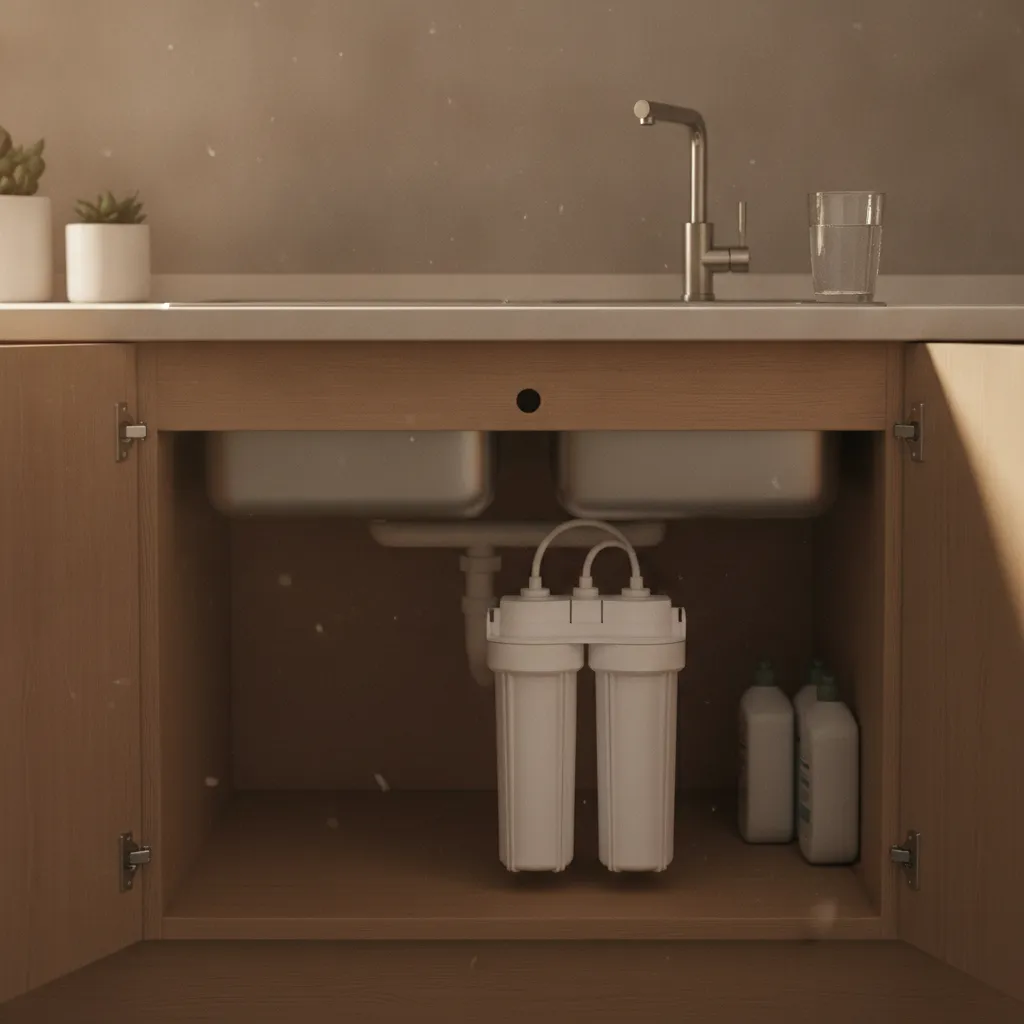
Two cartridges in two plastic sumps on a wall-mount manifold. Water comes in from a tee on your cold line, passes through both stages, and exits to a separate brushed nickel faucet. No tank, no drain line, no electricity except a battery for the change alarm.
The media is what A.O. Smith’s manual calls “Claryum filtration technology.” Claryum is Aquasana’s registered name for its carbon block blend: activated carbon for chlorine and organics, catalytic carbon for chloramine, ion exchange for lead and mercury, and sub-micron mechanical filtration for cysts, asbestos, and microplastics. A.O. Smith bought Aquasana on August 8, 2016 for $87 million, and Aquasana still runs as its own brand. The AO-US-200 is the A.O. Smith under sink water filter built on that design, sold through Lowe’s and Amazon.
I didn’t take the “same tech” line on faith. I put A.O. Smith’s performance data sheet (revised October 2025) next to Aquasana’s AQ-5200 sheet (revised April 2025). Same 500-gallon capacity. Same 0.5 GPM. Same chlorine (97.3%), chloramine (91%), lead (greater than 99.7% at pH 6.5, 99.6% at pH 8.5), mercury, MTBE (85.5%), and PFOA/PFOS (99.7%). Both certified by WQA. The one number that differs is cyst reduction, and only in the third decimal place, which is test noise. Same cartridges, same certification.
So the cheaper system carries a real certification, not a knockoff’s marketing. It also means you should shop the two side by side on price, which we’ll do below.
The Certification, Line by Line
We name the certifier every time. Three accredited bodies certify drinking water filters to the NSF/ANSI standards: NSF International, WQA Gold Seal, and IAPMO R&T. The AO-US-200 is a WQA certification. It won’t show up in NSF International’s database, and that’s not a red flag. It’s a different certifier.
Certified is the word that matters. A filter “tested to NSF standards” passed one lab run at one point in time. A certified filter gets factory audits and retesting from the certifier, year after year. Only the second one earns a removal claim from us. This one is certified.
One honesty note up front. WQA’s product database (find.wqa.org) only loads in a browser with JavaScript, and we could not open the AO-US-200’s listing for this review. Our basis is A.O. Smith’s performance data sheet, which states: “System tested and certified by WQA to NSF/ANSI Standards 42, 53, and 401 for the reduction of the claims specified on the Performance Data Sheet and at www.WQA.org.” That sheet matches Aquasana’s WQA sheet for the same cartridges, and Consumer Reports lists the Aquasana sibling as certified for chlorine, lead, and PFAS. We treat that as one step below an opened database row.
Here’s what the sheet says the system is certified for.
NSF/ANSI 42 (aesthetic): free chlorine 97.3%, chloramine 91%, particulate Class I (0.5 to under 1 micron) 99.6%.
NSF/ANSI 53 (health): lead greater than 99.7% at pH 6.5 and 99.6% at pH 8.5; PFOA/PFOS 99.7%; mercury greater than 96.2% at pH 6.5 and 95.4% at pH 8.5; cysts 99.995%; asbestos greater than 99%; MTBE 85.5%; turbidity 99.34%; VOCs 99.3% by chloroform surrogate.
NSF/ANSI 401 (emerging compounds): atenolol, bisphenol A, carbamazepine, DEET, estrone, ibuprofen, linuron, meprobamate, metolachlor, naproxen, nonylphenol, phenytoin, TCEP, TCPP, trimethoprim, plus microplastics at 99.6%.
The VOC claim is bigger than it looks. One chloroform surrogate test under NSF/ANSI 53 earns a certified claim on roughly 50 organic chemicals in the sheet’s Table 8.2: all four trihalomethanes at 95%, benzene, trichloroethylene, tetrachloroethylene, atrazine, alachlor, lindane, and a long list of pesticides. If your utility’s report shows disinfection byproducts, this is the line that covers them, and the DBP filter guide goes deeper.
Chloramine deserves a mention too. Plenty of cheap carbon blocks are certified for chlorine and quietly skip chloramine, which needs catalytic carbon and more contact time. This one carries a certified 91% chloramine claim. Chloramine vs. chlorine tells you which one your utility uses.
PFOA/PFOS: it’s under NSF/ANSI 53, not a separate “P473”
A.O. Smith’s retail pages and the Amazon listing print “P473.” The performance data sheet doesn’t. It lists PFOA/PFOS as a line item under NSF/ANSI 53, with a maximum permissible product-water concentration of 0.00002 mg/L. That’s 20 parts per trillion.
Both are describing the same certification. NSF P473 was the original PFOA/PFOS protocol, and it was folded into NSF/ANSI 53 in 2019. Some certifiers and marketing teams still say “P473.” Don’t dock the product for that, and don’t read it as an extra certification either. It’s one claim: PFOA and PFOS, certified under 53.
What the claim is not: a promise that your water lands at the EPA’s 2024 limit of 4 ppt each for PFOA and PFOS. The certified pass level on this sheet is 20 ppt. The 99.7% reduction figure came from a lab challenge far above anything most taps see, and real-world performance depends on your starting concentration and how loaded the cartridge is. It’s a certified PFOA/PFOS filter, and one of the cheapest. It’s not certified for “Total PFAS” or for the shorter-chain compounds like GenX. Elena’s PFAS filter guide covers what any carbon block can and can’t promise here.
What it’s not certified for
No TDS reduction (the Amazon listing says this plainly). No fluoride, nitrate, arsenic, chromium-6, hardness, or bacteria. A.O. Smith’s manual says not to use it on water that’s microbiologically unsafe or of unknown quality without disinfection, which rules out most private wells. If your test shows any of those, you’re looking at reverse osmosis, and the under-sink guide sorts out when RO is the right call.
One more oddity. When we checked, the Amazon listing said the system is certified to “NSF/ANSI Standards 42, 43 and 401.” There is no Standard 43 for drinking water filters. The data sheet is the document of record, and it says 53.
Flow Rate: On Paper vs. in the Field
On paper, 0.5 GPM. In the field, that’s about two minutes to fill a gallon pitcher and a real wait to fill a stockpot. It’s also why this system ships with its own faucet: you’re not running your main faucet through it.
Half a gallon a minute is normal for a compact carbon block with a lead and PFAS claim. Certification testing is done at that rated flow; push more water through a block this size and you cut contact time and lose the numbers above. Aquasana’s 3-Stage Max Flow bumps that to 0.72 GPM with a bigger third cartridge, one of the few reasons to spend more.
Amazon’s own review summary for the listing says flow “receives mixed feedback, with some reporting good flow while others find it too slow.” Both are right. Pitcher-sized fills are fine. Pasta pots aren’t. Flow also drops as the block loads up with sediment; if your water is visibly cloudy, a $20 sediment pre-filter ahead of the manifold will save you cartridges.
Installation Reality
This is a beginner-friendly install. Here’s what you’ll need and where it goes sideways.
What’s in the box: the manifold with both cartridges pre-installed, the brushed nickel faucet, two 3-foot lengths of 1/4-inch tubing, a 1/4-inch brass tee, compression fittings and inserts, mounting screws with anchors, and a plastic wrench.
Tools the manual calls for: a drill with a 7/32-inch bit, an adjustable wrench, a tape measure, a Phillips screwdriver, a hammer, and a bucket.
The faucet needs a hole. Use an existing sprayer or soap dispenser hole, or drill one no larger than 1/2 inch. With a spare hole, this is a 30-minute job. If you’re drilling stainless or granite, the manual says to call a pro, and I agree. That’s the one step that turns a DIY afternoon into a plumber’s invoice.
The tee goes on your cold shutoff. Close the valve, disconnect the faucet supply line, thread the tee onto the valve, reconnect the supply line, run the 1/4-inch tube off the side port. The Amazon listing specifies a 3/8-inch threaded supply, the common size under a kitchen sink. If your shutoff is 1/2 inch or your lines are old rigid copper, you’ll need an adapter the box doesn’t include. A proper tee beats a saddle valve every time; codes are moving against saddle valves and they leak eventually.
Mount it 12 inches up. The manual says leave at least 12 inches from the cabinet floor so you can twist the sumps off. Mounting holes are 2.55 inches apart. If the cabinet wall backs up to a dishwasher, the screws can poke through.
Push the tubing in a full inch. The manifold uses push-to-connect ports, and the manual says “It is VERY IMPORTANT to insert tubing completely (1″) to prevent leaking.” Wet the end, push until it stops, tug to confirm.
Hand-tighten the sumps only. The manual is blunt: “Do not use tools to remove or tighten sumps. Over-tightening can cause damage and result in leaking.” Push each sump up and turn right until it clicks. The manual notes that units bought before 2024 may not click, so the sump lock changed at some point. Don’t lubricate the O-ring.
Flush for 10 minutes. Open the new faucet and let it run until the carbon fines clear. Check every joint while it runs. Don’t drink the flush water.
Pull the battery tab. The red LED flashes and beeps five times to confirm the change alarm is live.
The 80 psi Line and the Five-Year Housing Rule
This is the section A.O. Smith’s product page doesn’t have, and it’s the reason the score isn’t higher.
The operating range is 20 to 80 psi, and the manual says “Do not install this system where the line pressure may exceed 80 psi.” Plenty of homes on municipal water sit at 80 psi or above, especially overnight when demand drops. A $10 gauge on the hose bib tells you your static pressure in thirty seconds. If it’s over 80, you need a pressure-reducing valve on the house, and that’s a plumber conversation, not an add-on for this filter.
Amazon’s review summary states it plainly: “Durability is a concern, with several customers reporting issues with the system bursting under water pressure.” I don’t have a count and I’m not going to invent one. But the pattern in owner reviews is a plastic sump or manifold that fails and a cabinet full of water, which is what you’d expect from a system rated to 80 psi installed in a house running 90.
Then there’s this line in the Care & Safeguards section: “Must replace housing every 5 years or risk property damage from leaks.” You order it by phone, and A.O. Smith doesn’t publish the price, so I can’t tell you what it costs. A five-year plastic housing is a design decision, not a defect, but plan for it when you compare this to a stainless unit with a lifetime housing warranty.
Two things to do about it. Check your pressure before you buy. And put a $15 leak sensor in the cabinet; they’ve saved more kitchens than any warranty.
Filter Changes and the Alarm
Every 500 gallons or 6 months, whichever comes first. For most households that’s the calendar. Our filter replacement guide explains why the two estimates diverge.
The manifold’s alarm sounds at 95% of rated capacity: red LED and a beep whenever water flows, continuing 15 seconds after you shut the faucet. The replacement 2-pack includes a fresh battery, and the manual says to swap it at every filter change.
Changing filters means shutting the cold supply, opening the faucet to relieve pressure, twisting each sump off, dropping in the new cartridge, twisting back on until it clicks, and flushing again. No tools. Hand-tighten; that’s where the O-ring damage and post-change leaks come from.
Use the genuine A.O. Smith Claryum filter, part AO-US-200-R. Amazon is full of knockoff “compatible” 2-packs at half the price with no certification behind them, the warranty excludes damage from non-genuine parts, and the certification only covers the real cartridge.
What It Costs to Own
This is where “cheapest certified filter” gets complicated.
| Item | AO-US-200 | Aquasana Claryum 2-Stage (AQ-6200) |
|---|---|---|
| System (Sept 2026) | about $111 Amazon; $139.99 MSRP | $124.99 sale; $249.99 MSRP |
| Replacement set (2 cartridges, 500 gal) | $83.99 (about $71 on Subscribe & Save) | $73.99 (about $63 on Aquasana’s subscription) |
| Annual filters, 2 sets | $168 (about $143 subscribed) | $148 (about $126 subscribed) |
| 5-year total, 9 replacement sets | about $867 (about $754 subscribed) | about $791 (about $691 subscribed) |
| Per gallon (filters only) | $0.17 | $0.15 |
| Warranty | 1 year | 1 year |
Prices are what each seller showed in mid-September 2026, and both brands run sales, so check before you buy. The 5-year totals are my arithmetic, not a published number.
Read that table twice. The A.O. Smith is about $14 cheaper to buy and about $10 more per filter set. By the second filter change, the Aquasana has caught up. Over five years, the Aquasana costs less to own. A.O. Smith’s Amazon listing promises “$120 or less in annual maintenance cost,” which does not square with an $83.99 set changed twice a year. I couldn’t find any price at which that number works.
The AO-US-200 wins on one thing: upfront cost. If you’re tight this month, that’s a real reason. If you’re planning on five years, it’s not the cheaper filter.
AO-US-200 vs. Aquasana Claryum 2-Stage: Which One?
Same cartridge, same certification, same flow, same warranty. Here’s how I’d split AO-US-200 vs Aquasana.
Buy the A.O. Smith if you want the lowest price at checkout, you’re buying on Amazon anyway, or your local Lowe’s stocks it and you’d rather have a return counter than a shipping label.
Buy the Aquasana if you want the lower cost per filter and you’ll use the subscription. That’s the Claryum 2-Stage. Aquasana also sells the Claryum 3-Stage Max Flow at 0.72 GPM and 800 gallons, which A.O. Smith doesn’t offer. Full disclosure again: we’re an Aquasana affiliate and not an A.O. Smith affiliate, and both Aquasana links and the Amazon link are tracked. That doesn’t change the math in the table.
Buy neither if your problem is arsenic, nitrate, fluoride, or TDS. This cartridge does nothing for those. The lead filter guide and the under-sink guide both cover RO units that do.
And if you’re weighing this against a whole-house system, they’re different tools. This certifies the water at one tap. A whole-house carbon unit treats everything but usually holds no lead or PFAS certification. Whole-house vs. under-sink lays out when you want one, the other, or both.
Where It Breaks
0.5 GPM. Fine for drinking and coffee. Slow for pots. It’s the price of a certified lead claim in a cartridge this size.
80 psi cap and a five-year housing. The manual says so in writing. Owner reviews describe what happens when that’s ignored. Check your pressure before you buy, and budget for the housing.
Replacement sets cost more than Aquasana’s. $83.99 versus $73.99 for the same part. Over five years that flips the value story, and the “$120 a year” maintenance claim on Amazon doesn’t add up.
One year of warranty, filters excluded, no labor, no water damage. Standard for the price, but you’ll need proof of purchase from an authorized reseller: Lowe’s, Amazon sold by A.O. Smith, or A.O. Smith’s own channels, not a marketplace seller.
Not for wells. Municipal or disinfected water only, per the manual.
We couldn’t open the WQA database row. The certification basis is A.O. Smith’s WQA-referenced data sheet plus Aquasana’s matching sheet for the identical cartridges. Good evidence, but not the same as reading the listing ourselves.
Who Should Buy It, and Who Shouldn’t
Buy the AO-US-200 if: you’re on municipal water, your report or a lab test shows lead, PFOA/PFOS, disinfection byproducts, or chloramine, you have a spare faucet hole or don’t mind drilling one, your house pressure is under 80 psi, and you want the lowest upfront price on a certified cartridge. It’s also a sensible pick for a rental, since you can take it with you when you leave.
Skip it if: your test shows arsenic, nitrate, fluoride, or high TDS, you’re on a private well, your pressure runs over 80 psi and you’re not fixing that, or you want a faucet that fills a pot in under a minute. Skip it for the Aquasana 2-Stage if you’ll keep it five years and use the subscription.
Before any of that, test your water. A $111 filter certified for the wrong contaminant is a $111 mistake. Get a Tap Score Test for the numbers, or start with your utility’s Consumer Confidence Report for free.
FAQ
Is the A.O. Smith AO-US-200 NSF certified?
It’s certified by WQA (Water Quality Association Gold Seal) to NSF/ANSI Standards 42, 53, and 401, per A.O. Smith’s performance data sheet. That’s a real certification to the NSF/ANSI standards, but the certifier is WQA, not NSF International, so it won’t appear in NSF’s own database. The Amazon listing’s “42, 43 and 401” is a typo for 53.
Does the AO-US-200 remove PFAS?
It’s certified under NSF/ANSI 53 for PFOA and PFOS reduction, with A.O. Smith reporting 99.7% under WQA test conditions and a certified pass level of 20 parts per trillion. A.O. Smith’s marketing calls this “P473,” the older protocol name folded into Standard 53 in 2019. It is not certified for Total PFAS or short-chain compounds, and 20 ppt is above the EPA’s 4 ppt limit.
Does the AO-US-200 remove lead?
Yes. NSF/ANSI 53 lead reduction is on the certified list, with A.O. Smith reporting greater than 99.7% at pH 6.5 and 99.6% at pH 8.5. See our lead filter guide for how that compares to other under-sink options.
Is the A.O. Smith AO-US-200 the same as the Aquasana Claryum 2-Stage?
Functionally, yes. A.O. Smith has owned Aquasana since 2016, the AO-US-200 uses Claryum cartridges, and the two performance data sheets show the same capacity, flow rate, certifier, and reduction figures. The differences are price, where you buy it, and the cost of replacement filters.
How much are AO-US-200 replacement filters?
The AO-US-200-R 2-pack, which replaces both cartridges, was $83.99 at MSRP and on Amazon in September 2026, or about $71 with Subscribe & Save. One pack lasts 500 gallons or 6 months and includes a new battery for the change alarm.
What flow rate does the AO-US-200 have?
0.5 gallons per minute at the dedicated faucet. That’s typical for a compact carbon block certified for lead, and it’s slow if you fill large pots. Aquasana’s Claryum 3-Stage Max Flow runs 0.72 GPM if that matters to you.
Can I use the AO-US-200 on well water?
A.O. Smith says not to use it on microbiologically unsafe water or water of unknown quality without disinfection. It has no bacteria or virus claim and no arsenic or nitrate claim. On a well, test first and look at whole-house treatment.
Why does A.O. Smith say to replace the housing every five years?
The manual states: “Must replace housing every 5 years or risk property damage from leaks.” The sumps and manifold are plastic and rated to 80 psi. A.O. Smith doesn’t publish the replacement housing price on its product page; you order it by phone.
A.O. Smith AO-US-200 Review: Final Verdict
The AO-US-200 is a WQA-certified Claryum cartridge in a $111 box. For lead, PFOA/PFOS, disinfection byproducts, and chloramine on city water, it carries the same certified claims as the Aquasana that lists for $249.99, and A.O. Smith’s own data sheet shows it’s the same cartridge Aquasana sells. That’s why it belongs on budget lists that have been ignoring it.
What it asks of you is to read the manual’s fine print. Keep your pressure under 80 psi. Push the tubing in a full inch. Hand-tighten the sumps. Plan on a new housing at five years. And run the filter-cost math before you assume the cheaper box is the cheaper filter, because over five years it isn’t.
4.3/5.
Check on Amazon | View at A.O. Smith (no affiliate relationship)
Sources
- A.O. Smith, AO-US-200 Performance Data Sheet (PDF, revised 10/21/2025) (WQA certification statement; NSF/ANSI 42, 53, 401 claims and reduction figures; PFOA/PFOS pass level; pressure, temperature, capacity, flow)
- A.O. Smith, AO-US-200 Owner’s Manual (PDF, 2025) (box contents, tools, installation steps, 10-minute flush, 80 psi limit, 5-year housing rule, alarm, Claryum wording)
- A.O. Smith, AO-US-200 Limited Warranty (PDF) (12-month term, exclusions, authorized-reseller requirement)
- A.O. Smith, AO-US-200 product page ($139.99 MSRP, dimensions, Lowe’s item number; accessed September 16, 2026)
- A.O. Smith, AO-US-200-R replacement filter page ($83.99 MSRP, 2-pack, 500 gal / 6 months; accessed September 16, 2026)
- Amazon, A.O. Smith AO-US-200 listing (price, stock, review summary on flow and durability, “42, 43 and 401” bullet; accessed September 16, 2026)
- Amazon, A.O. Smith AO-US-200-R replacement listing ($83.99; accessed September 16, 2026)
- Aquasana, AQ-5200 Performance Data Sheet (PDF, revised 04/28/2025) (matching WQA claims and reduction figures for the Claryum 2-Stage cartridges)
- Aquasana, Claryum 2-Stage product page and Claryum 2-Stage replacement filters ($124.99 sale / $249.99 MSRP; $73.99 replacement set; accessed September 2026)
- Aquasana, Aquasana acquired by A.O. Smith (August 8, 2016; $87 million)
- A. O. Smith Corporation, A. O. Smith acquires water treatment company Aquasana (investor news release confirming the date and price)
- U.S. EPA, Per- and Polyfluoroalkyl Substances (PFAS) drinking water regulation (2024 rule; PFOA and PFOS limits of 4.0 ppt each)
- Water Quality Association, Gold Seal certified product listings (JavaScript-only; listing not opened for this review)
- Consumer Reports, Aquasana Claryum 2-Stage AQ-5200 test page (sibling model; certified chlorine, lead, and PFAS reduction noted; scores paywalled)
- NSF International, Certified Drinking Water Treatment Units database (WQA-certified products do not appear here)