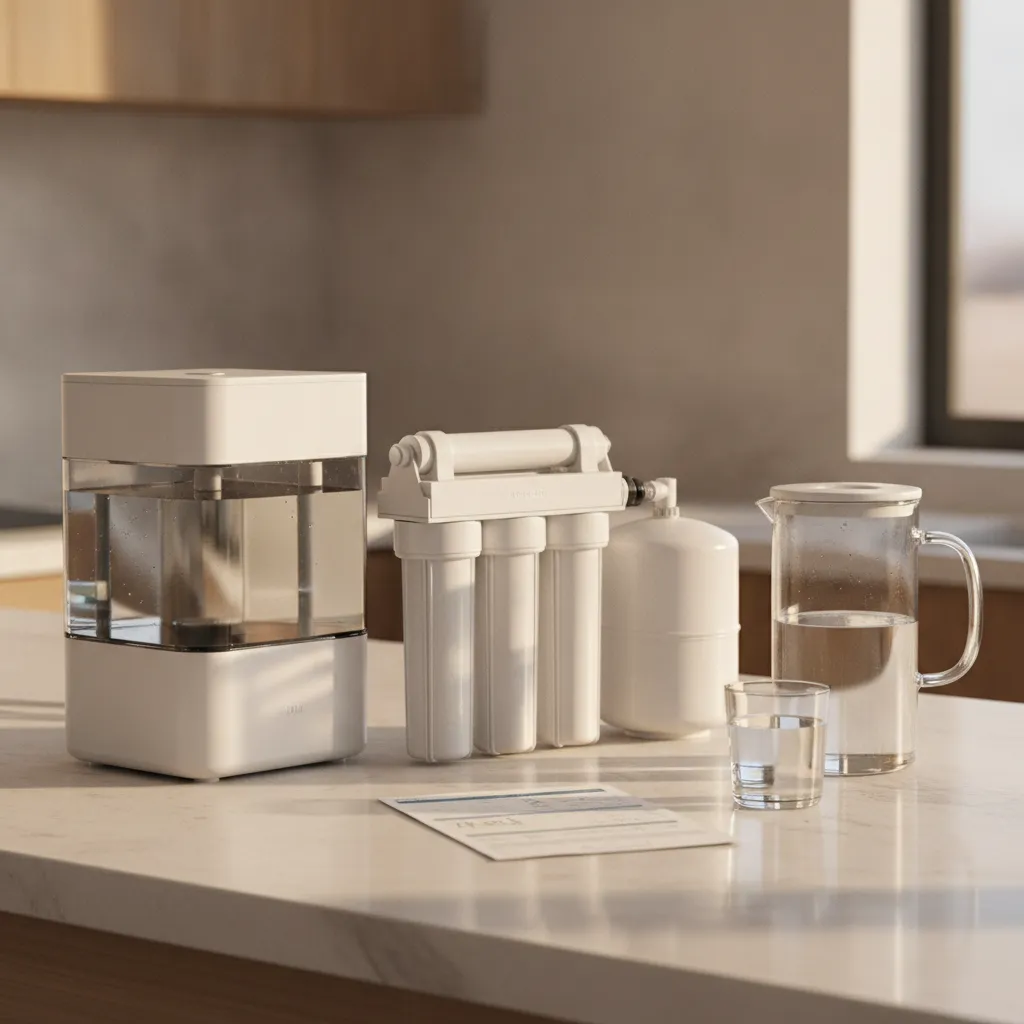
Best Water Filters for Chromium-6 Removal 2026: Certified Picks
> Affiliate disclosure: FilterdWaterGuide.com earns a commission from qualifying purchases made through some links in this article, including Amazon links. We have no affiliate relationship with Pentair, Brondell, or RKIN; buying direct from them earns us nothing. Products are ranked on certification data and independent sources, not commission rates.
Chromium-6 is dissolved, invisible, and legal at levels the health research says you shouldn’t ignore. There is no federal limit for it. The EPA regulates total chromium at 100 parts per billion (ppb), a number from 1991 that lumps the carcinogenic hexavalent form in with the harmless trivalent one.
California is the only state with its own chromium-6 limit: 10 ppb, effective October 1, 2024. California’s public health goal is 0.02 ppb. That’s the gap you’re working with.
It shows up in real city water. Nine of our 55 metro water reports flag it, from El Paso at about 2.4 ppb to Sacramento, where the system average is 4.7 ppb and some groundwater wells run higher, to Omaha, Raleigh, and Los Angeles. All legal. All above the health goal.
Here’s the short version. A standard carbon pitcher or fridge filter is the wrong tool. The best water filters for chromium-6 removal hold a certified claim for hexavalent chromium by name: reverse osmosis under NSF/ANSI 58, or a filter with chromium-6 listed under NSF/ANSI 53. That’s a short list, and a couple of popular RO systems don’t make it.
For the chemistry and health side, read Kenji’s chromium-6 in drinking water explainer. This guide is the other half: what to buy.
Quick Picks
- Best Overall: AquaTru Classic Countertop RO: IAPMO-certified to NSF/ANSI 58 for hexavalent chromium, 97.2% average reduction on its data sheet, zero plumbing.
- Best Under-Sink: Pentair FreshPoint GRO-575B: NSF International lists hexavalent chromium under NSF/ANSI 58 for this unit. The most checkable claim in the category.
- Best Under-Sink Runner-Up: Brondell Capella RC250: WQA Gold Seal NSF/ANSI 58 listing names hexavalent chromium; 98.5% average reduction on its data sheet.
- Best Compact Countertop: RKIN Zero Installation Purifier: IAPMO NSF/ANSI 58 claim for hexavalent chromium in a smaller countertop box.
- Best Budget: ZeroWater 5-Stage Pitcher: IAPMO-certified to NSF/ANSI 53 for hexavalent chromium, 99.4% on its data sheet. Cheap to buy, not cheap to run.
How We Picked (and What We Cut)
Every pick holds a current certification from one of the three ANSI-accredited certifiers (NSF International, WQA Gold Seal, or IAPMO R&T) with hexavalent chromium named in the certified claim set. Not “chromium.” Not “heavy metals.” Hexavalent. We seeded candidates from our merit roster, not our affiliate list, then checked each claim against the certifier listing or the manufacturer’s Performance Data Sheet, which has to match the listing. That’s the whole test for the best water filters for chromium-6 removal: the claim, in writing, from a certifier.
Certification is not the same as “tested to NSF standards.” A one-time lab test proves a filter passed once. Certification means the certifier retests, audits the factory, and can pull the listing. Only the certified claim counts here. If you want the full rundown on what those certifiers do, our water filter certifications explainer covers it.
Here’s what got cut, and why it matters:
- iSpring RCC7AK. A popular, well-built RO system with a real NSF/ANSI 58 certification from NSF International. But we opened its NSF listing, and the certified claim set for the current RCC7AK-BN and RCC7AK-BLK models names trivalent chromium, not hexavalent (the older plain RCC7AK row covers TDS only). RO membranes do reject chromium-6 as a matter of physics. “Should work” isn’t the bar here. If chromium-6 is your reason for buying, buy a unit with the claim in writing.
- Waterdrop G3P800. Our top pick in the best reverse osmosis systems guide, IAPMO-certified to NSF/ANSI 42, 53, 58, and 372. Retailer listings disagree about whether hexavalent chromium is on its certified claim list, and we couldn’t get the Performance Data Sheet to settle it. Until we can, it’s not in a chromium-6 guide.
- APEC ROES-50. Its WQA NSF/ANSI 58 certification covers TDS reduction only.
- Standard carbon pitchers and faucet filters. Chromium-6 sits in water as a dissolved, negatively charged ion (chromate). Ordinary activated carbon isn’t built to hold it, and none of the mainstream carbon pitchers carry a certified claim for it.
AquaTru Classic Countertop RO: Best Overall
A certified chromium-6 fix you can plug in on day one.
| Spec | Detail |
|---|---|
| Price | $475 direct as of September 23, 2026 (Classic Smart $525); AquaTru ran it at $359 in August, and Amazon pricing moves independently |
| Form factor | Countertop RO, batch-style (fill the tap tank, dispense from the clean tank) |
| Certifications | IAPMO R&T to NSF/ANSI 42, 53, 58, 401 (plus 372 for materials) |
| Chromium-6 claim | NSF/ANSI 58: challenge 0.30 mg/L (300 ppb), minimum 94.3%, average 97.2% reduction |
| Other certified claims include | Lead, arsenic (pentavalent), fluoride, nitrate, perchlorate, trivalent chromium, barium, copper, radium, selenium, PFOA/PFOS |
| Filter life | Pre/carbon and VOC filters every 600 gallons; RO membrane every 1,200 gallons |
| Annual filter cost | About $110/year at AquaTru’s direct prices (as checked for our August 2026 review) |
| Water limits | Rated for hardness up to 10 gpg; soften harder water first |
Why we recommend it: Chromium-6 problems land hardest on renters and people who don’t want a drill anywhere near their sink. The AquaTru Classic serves both. Its current Performance Data Sheet (rev. 10.24.R4, linked from AquaTru’s product page) lists hexavalent chromium under NSF/ANSI 58, and the certifier is IAPMO R&T, one of the three accredited bodies. At a 300 ppb challenge, it averaged 97.2% reduction. One thing to say plainly: IAPMO is not NSF International, so you won’t find this unit in NSF’s own database. Check IAPMO’s listing directory instead. Our full AquaTru Classic review covers the day-to-day ownership side.
Best for: Renters, anyone with a crowded sink cabinet, and households that want protection this week while they figure out anything bigger.
Installation reality: None. Set it on the counter, plug it in, fill the tap tank. No compression fittings, no landlord conversation.
Where it breaks:
- It’s a batch unit. You fill the tap tank and empty the reject water yourself. If nobody in the house keeps up with that, the filter isn’t protecting anyone.
- The data sheet caps inlet hardness at 10 gpg (171 mg/L). Several chromium-6 metros, especially in the desert Southwest, run hard water. Above that line, scale plugs the membrane unless the water is softened first. Check your city’s hardness number before you buy.
Our rating: 4.5/5
Pentair FreshPoint GRO-575B: Best Under-Sink
The chromium-6 claim you can look up in NSF International’s own database.
| Spec | Detail |
|---|---|
| Price | Check current price; sold through Pentair and plumbing retailers |
| Form factor | Under-sink RO, 4.4-gallon storage tank, air-gap faucet |
| Certifications | NSF International to NSF/ANSI 42, 53, 58 and CSA B483.1; separately IAPMO-certified to NSF/ANSI 53 for Total PFAS |
| Chromium-6 claim | Hexavalent chromium named on the NSF/ANSI 58 claim list |
| Other certified claims include | Lead, arsenic (pentavalent), fluoride, barium, cadmium, trivalent chromium, copper, radium, selenium, TDS |
| Filter life | Pre/post filters yearly; RO membrane every 18 months (675-gallon rated capacity) |
| Production | 30.57 gallons per day system rate (Pentair spec sheet) |
Why we recommend it: If you want the shortest chain between a claim and a record anyone can pull up, this is it. Pentair’s 2025 spec sheet states the GRO-575B is certified by NSF International to NSF/ANSI 42, 53, and 58 and lists hexavalent chromium among its reductions. We opened the listing in NSF’s certified product database ourselves, and hexavalent chromium is on the GRO-575B’s Standard 58 row. The claim set is broad: chromium-6, lead, arsenic V, fluoride, radium, and more, plus a separate IAPMO certification for total PFAS. The PFAS cert belongs to the 575. The similarly named 475 doesn’t carry it, so check the model number on the box.
Best for: Homeowners who want a permanent, plumbed-in chromium-6 fix at the kitchen tap and value a database-checkable claim over a low price.
Installation reality: Standard under-sink RO: cold-line tee, dedicated faucet, drain saddle for the reject line, and room for a tank. Use compression fittings, not a saddle valve on the supply. A handy homeowner can do it in an afternoon. If you’ve never drilled a countertop or sink deck, hire it out.
Where it breaks:
- We couldn’t find a published chromium-6 reduction percentage for this unit, only the certified claim. You’re trusting that it met the NSF/ANSI 58 pass line, which it did, but you can’t compare its number side by side with the AquaTru or Capella.
- Thin retail presence and no Amazon listing we could verify. You’ll likely buy through a plumbing supplier, and support routes through dealers. We earn nothing on it, which is fine. That’s not the test.
Buy from Pentair: no affiliate relationship
Our rating: 4.5/5
Brondell Capella RC250: Best Under-Sink Runner-Up
The best documented chromium-6 number of any installed system here.
| Spec | Detail |
|---|---|
| Price | $329.99 list direct as of September 22, 2026 (Brondell runs sales) |
| Form factor | Under-sink RO, 3-stage, 3.2-gallon tank |
| Certifications | WQA Gold Seal to NSF/ANSI 42, 53, 58, 401 (58 and 53 rows confirmed on WQA’s database) |
| Chromium-6 claim | NSF/ANSI 58: 98.5% average reduction at a 0.3 mg/L challenge |
| Other certified claims include | Lead, PFOA/PFOS, arsenic V, fluoride, radium, barium, cadmium, selenium, TDS |
| Filter life | Carbon filters every 6 months or 300 gallons; RO membrane every 24 months |
| Annual filter cost | About $205/year at Brondell’s direct prices |
| Production | 21.9 gallons per day; 29.1% efficiency rating on the data sheet |
Why we recommend it: The WQA’s own NSF/ANSI 58 listing for the Capella names hexavalent chromium, alongside arsenic V, fluoride, lead, and radium. Its Performance Data Sheet reports a 98.5% average reduction, the highest published RO number in this guide. Add WQA certification for lead and PFOA/PFOS under Standard 53, and it covers most of what sends people to RO in the first place. Elena’s Capella RC250 review digs into the ownership costs.
Best for: Homeowners who want installed RO with a published chromium-6 number and don’t need a lot of water per day.
Installation reality: Same afternoon job as any tank RO: cold-line tee, faucet hole at least 1 inch, drain connection, tank space. The twist-and-seal filters make changes quick once it’s in.
Where it breaks:
- The filters are proprietary and pricey. About $205 a year at Brondell’s prices, and you can’t shop around for generics. By year two it costs more to own than the AquaTru, and the gap keeps widening.
- It’s slow. 21.9 gallons a day of production and a 29.1% efficiency rating on its own data sheet. That’s fine for drinking and cooking for two or three people, not for filling pots all day.
Buy Direct from Brondell (no affiliate relationship) | Check on Amazon
Our rating: 4.3/5
RKIN Zero Installation Purifier: Best Compact Countertop
The other certified countertop RO, in a smaller box.
| Spec | Detail |
|---|---|
| Price | $369.95 direct as of September 23, 2026 (list $489.95) |
| Form factor | Countertop RO, batch-style; about half a gallon per cycle |
| Certifications | IAPMO R&T to NSF/ANSI 58 |
| Chromium-6 claim | Hexavalent chromium named in the NSF/ANSI 58 claim set |
| Other certified claims | TDS, fluoride, lead, PFOA/PFOS, trivalent chromium |
| Editions | AlcaPure (adds minerals back) or OnliPure (zero TDS) |
| Warranty | 1-year satisfaction guarantee |
Why we recommend it: Besides the AquaTru, this is the only countertop RO we know of with a certified hexavalent chromium claim. RKIN states the unit is certified by IAPMO R&T to NSF/ANSI 58 for TDS, fluoride, lead, PFOA/PFOS, and both chromium species. We could not open the IAPMO listing itself, so that claim rests on RKIN’s published certification statement. It works like a coffee maker: fill the bottom reservoir from the tap, push a button, and RKIN says you get about half a gallon of treated water in roughly 15 minutes. It’s a real option if your counter can’t spare the AquaTru’s footprint.
Best for: Small apartments, dorms, offices, and RVs where you want a certified chromium-6 claim and don’t need a lot of water at once.
Installation reality: None. It sits on the counter and plugs in.
Where it breaks:
- Narrow certification. It’s certified to NSF/ANSI 58 only, with no arsenic claim and no Standard 53 or 401 coverage. If your water test shows arsenic too, which happens in the desert metros, the AquaTru is the better buy.
- We couldn’t find a published chromium-6 reduction percentage, so there’s no number to compare. And half a gallon per cycle means a lot of button-pushing for a family.
- Availability is patchy. The Amazon listing for the AlcaPure edition read “currently unavailable” when we checked, so buying direct from RKIN is the reliable route.
Buy Direct from RKIN (no affiliate relationship)
Our rating: 4/5
ZeroWater 5-Stage Pitcher: Best Budget
The one pitcher with a certified chromium-6 claim. Cheap to buy, expensive to feed.
| Spec | Detail |
|---|---|
| Price | Low up front; check current price |
| Form factor | Pitcher / dispenser (10-cup pitchers and larger dispensers share the filter) |
| Certifications | IAPMO R&T to NSF/ANSI 42 and 53 |
| Chromium-6 claim | NSF/ANSI 53: 99.4% (pH 6.5) and 99.5% (pH 8.5) reduction at a 0.3 mg/L challenge |
| Other certified claims | Lead, mercury, PFOA/PFOS, chlorine |
| Certified filter life | 15 gallons per filter (Performance Data Sheet, April 2026) |
Why we recommend it: ZeroWater doesn’t rely on carbon alone. Its filter includes mixed-bed ion exchange resin, which pulls charged ions like chromate out of the water. That’s why it can carry a claim other pitchers can’t. The April 2026 Performance Data Sheet shows IAPMO certification to NSF/ANSI 53 for hexavalent chromium at 99.4% to 99.5% reduction, plus lead and PFOA/PFOS. If you can’t install anything and can’t spend a few hundred dollars right now, this is the certified entry point.
Best for: Renters and tight budgets, as a stopgap or for a household that drinks modest amounts of water.
Installation reality: Fill it and put it in the fridge.
Where it breaks:
- The certified filter life is 15 gallons. That’s the number the certification rests on. A family drinking a gallon a day burns through one filter every two weeks, and the filter cost adds up fast. Price the replacements before you buy the pitcher.
- Harder or mineral-heavy water uses up the ion exchange resin faster, so real-world life can be even shorter. ZeroWater includes a TDS meter so you can see when the filter is spent. Use it. And the stripped-mineral taste isn’t for everybody.
Our rating: 4/5
Comparison Table
| Product | Form Factor | Certifier | Chromium-6 Standard | Published Cr-6 Reduction | Price | Our Rating |
|---|---|---|---|---|---|---|
| AquaTru Classic | Countertop RO | IAPMO R&T | NSF/ANSI 58 | 97.2% avg | $475 direct (Sep 2026) | 4.5/5 |
| Pentair GRO-575B | Under-sink RO | NSF International | NSF/ANSI 58 | Not published | Varies by retailer | 4.5/5 |
| Brondell Capella RC250 | Under-sink RO | WQA Gold Seal | NSF/ANSI 58 | 98.5% avg | $329.99 list (Sep 2026) | 4.3/5 |
| RKIN Zero Installation Purifier | Countertop RO | IAPMO R&T | NSF/ANSI 58 | Not published | $369.95 direct (Sep 2026) | 4/5 |
| ZeroWater 5-Stage | Pitcher | IAPMO R&T | NSF/ANSI 53 | 99.4–99.5% | Low up front; 15-gal filters | 4/5 |
How to Choose a Chromium-6 Filter
Test first, and ask for chromium-6 by name
Your utility’s annual Consumer Confidence Report may only list total chromium, which doesn’t tell you how much is the hexavalent form. Start with the report, then look up your city in our metro guides; ours list chromium-6 where it’s been measured. If you’re on a private well or want your own tap number, a lab panel like Tap Score can report chromium-6 separately. Our home water testing guide covers the options.
Buy on the named claim, not the standard number
“NSF/ANSI 58 certified” tells you the RO system passed a test for something. It doesn’t tell you what. The iSpring RCC7AK is the clearest example: certified to 58, with trivalent chromium on the list and hexavalent chromium missing. Open the Performance Data Sheet and look for the words “hexavalent chromium” or “chromium (VI).” If they’re not there, it isn’t a certified chromium-6 filter.
Understand what the certification test actually proves
Here’s what actually happens in the lab. The certification test spikes water with 300 ppb of chromium-6, and the filter has to bring it down to 100 ppb or less. Your tap water probably carries somewhere between a few hundredths of a ppb and a few ppb.
So the pass line itself tells you almost nothing about your glass. The percentage is the useful number. It’s why we list published reduction figures where they exist.
Run the math on Sacramento’s system average of 4.7 ppb. At the AquaTru’s 97.2% average, that would land around 0.13 ppb. That’s a big cut, and still above the 0.02 ppb health goal.
Certification doesn’t test performance at those low concentrations, so treat that as an estimate, not a promise. The honest takeaway: a certified filter cuts your exposure dramatically. It won’t guarantee zero.
Countertop vs. under-sink
Countertop RO (AquaTru, RKIN) needs no plumbing, moves with you, and works for renters. You pay for that with hand-filling and a daily routine. Under-sink RO (Pentair, Capella) is set-and-forget at a dedicated faucet, but it needs a cold-line tee, a drain connection, cabinet space for a tank, and ideally a plumber if you’ve never done it. Our RO systems guide goes deeper on the trade-offs.
Check your hardness before you buy RO
Hard water shortens membrane life on every RO system, and the AquaTru’s data sheet caps inlet hardness at 10 gpg. Chromium-6 and hard water often travel together in the same groundwater-heavy regions. If your city report shows high hardness, budget for more frequent membrane changes or a softener ahead of the RO. Softeners themselves do nothing for chromium-6; they swap out positively charged minerals, and chromate is negatively charged.
Whole-house treatment is usually not the move
The health research on chromium-6 in water is built around drinking it. That’s why point-of-use treatment at the kitchen tap is the standard answer, at a fraction of the cost of treating every gallon that flushes a toilet. Whole-house chromium-6 removal is specialized anion-exchange or RO equipment sized by a pro after testing. If you’re looking at that, start with a lab test and a local water treatment specialist, not a box off the internet.
Replacement filters are the real cost
Every pick here uses proprietary cartridges. A chromium-6 filter you stop maintaining keeps pouring water while its certified performance quietly runs out. Figure out the year-two cost before you buy, and stick to the schedule. Our filter replacement guide explains why.
FAQ
Does a Brita or PUR pitcher remove chromium-6?
Not with a certified claim. Standard carbon pitchers aren’t certified for hexavalent chromium, and carbon isn’t designed to hold the dissolved chromate ion. The exception in pitcher form is ZeroWater, whose ion exchange filter is IAPMO-certified to NSF/ANSI 53 for chromium-6. If a pitcher’s box implies chromium removal, look for “hexavalent chromium” on its Performance Data Sheet. If it isn’t there, the claim isn’t certified.
Does boiling water remove chromium-6?
No. Boiling evaporates water and leaves dissolved metals behind, so the concentration goes up slightly. Letting water sit doesn’t help either. Chromium-6 comes out only through a barrier or media built for it: reverse osmosis, or an ion exchange filter certified for it.
If a filter is certified for lead, does it also remove chromium-6?
Not necessarily. Lead and chromium-6 are separate claims, each with its own test. Plenty of excellent lead filters, including several in our lead removal guide, have no chromium-6 claim at all. Check the claim list, not the standard number.
Do these picks also handle PFAS?
Mostly, yes. The AquaTru Classic, Brondell Capella, RKIN, and ZeroWater carry certified PFOA/PFOS claims, and the Pentair GRO-575B holds a separate IAPMO certification for total PFAS. Most certified PFAS claims were tested against a pass line well above the EPA’s 4 parts per trillion limit, so read our PFAS filter guide if PFAS is your bigger concern.
What level of chromium-6 is safe?
No federal chromium-6 limit exists. California enforces 10 ppb, and its public health goal is 0.02 ppb, the level linked to no more than one extra cancer case per million people over a lifetime. The EPA finalized an updated IRIS health assessment of chromium-6 in August 2024 and, under a settlement, must decide by August 1, 2027 whether to revise the federal chromium standard. Until then, how much risk you accept is your call.
Does RO remove chromium-6 even without a specific certified claim?
An RO membrane will reject most dissolved chromium-6 because of how the technology works. But performance varies with the membrane, pressure, and maintenance, and only a certified claim means someone tested that specific unit for it. For a chromium-6 purchase, pay for the claim in writing.
Is chromium-6 also a problem on well water?
It can be. Natural chromium-6 comes from certain rock formations, so private wells in affected geology can carry it, and nobody tests a private well unless you do. Test your well water specifically for hexavalent chromium, and see our well water testing guide for how to go about it.
Final Verdict
For most people with a chromium-6 number worth acting on, the AquaTru Classic is the buy: an IAPMO-certified hexavalent chromium claim with a 97.2% average reduction, and it works the day it arrives. If you want it plumbed in, the Pentair FreshPoint GRO-575B carries the most checkable claim, listed by NSF International itself, and the Brondell Capella RC250 posts the best published number at 98.5%.
Short on counter space? The RKIN Zero Installation Purifier. Short on budget? The ZeroWater pitcher gets you a certified claim for the price of a pitcher, as long as you keep buying filters. Those are the best water filters for chromium-6 removal we can stand behind today. Whatever you pick, test first. If arsenic shows up in the same test, our arsenic filter guide covers that overlap.
Sources
- IAPMO R&T Product Listing Directory: AquaTru, RKIN, ZeroWater certifications (directory not opened for this guide; claims rest on each manufacturer’s Performance Data Sheet or certification statement)
- NSF International Certified Drinking Water Treatment Units Database: Pentair FreshPoint GRO-575B Standard 58 row (hexavalent chromium named) and iSpring RCC7AK-BN/BLK Standard 58 row (trivalent chromium only), both opened September 23, 2026
- WQA Gold Seal product database (find.wqa.org): Brondell Capella RC250 NSF/ANSI 53 and 58 rows (opened September 22, 2026)
- AquaTru Classic (AT2000 series) Performance Data Sheet (rev. 10.24.R4, linked from the product page): NSF/ANSI 58 hexavalent chromium minimum 94.3% / average 97.2%; arsenic V, nitrate, perchlorate, lead, fluoride rows; hardness limit 10 gpg; filter intervals
- Pentair FreshPoint GRO-575B Specification Sheet (2025): NSF International 42/53/58 + CSA B483.1; IAPMO NSF/ANSI 53 total PFAS; hexavalent chromium on reduction list; 30.57 gpd; 675-gallon capacity
- Brondell Capella RC250 Owner’s Manual / Performance Data Sheet: WQA 42/53/58/401; hexavalent chromium 98.5% average reduction; 21.9 gpd; 29.1% efficiency
- RKIN Zero Installation Purifier product page: IAPMO NSF/ANSI 58 claim list; $369.95 as of September 23, 2026
- ZeroWater Performance Data Sheet (April 22, 2026): IAPMO NSF/ANSI 53 hexavalent chromium 99.4–99.5%; 15-gallon rated life
- TapWaterData: chromium-6 filter listing review: independent read of the iSpring RCC7AK and APEC ROES-50 NSF/ANSI 58 claim lists
- California State Water Resources Control Board: Hexavalent Chromium: 10 µg/L MCL effective October 1, 2024; 0.02 µg/L public health goal (2011)
- US EPA: Chromium in Drinking Water: total chromium MCL 0.1 mg/L (100 ppb), promulgated 1991
- US EPA IRIS Toxicological Review of Hexavalent Chromium (Final, August 2024)
- ASDWA: EPA Releases Final IRIS Review of Cr(VI): regulatory determination due by August 1, 2027
- FilterdWaterGuide metro water quality reports (El Paso, Sacramento, Omaha, Raleigh, Los Angeles, and others): chromium-6 flagged as a headline contaminant