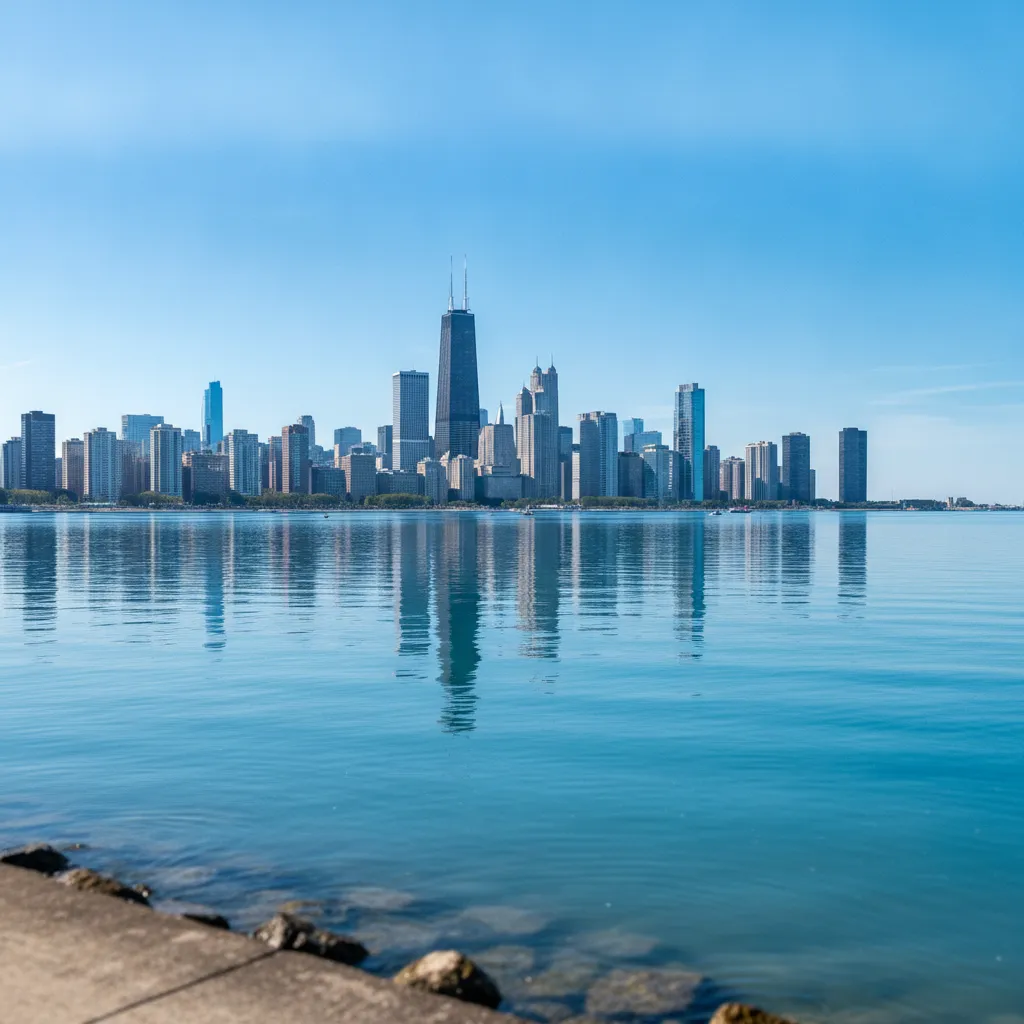
Chicago Water Quality Report 2026: What’s Really in Your Tap Water
QUICK SUMMARY:
- Overall Rating: Poor
- Top 3 Contaminants of Concern: Lead (service line contamination), PFAS, Chloroform
- Recommended Filter: Aquasana Claryum 2-Stage (WQA-certified to NSF/ANSI 53 for lead, under-sink) or ZeroWater 10-Cup (budget pitcher). See full buying guide for comparisons.
- Water Hardness: 7-8 GPG (Hard)
Where Does Chicago Get Its Drinking Water?
Chicago draws its drinking water directly from Lake Michigan. Municipal treatment plants apply conventional processing protocols: coagulation, sedimentation, granular media filtration, and chlorine disinfection — before distribution through the municipal system. Treatment processes function adequately at the plant level.
The structural failure occurs downstream of treatment. Chicago’s water infrastructure is substantially aged. The majority of the distribution system was constructed between 1900 and 1986, and extensive segments rely on service connections that have deteriorated across decades. Chicago is unique among major US cities in that it mandated lead service lines by municipal ordinance until 1986 — the year federal law finally banned lead pipe installation. This aged infrastructure is where Chicago’s water quality degradation concentrates.
What Contaminants Are in Chicago Tap Water?
The Lead Crisis: Chicago Lead in Water
Chicago confronts one of the most severe lead service line problems documented in the United States. The city maintains an estimated 412,000 lead service lines per Chicago DWM’s 2026 inventory — among the highest of any US city. Lead leaches into drinking water as water passes through these corroded pipes, with elevated risk in homes constructed before 1986. This date is critical: Chicago mandated lead service lines by city ordinance until 1986, meaning homes built between 1970 and 1986 — often assumed to be “safe” — carry the same lead service line risk as older construction.
The EPA’s action level for lead is 15 ppb (parts per billion). The Environmental Working Group, applying health-based evidence, recommends 0 ppb because no established safe exposure threshold exists — particularly for children and pregnant individuals. Lead exposure at low concentrations causes irreversible neurological damage, IQ reduction, and developmental delays in pediatric populations.
The distinction matters critically here: Chicago’s lead problem remains invisible in compliance reporting. The city meets EPA standards at the treatment plant. Contamination occurs in the pipes between the distribution mains and individual household taps. If you occupy a pre-1986 Chicago home, your actual lead exposure likely exceeds citywide averages substantially.
Chicago PFAS Drinking Water Concerns
Chicago tap water contains detectable PFAS (per- and polyfluoroalkyl substances) — synthetic compounds found in nonstick cookware, stain-resistant fabrics, and aqueous film-forming foams used in firefighting. The Environmental Working Group’s health-based guideline for total PFAS is 4 ppt (parts per trillion). Chicago residents have documented measurable concentrations exceeding this threshold in multiple municipal supply zones.
Chloroform, a disinfection byproduct, completes the contaminant profile. It appears at concentrations that exceed EWG recommendations but remain within EPA legal limits — illustrating the distinction between compliance and health-protective exposure levels.
Chicago Tap Water Contaminant Summary
| Contaminant | Chicago Level | EPA MCL | EWG Guideline | Health Concern |
|---|---|---|---|---|
| Lead | Variable (0-20+ ppb in some homes) | 15 ppb | 0 ppb | Neurological damage, reduced IQ in children |
| PFAS (Total) | Detectable (~5-15 ppt in some areas) | — | 4 ppt | Cancer risk, immune system effects |
| Chloroform | 5-10 ppb | 80 ppb | 1.5 ppb | Cancer risk |
| Chlorine | 0.5-1.5 ppm | 4 ppm | — | Taste/odor, disinfection byproduct |
Data sources: EWG Tap Water Database; Chicago 2024 Consumer Confidence Report
Here’s what the data actually shows: Chicago’s municipal water meets EPA compliance standards at the treatment facility, but lead service lines represent the actual contamination vector for individual households. Unless your service line has undergone replacement, you likely experience some measurable lead exposure.
Chicago’s Lead Service Line Replacement Program
Chicago initiated a replacement program with rebates and financing assistance to offset resident costs for service line replacement from the municipal main to the property boundary. A typical full replacement project costs $15,000–$30,000 — significantly higher than many homeowners expect. The city offers permit fee waivers (approximately $5,000 in value) and financing assistance for qualifying households, but the total project cost remains substantial. Under the EPA’s Lead and Copper Rule Revisions (LCRI), Chicago must complete replacement of all lead service lines within 10 years — targeting approximately 2034–2037 depending on the compliance start date.
Uncertain whether your home contains a lead service line? The Chicago Department of Water Management maintains an interactive map and accepts direct inquiries. Homes constructed before 1986 carry high lead service line probability — not just pre-1950 homes, because Chicago’s lead pipe ordinance extended through 1986.
Chicago Water Hardness
Chicago tap water measures 7-8 GPG (grains per gallon) — classifying as hard water. This hardness manifests as:
- Mineral scale accumulation on plumbing fixtures and inside water heaters and dishwashers
- Reduced soap efficacy — soap will not lather effectively
- Elevated detergent requirements for laundry operations
- Accelerated appliance degradation from mineral deposits within heat exchangers
Hard water poses no toxicological risk, but it creates operational inconvenience. Many Chicago residents install water softeners or conditioning filters to reduce hardness below the problematic range.
Best Chicago Water Filters for Lead and PFAS
Three evidence-supported options for Chicago water quality challenges, arranged from most to least comprehensive:
Whole House: SpringWell CF Whole House Filter
The SpringWell employs catalytic carbon media to target chlorine, chloramines, and organic contaminants at the point of entry — treating water before it reaches any household fixture.
Critical clarification: The SpringWell CF does NOT remove lead. It carries NSF/ANSI 42 certification only — chlorine, taste, and odor reduction. NSF 42 does not certify lead removal. NSF/ANSI 53 is required for verified lead reduction, and the SpringWell CF does not hold that certification. In a city with 412,000 lead service lines, this distinction is safety-critical. If lead is your concern — and in Chicago it should be — pair the SpringWell CF with a WQA-certified (NSF/ANSI 53) point-of-use filter like the Aquasana Claryum 2-Stage at your drinking tap. The SpringWell handles whole-house chlorine/chloramine reduction; the under-sink filter handles lead where you actually drink.
Certifications: NSF/ANSI 42 certification (chlorine, taste, odor reduction). This represents verified third-party certification — an independent laboratory assessed the product and confirmed performance claims.
Engineering trade-offs: Professional installation requires $1,500-$2,500 capital investment. The system does not capture every PFAS structural variant. Does not address lead. System maintenance involves backflushing every 6 months.
Buy from SpringWell | Check on Amazon
Under Sink: Aquasana Claryum 2-Stage
A compact under-sink filtration system addressing lead, PFAS, chlorine, and chloroform — encompassing all primary Chicago contaminants. The multi-stage system integrates activated carbon and ion exchange, achieving up to 99% lead reduction. Our Best Under-Sink Water Filters 2026 guide compares performance across competing models.
This option suits renters or households preferring point-of-use protection without full plumbing system modification. Installation requires 10-15 minutes using basic hand tools.
Certifications: WQA-certified to NSF/ANSI 53 (lead removal, health claims) — independent third-party verification of performance, not manufacturer self-testing.
Engineering trade-offs: The Claryum 2-Stage addresses only one tap location. Shower and bathing water remain unfiltered (though ingestion pathways represent substantially greater PFAS exposure than dermal absorption). Under-sink installation demands adequate cabinet clearance and basic plumbing connectors. Replacement cartridges cost approximately $140 per pair every six months — a higher per-gallon cost than whole-house systems.
Buy Direct from Aquasana | Check on Amazon
Budget Pitcher: ZeroWater 10-Cup
The ZeroWater 10-Cup operates a five-stage filtration cascade removing up to 99% of lead and total dissolved solids. It tests water to zero Total Dissolved Solids (TDS), meaning dissolved lead and PFAS compounds are captured in the filter media. Our guide to pitcher filter PFAS performance provides additional detail.
A pitcher-based system will not achieve whole-home coverage, but for drinking and cooking water within budget constraints, it performs adequately.
Certifications: IAPMO-certified to NSF/ANSI 42, 53 (lead removal, health claims)
Engineering trade-offs: This represents the highest per-gallon cost among pitcher products. Cartridge life is limited — 2-3 months depending on influent water quality. Filtration rate is slow: 4-5 minutes per pitcher fill cycle. Shower and appliance water remains unfiltered.
Buy from ZeroWater | Check on Amazon
Regardless of filter selection, replace cartridges on manufacturer schedules. An exhausted filter provides minimal contamination reduction.
How to Test Your Chicago Tap Water
Chicago’s Consumer Confidence Report presents citywide aggregated data. Your specific tap water quality may diverge substantially from system-wide averages depending on your local pipes, your neighborhood’s infrastructure age, and your service line composition. Lead concentrations vary dramatically from residence to residence.
Obtain a certified laboratory test. Tap Score testing kits represent the standard approach — mail-in sample collection, laboratory analysis, detailed results with interpretation. A lead and PFAS panel for Chicago addresses costs $130-$180 and requires 1-2 weeks for completion.
Disregard hardware store test strips. They provide qualitative detection only — confirming lead presence without quantifying concentration. Such data lacks utility for treatment decisions. Our water testing guide explains testing methodology in detail.
Renting without landlord cooperation for testing? Request documentation of plumbing materials. Homes with documented service line replacement carry substantially reduced lead risk.
For broader context on US tap water safety nationally, consult our analysis of tap water quality data.
Frequently Asked Questions
Is Chicago tap water safe to drink?
Technically, yes — at the treatment plant. However, with approximately 412,000 lead service lines in the distribution system, “safe” depends entirely on your home’s plumbing infrastructure. Pre-1986 homes with original lead service lines almost certainly have lead concentrations above EWG health guidelines — and in Chicago, that includes homes built through 1986 due to the city’s lead pipe ordinance. Conduct laboratory testing, investigate whether you qualify for the city’s service line replacement assistance, and install a lead-removing filter (NSF 53 certified) as interim protection.
Does Chicago water have PFAS?
Confirmed. PFAS concentrations in Chicago drinking water exceed EWG’s 4 ppt health-based recommendation in multiple supply zones. These compounds accumulate in human tissues and are epidemiologically linked to cancer and immune system dysfunction. Activated carbon filters and reverse osmosis systems reduce PFAS, though effectiveness varies by system design. Select filters carrying NSF/ANSI 53 certification with explicit PFAS reduction claims.
How hard is Chicago water?
Chicago tap water hardness measures 7-8 GPG — solidly within the “hard” classification. This presents no health concern, but it produces scale deposits on all fixtures, diminishes soap effectiveness, and reduces appliance lifespans through mineral accumulation. A water softener or whole-house conditioning filter addresses hardness. Pitcher filters provide partial benefit for drinking water applications.
Do I need a water filter in Chicago?
If your home predates 1986 and retains an original lead service line, filtration is not discretionary — it represents an essential intervention until service line replacement occurs. Newer homes benefit from filtration as well: filters reduce chlorine taste, minimize PFAS ingestion, and improve overall water palatability. If budget is constrained, a pitcher filter addresses drinking water. Whole-house systems provide comprehensive protection.
Sources Cited
- EWG Tap Water Database — Chicago, Illinois
- Chicago Department of Water Management — 2024 Consumer Confidence Report
- EPA SDWIS (Safe Drinking Water Information System) — Chicago Public Water System
- U.S. EPA — Lead Service Line Replacement Program Guidance
- NSF International — NSF/ANSI 53 Certification Database