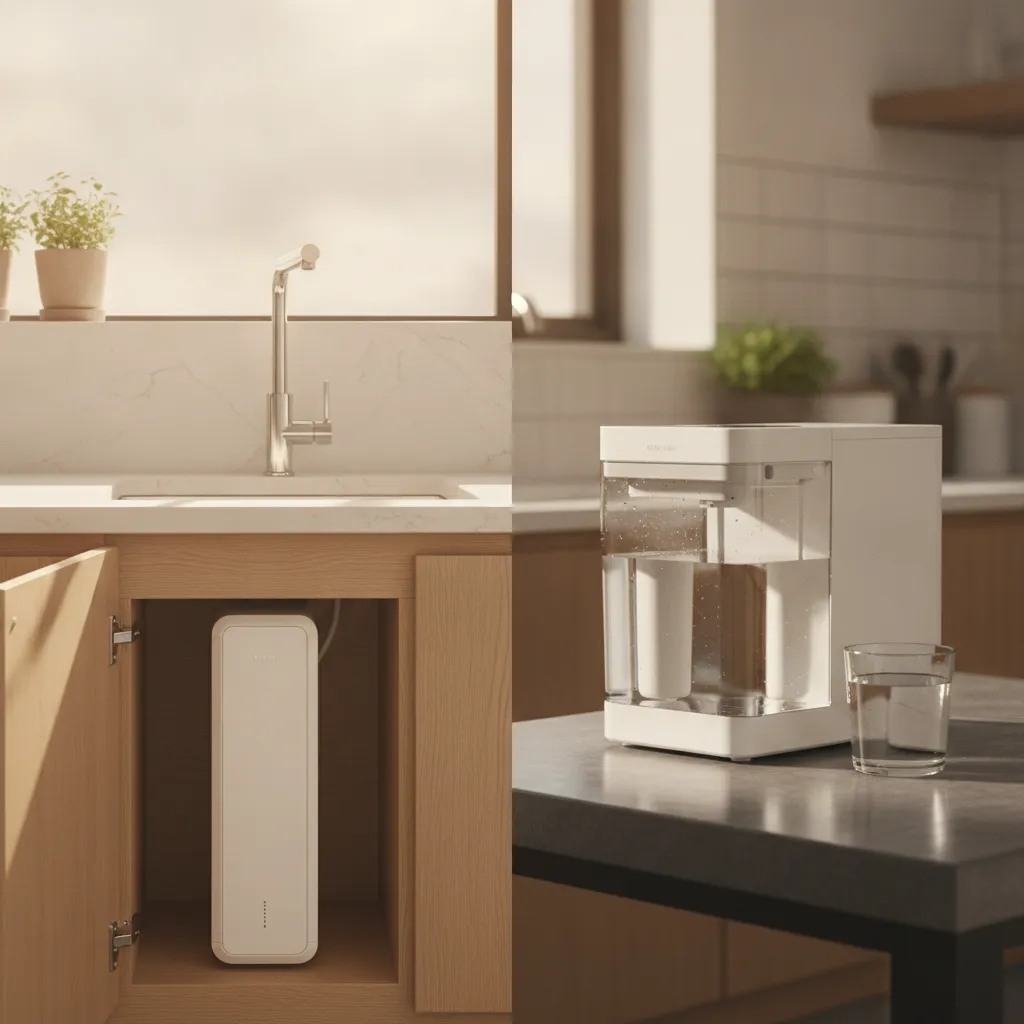
Waterdrop G3P800 vs AquaTru Classic: Which RO Wins in 2026?
> Affiliate disclosure: FilterdWaterGuide.com earns a commission from qualifying purchases made through some links in this article, including Waterdrop and Amazon links. We have no affiliate relationship with AquaTru; if you buy direct from AquaTru’s site through our link, we earn nothing. Products are evaluated on certification data and real-world performance, not commission rates.
You’ve narrowed it down to two reverse osmosis systems that both hold real third-party certification, and now you’re stuck on the part that actually matters: one goes under the sink and one sits on the counter. That’s not a small difference. It changes what you pay, what you install, and what you do every single day to get a glass of water.
Here’s the short version. The Waterdrop G3P800 is the better appliance if you own your home and can plumb it in. It makes certified RO water on demand, through its own faucet, and you never think about it. The AquaTru Classic is the better appliance if you can’t or won’t touch your plumbing. It costs about half as much up front, carries a broader certified contaminant list, and it moves with you. The trade is a refill routine you’ll live with every day.
Below is the field version of that answer: certifications side by side, what each one is like to live with, the install realities, and the five-year math.
Quick Verdict
Both systems earn 4.5/5 in our individual reviews, and neither one is a bad buy. They’re built for different houses.
Buy the Waterdrop G3P800 if you can install under the sink, you have an outlet in the cabinet (or can add one), and your household drinks and cooks with filtered water all day. It’s our top RO pick overall.
Buy the AquaTru Classic if you rent, your under-sink cabinet is full, or you want certified RO water in a house you’ll leave in two years. It’s the strongest countertop RO we’ve evaluated.
Buy Direct from Waterdrop | Check on Amazon
Check AquaTru Classic on Amazon | Buy Direct from AquaTru (no affiliate relationship)
Side-by-Side Comparison
Prices below are as of September 2026. Both companies run promotions, and AquaTru in particular moves its price around a lot, so check the current number before you buy.
| Factor | Waterdrop G3P800 | AquaTru Classic |
|---|---|---|
| Type | Under-sink tankless RO, dedicated faucet | Countertop RO, fill-and-dispense tanks |
| Price (Sept 2026) | $849 direct and on Amazon; $999 list | $475 direct and on Amazon; promoted as low as $359 in August 2026 |
| Certifier and standards | IAPMO R&T to NSF/ANSI 42, 53, 58, 372 | IAPMO R&T to NSF/ANSI 42, 53, 58, 401 |
| Reduction claims | TDS under Standard 58 and chlorine, taste, odor under 42 confirmed; Waterdrop also lists lead, chromium-6, and PFOA/PFOS under 53 (check the IAPMO listing for the named claims) | 84 contaminants incl. lead, PFOA/PFOS, arsenic, chromium-6, fluoride, nitrate (42/53/58); emerging compounds (401) |
| Production | 800 gallons per day, on demand; Waterdrop says a 6-ounce cup in about 5 seconds | 0.75 gallon per batch; 10 to 15 minutes per gallon |
| Water efficiency | 3:1 pure-to-drain, sent continuously to a drain line | 75% efficiency per AquaTru; concentrate stays in the tap tank and you dump it |
| Installation | Cold-line tap, drain saddle, faucet hole, under-sink outlet | None. Fill tank, plug in |
| Power | Outlet required under the sink; Waterdrop does not publish a wattage on the product page | Standard 120V outlet; about 30 watts when plugged in |
| Footprint | 18.1 x 5.7 x 17.7 in, 32.4 lb, under the cabinet | 12 x 14 x 14 in, about 17 lb, on the counter |
| Filter schedule | CF pre-filter 6 mo; CB carbon 12 mo; RO membrane 24 mo | Pre/carbon 6 mo; VOC carbon 12 mo; RO membrane 24 mo or 1,200 gal |
| Annual filter cost | About $155 to $160 (Waterdrop’s own estimate; Consumer Reports lists $160) | About $110 ($79.95 one-year combo plus a $59.95 membrane every two years) |
| 5-year cost of ownership | About $1,600 to $1,650 | About $900 to $1,075, depending on what you paid for the unit |
| Warranty | 1 year | 1 year, plus a 30-day money-back guarantee |
| Our rating | 4.5/5 | 4.5/5 |
The Certifications: Same Tier, Different Lists
Here’s what actually matters, and it’s the part most comparison pages get wrong. Both of these systems are certified by IAPMO R&T, an ANSI-accredited certification body, to NSF/ANSI standards as complete systems. Neither one is “NSF certified” in the strict sense, because NSF International didn’t do the certifying. IAPMO did. You won’t find either product in NSF’s own database, and that’s not a red flag. The IAPMO listing at pld.iapmo.org carries the same ongoing oversight: factory audits, re-testing, the works.
That puts both systems in the top tier. Plenty of RO units at every price point carry component-level certs on one cartridge, or a one-time “tested to NSF standards” lab claim. Neither of those is certification. These two have full-system paperwork.
Now the differences, because they’re real.
The Waterdrop G3P800 is certified to NSF/ANSI 42, 53, 58, and 372. The listing covers TDS reduction under Standard 58, which is the core performance measure for any RO system, and chlorine, taste, and odor under 42. Waterdrop also lists lead, chromium-6, and PFOA/PFOS under Standard 53. Here’s the catch: IAPMO’s directory won’t load without a browser session, so we couldn’t open the row and read the named claims ourselves this month, and third-party certification trackers disagree on whether PFOA/PFOS is a named claim. If one specific contaminant is the reason you’re buying, pull the listing at pld.iapmo.org or ask Waterdrop for the performance data sheet before you order. Standard 372 is lead-free materials, not contaminant removal, so don’t count it as a performance claim.
Waterdrop also advertises fluoride, arsenic, and nitrate reduction. The membrane handles those by physics, and independent testing backs it up, but we haven’t seen them as named certified claims. Treat them as expected performance, not documented proof.
The AquaTru Classic is certified to NSF/ANSI 42, 53, 58, and 401, covering 84 contaminants. The certified list includes lead, PFOA/PFOS, and chromium-6 like the Waterdrop, and it adds arsenic, fluoride, and nitrate as named certified claims. Standard 401 covers emerging contaminants like pharmaceutical residues, which the Waterdrop isn’t certified for.
So on paper, the AquaTru has the longer certified list. In the field, both membranes are doing the same job on the same contaminants. The difference is which ones the manufacturer paid to have listed. If you specifically need third-party documentation for arsenic, fluoride, or nitrate, the AquaTru’s certificate names them. If your water test shows lead, PFAS, or chromium-6, both are full-system certified RO units built for exactly that, and the AquaTru is the one whose named claims we’ve been able to confirm line by line. That matters more since the EPA set its 4 parts per trillion limit for PFOA and PFOS.
One more thing. If you haven’t tested your water yet, do that before you spend $475 or $849 on anything. A home water test tells you whether RO is even the right tool. Plenty of homes on city water need a certified carbon block, not RO. Our RO vs under-sink filter comparison walks through that decision.
Speed and Daily Use: On Paper vs in the Field
This is where these two stop being comparable, and it’s the reason the G3P800 wins for most homeowners.
On paper, the G3P800 makes 800 gallons per day. Nobody drinks 800 gallons. What that number actually means is there’s no tank and no waiting. You open the faucet and RO water comes out. Waterdrop clocks a 6-ounce cup at about 5 seconds. Fill a stockpot, fill a coffee maker, fill a dog bowl. It doesn’t run out, because it’s making water as fast as you draw it. You install it once and forget it exists until the faucet’s filter-life light comes on.
On paper, the AquaTru Classic holds a gallon of tap water and produces three quarts of purified water per batch. In the field, here’s what actually happens. You fill the back tank from your faucet, slide it in, and press the button. Ten to fifteen minutes later, you have 0.75 gallons in the front tank. You dispense from that with a push button. When it runs low, you refill the back tank and wait again.
For a couple, that’s one or two refills a day. For a family that cooks with filtered water, it’s more. AquaTru’s own help center says a healthy unit takes 10 to 15 minutes per gallon, and if it starts taking longer than 25 minutes, something needs attention, usually descaling. Do the math: if you babysit it all day you could push five or six gallons through it. Realistically, most households treat it as a few batches a day.
There’s a second chore on the AquaTru that matters more than the refills. Reverse osmosis rejects concentrated contaminants. On the G3P800, that concentrate goes down a drain line and you never see it. On the AquaTru, it stays behind in the tap water tank. That leftover water is more concentrated than what came out of your faucet. You have to dump it and rinse the tank regularly, not just top it off forever. It’s not a defect. It’s how a countertop unit avoids a drain connection. But it’s your job now.
Bottom line on daily use: the G3P800 is plumbing. The AquaTru is a small appliance with a routine, like a coffee maker you also have to empty.
Installation Reality
Here’s where the countertop unit earns its keep, and where the under-sink unit bites some people.
Installing the Waterdrop G3P800
The G3P800 is a standard under-sink RO install with one extra requirement. What you’ll need:
- A cold-water connection. Tap the cold line under the sink with the included adapter. Use a compression fitting, not a saddle valve. Local plumbing codes are increasingly banning saddle valves because they leak over time, and any plumber who finds one on a service call is going to look at you sideways.
- A drain connection. The 3:1 ratio means one gallon goes to the drain for every three you make. That needs a drain saddle on the sink trap. This is the step where amateurs cause leaks.
- A faucet hole. The G3P800 uses its own smart faucet. If your sink has a spare hole under a blank cap, you’re set. If not, you’re drilling the sink deck or countertop, and that’s the part most people hire out. Budget $100 to $200 for a plumber to do it.
- An electrical outlet in the cabinet. Tankless RO runs a pump. No outlet under the sink means an electrician visit before the system goes in. Open the cabinet and look before you order.
- Feed pressure between 14.5 and 87 psi. That’s Waterdrop’s published range. Most municipal supplies land inside it. If you’re on a well with a tired pump, check your pressure first.
Most confident DIYers finish this in an afternoon. The tankless housing is 18 by 6 by 18 inches, and it stands upright, so it eats far less cabinet space than a tank system. Waterdrop claims 70% space savings versus a tank unit, and in a condo kitchen that’s a genuine win. At 32 pounds it’s not light, but it sits on the cabinet floor, so weight isn’t a problem.
Installing the AquaTru Classic
Take it out of the box. Set it on the counter. Plug it into a wall outlet. Fill the tank. That’s the install.
The catch is counter space and outlet location. The unit is roughly 12 by 14 by 14 inches and 17 pounds. That’s a small appliance, not a pitcher. It needs to sit near an outlet and near enough to the sink that refilling a gallon tank isn’t a hike. If your kitchen counter is already fighting for space with a coffee maker and an air fryer, measure before you buy. Our countertop filter guide covers smaller options if the footprint kills it.
For renters, this is the whole ballgame. No landlord signoff, no drilling, no plumber, and it goes with you when the lease ends.
Water Waste and Power
Both of these need electricity. Both send water to waste. The numbers are closer than the marketing suggests.
Water waste. The G3P800 runs a 3:1 pure-to-drain ratio: three gallons of clean water for every gallon down the drain. AquaTru says the Classic runs at 75% efficiency, which works out to the same thing, roughly three gallons purified per gallon of concentrate. The difference is where the concentrate goes. On the Waterdrop, it’s plumbed to the drain. On the AquaTru, it’s sitting in the tap tank until you pour it out. Older tank-style RO systems waste three to four gallons per clean gallon, so both of these are a big improvement over what was under most sinks ten years ago.
Power. The AquaTru Classic draws about 30 watts when plugged in, per AquaTru’s own help center. That’s a nightlight and a half. Waterdrop’s product page confirms the G3P800 needs electricity but doesn’t publish a wattage figure. Tankless RO pumps typically draw more than a countertop unit while running, but the pump only runs while you’re drawing water. Neither one is going to show up on your electric bill. The real power question isn’t cost. It’s whether there’s an outlet where the unit needs to sit.
What Each One Costs Over Five Years
The sticker price is the down payment. Here’s the real number, using both manufacturers’ own filter prices as of September 2026.
| Item | Waterdrop G3P800 | AquaTru Classic |
|---|---|---|
| Unit | $849 (direct or Amazon; $999 list) | $475 (direct or Amazon) |
| Pre-filter | CF, $29.99 every 6 months | Pre/carbon, in the combo pack every 6 months |
| Carbon stage | CB, $29.99 every 12 months | VOC carbon, in the combo pack every 12 months |
| Annual combo | Not offered as a single pack; buy individually | One-Year Combo (2 pre/carbon + 1 VOC), $79.95 |
| RO membrane | $139.99 every 24 months | $59.95 every 24 months or 1,200 gallons |
| Filters per year | About $155 to $160 | About $110 |
| 5-year filters | About $775 to $800 | About $550 |
| 5-year total | About $1,600 to $1,650 | About $1,025 at today’s price; $900 to $1,075 across recent promo pricing |
A few things to notice.
The Waterdrop’s filters are proprietary. There are no generic third-party cartridges for the G3P800, so you’re buying from Waterdrop at Waterdrop’s prices for the life of the system. Waterdrop’s own site estimates $155 per year in filters, and Consumer Reports lists $160. The RO membrane is the expensive one at $139.99, and it’s a separate model-specific purchase, not part of any combo pack.
The AquaTru’s filters are also proprietary, but they’re cheaper across the board. The $79.95 one-year combo covers two pre/carbon filters and one VOC filter. The $59.95 membrane every two years brings the annual number to about $110. Over five years that’s roughly $250 less in filters than the Waterdrop, on top of a unit that costs $374 less up front.
One honest caveat on both: filter life estimates assume typical municipal water. Heavy sediment, high chlorine, or hard water shortens pre-filter life on either unit. The G3P800’s faucet tracks filter life, and the AquaTru’s panel does the same. Trust the indicator over the calendar. Our guide on how often to change your water filter covers the schedules.
So the AquaTru saves you roughly $600 over five years. What the Waterdrop buys with that $600 is on-demand water through a real faucet, no refills, no dumping, and a system you don’t think about. Whether that’s worth it depends on how much filtered water your house goes through. For a couple who drinks a few glasses a day, it’s probably not. For a family of four that cooks with it, it usually is.
Where Each One Falls Short
Neither of these is perfect. Here’s what to know going in.
Waterdrop G3P800 weaknesses
- 5-year cost of ownership runs $1,600 or more. That’s about $600 more than the AquaTru and nearly three times a budget tank RO like the APEC ROES-50. You’re paying for tankless speed and full-system certification breadth. Make sure you need both.
- The 1-year warranty is thin for the price. A four-figure appliance with a 1-year warranty is asking for trust it hasn’t backed on paper. Three to five years would match the price tag.
- It needs an outlet under the sink. No outlet, no G3P800, until an electrician adds one.
- The named certified claims are harder to pin down. Fluoride, arsenic, and nitrate aren’t certified claims we can point to, and we couldn’t open the IAPMO row to confirm the Standard 53 list line by line. The membrane handles all of it, but if you need documented third-party proof for one contaminant, ask for the performance data sheet.
- Real install work. Drain saddle, faucet hole, cold-line tap. Doable for a confident DIYer. Not doable for a renter.
AquaTru Classic weaknesses
- The refill-and-dump routine. You fill a 1-gallon tank by hand, wait 10 to 15 minutes, and get three quarts. Then you do it again. And you empty the concentrated leftover water in the tap tank regularly. One reviewer on AquaTru’s own site put it plainly: “refilling 5 times a day is tedious.”
- It’s a countertop appliance. Roughly 12 by 14 by 14 inches and 17 pounds, parked next to an outlet, near the sink. In a small kitchen that’s real estate you’ll feel.
- The 1-year warranty is also thin, though AquaTru does add a 30-day money-back guarantee, which Waterdrop doesn’t match.
- Pricing is a moving target. AquaTru’s price has swung from $359 to $475 within a few weeks in 2026. That’s not a defect in the product, but you can overpay by $100 or more depending on when you click.
- Skip the alkaline filter for health reasons. AquaTru sells a Mineral Boost version for an extra $20 up front and $10 a year in filters. If you want it for taste, fine. Alkaline water is a marketing category, not a health treatment.
Who Should Buy Which
Here’s the decision, and it doesn’t depend on the water. Both systems handle the contaminants that send people to RO. It depends on your house.
Buy the Waterdrop G3P800 if:
- You own your home, or you have a landlord who’ll sign off on an under-sink install.
- There’s an outlet under the sink, or you’re willing to add one.
- Your household goes through a lot of filtered water: cooking, coffee, kids, pets.
- You want to install it once and never think about it again.
- You’re fine with the ownership math: about $1,600 over five years.
Buy the AquaTru Classic if:
- You rent, or you move every couple of years.
- Your under-sink cabinet is full, or there’s no outlet in it and you don’t want to pay an electrician.
- You want a certified list that names arsenic, fluoride, and nitrate specifically.
- Your household drinks a moderate amount of filtered water and someone will keep up the refill routine.
- You want to spend about $475 today and about $1,025 over five years.
Consider something else if:
- Your water test came back with mostly chlorine, lead, and PFAS on a municipal supply. A certified under-sink carbon block does that job for a fraction of the cost and wastes no water. See our best under-sink filters guide.
- You want tankless RO but not the four-figure commitment. The Waterdrop G2 runs about half the G3P800’s price with the same form factor, though its certification is limited to NSF/ANSI 58 and 372. Our best reverse osmosis systems guide covers it and the budget tank options.
Frequently Asked Questions
Is the AquaTru Classic as good as an under-sink RO system?
For contaminant removal, yes. The AquaTru Classic is IAPMO R&T-certified to NSF/ANSI 42, 53, 58, and 401 as a complete system, which is the same tier of certification the Waterdrop G3P800 holds, and its certified list is actually longer. Where it falls behind is convenience: you get three quarts per 10-to-15-minute batch instead of on-demand water from a faucet, and you handle refills and concentrate dumping yourself.
Are the Waterdrop G3P800 and AquaTru Classic NSF certified?
Strictly speaking, no, and the distinction matters. Both are certified by IAPMO R&T, an ANSI-accredited certification body, to NSF/ANSI standards. The standards are NSF standards; the certifying body is IAPMO. Neither product appears in NSF International’s own database, because NSF didn’t certify them. The IAPMO listing carries the same ongoing oversight and is just as legitimate.
Which one removes more contaminants?
On the certified list, the AquaTru Classic. Its IAPMO certification to NSF/ANSI 42, 53, 58, and 401 covers 84 contaminants and names lead, PFOA/PFOS, arsenic, chromium-6, fluoride, and nitrate. The Waterdrop G3P800 is certified to 42, 53, 58, and 372, with TDS and chlorine confirmed and lead, chromium-6, and PFOA/PFOS listed by Waterdrop under 53. Both membranes reduce fluoride, arsenic, and nitrate in practice, but only the AquaTru’s paperwork names them.
Does the Waterdrop G3P800 need electricity?
Yes. Like all tankless RO systems, it runs a pump and needs an outlet under the sink. Waterdrop’s product page lists “electricity required” but doesn’t publish a wattage. The AquaTru Classic also needs power, about 30 watts when plugged in, but it uses a standard wall outlet on the counter, which most kitchens already have.
Which one wastes less water?
They’re about even. The G3P800 runs a 3:1 pure-to-drain ratio. AquaTru rates the Classic at 75% efficiency, which is roughly three gallons purified per gallon of concentrate. The practical difference is that the Waterdrop’s waste goes down a plumbed drain line and the AquaTru’s stays in the tap tank until you pour it out.
How much do replacement filters cost for each?
The Waterdrop G3P800 runs about $155 to $160 per year: a $29.99 CF pre-filter every 6 months, a $29.99 CB carbon filter every 12 months, and a $139.99 RO membrane every 24 months. The AquaTru Classic runs about $110 per year: a $79.95 one-year combo pack plus a $59.95 RO membrane every two years. Both use proprietary cartridges with no generic alternatives.
Can I use the AquaTru Classic on well water?
It’s designed for municipal tap water. If your well has bacteria, heavy sediment, or iron, a countertop RO isn’t primary treatment, and the same goes for the G3P800. Test first, deal with sediment and disinfection upstream, and use RO as the drinking-water polish step.
Is the Waterdrop G3P800 worth $374 more than the AquaTru Classic?
If you own your home and drink a lot of filtered water, yes. You’re paying for on-demand water through a dedicated faucet with zero daily routine. If you rent, drink a moderate amount, or don’t have an outlet under the sink, no. The AquaTru delivers the same certification tier for about half the up-front price and about $600 less over five years.
Final Verdict
If you own the place and can install under the sink, buy the Waterdrop G3P800 (Check on Amazon). IAPMO R&T certification to NSF/ANSI 42, 53, and 58 as a complete system, 800 gallons per day on demand, 3:1 water efficiency, and a faucet you open like any other. It costs more, about $1,600 over five years, and the 1-year warranty should be longer. But it’s the one you install and forget.
In an apartment, a rental, or a kitchen with a packed cabinet and no under-sink outlet, the AquaTru Classic (Buy Direct from AquaTru, no affiliate relationship) is the answer. Same certification tier, a longer certified contaminant list, half the up-front price, no install, and it moves with you. The refill routine is the cost of that freedom. Know that going in and you won’t be disappointed.
Either way, test your water first. Both of these are excellent tools for a specific job. Make sure it’s the job your water actually needs. Full picks and budget alternatives are in our best reverse osmosis systems guide.
Sources
- IAPMO R&T Product Listing Directory
- Waterdrop G3P800 product and specification pages, waterdropfilter.com (pricing and filter costs verified September 2026)
- AquaTru Classic product page and Classic Filters collection, aquatru.com (pricing and filter costs verified September 2026)
- AquaTru Help Center: “How quickly does AquaTru Classic purify water?”, “How much electricity does the AquaTru Classic use?”, “What is Waste Water?”
- Consumer Reports: Waterdrop G3P800 listing (filter schedule and annual filter cost)
- Quality Water Lab: AquaTru Classic long-term review with Tap Score lab results
- EPA National Primary Drinking Water Regulation for PFAS (2024)
- FilterdWaterGuide reviews: Waterdrop G3P800 and AquaTru Classic