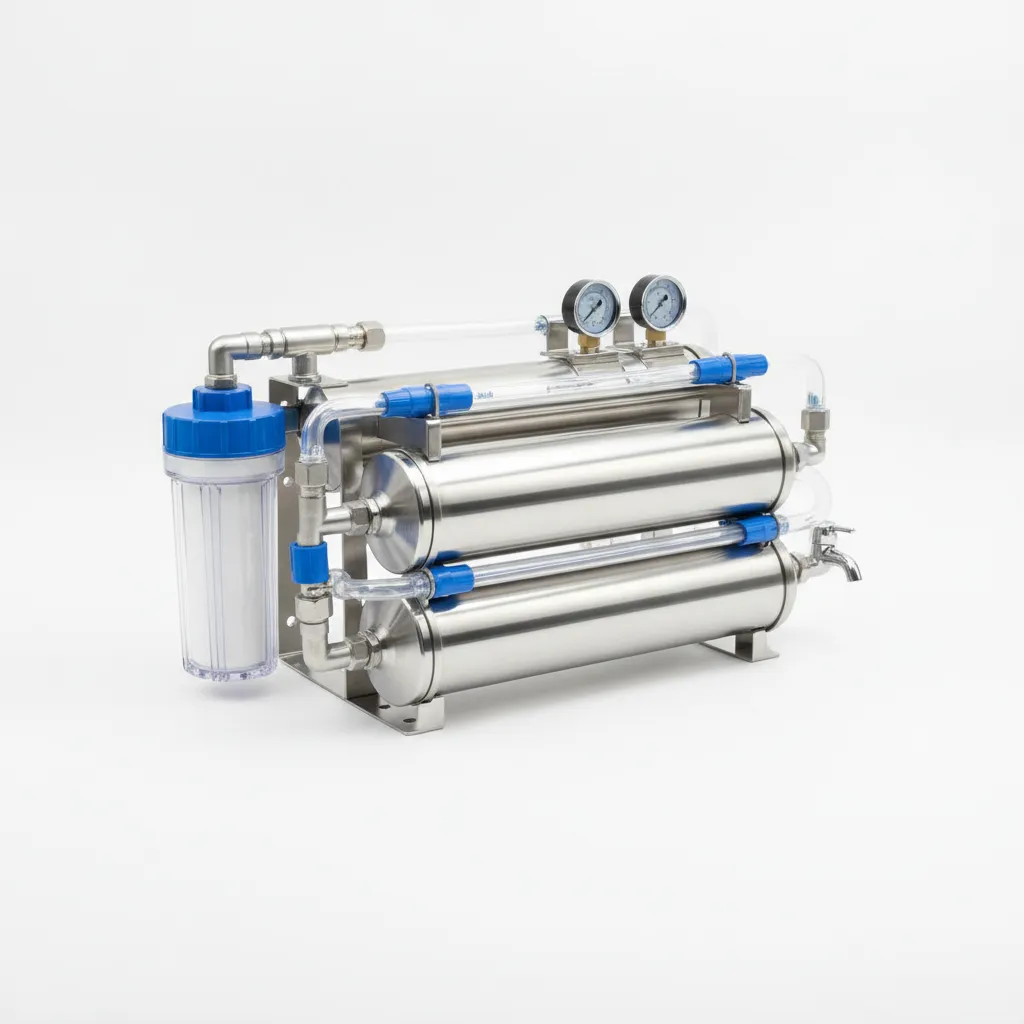
Best Reverse Osmosis Systems 2026: NSF Certified Picks
> Affiliate disclosure: FilterdWaterGuide.com earns a commission from qualifying purchases made through links in this article. This does not affect our recommendations — products are evaluated based on NSF certification data and independent testing results, not commission rates.
Reverse osmosis forces water through a membrane with pores small enough to block dissolved solids, heavy metals, PFAS, fluoride, and most contaminants that standard carbon filters leave behind. The EPA’s 2024 PFAS limits — 4 parts per trillion for PFOA and PFOS — pushed a lot of homeowners toward RO, and for good reason. If your water test shows elevated dissolved contaminants, an RO system is usually the most reliable fix.
Not every RO system performs the same under real plumbing conditions. Flow rates on the spec sheet don’t account for your water pressure, pipe diameter, or how much sediment your pre-filter is catching. I’ve pulled out plenty of RO units that looked great on paper but couldn’t keep up at 40 PSI with a half-clogged sediment cartridge. The systems below earned their spot because they hold up in the field, not just in the lab.
Quick Picks
- Best Overall: Waterdrop G3P800 — NSF 42, 53, 58, 372 certified, 800 GPD tankless, 3:1 pure-to-drain ratio
- Best Budget: APEC ROES-50 — WQA Gold Seal to NSF 58, proven 5-stage design, under $200
- Best for Remineralization: Aquasana SmartFlow RO — NSF 42, 53, 58, 401 certified, adds back minerals post-filtration
- Best Mid-Range Tankless: Waterdrop G2 — NSF 58, 372 certified, 400 GPD, compact tankless design
- Best for DIY Installation: iSpring RCC7AK — NSF 58 certified, 6-stage with alkaline remineralization, beginner-friendly setup
How We Evaluated These Systems
Every system was verified against the NSF International Certified Drinking Water Treatment Units database — not manufacturer marketing. I cross-referenced claims with Consumer Reports, Wirecutter, and Quality Water Lab, and factored in installation reality: space, plumbing compatibility, filter costs, and DIY feasibility.
One distinction that matters here: “NSF certified” and “tested to NSF standards” are not the same thing. NSF certification means ongoing third-party oversight — factory audits, annual re-testing, unannounced inspections. “Tested to NSF standards” describes a one-time lab test with no continuing verification. Both are legitimate, but only certification gives you long-term accountability. I excluded systems that relied on component-level certifications rather than full-system NSF verification.
Waterdrop G3P800 — Best Overall
The most capable tankless RO system you can buy right now, with the certifications to back it up.
| Spec | Detail |
|---|---|
| Price | ~$880–$1,050 |
| Capacity / Flow Rate | 800 GPD / tankless, fills a glass in about 8 seconds |
| NSF Certifications | NSF 42, 53, 58, 372 (IAPMO certified) |
| Contaminants Removed | TDS, lead, fluoride, PFAS, chlorine, chromium, arsenic |
| Filter Life | CF filter: ~12 months; RO membrane: ~24 months |
| Warranty | 1 year |
Why it earned the top spot: The G3P800 is one of the few RO systems carrying NSF 42, 53, and 58 certifications as a complete system — not just component-level claims. Quality Water Lab’s hands-on testing confirmed strong performance across the board. The 800 GPD production rate is legitimately fast, and the 3:1 pure-to-drain ratio cuts waste significantly compared to older tank systems that waste 3-4 gallons per gallon of clean water. Built-in UV sterilization is a bonus for well water or boil-advisory areas, though it’s not a substitute for proper well water treatment.
Best for: Homeowners who want the broadest NSF certification coverage and don’t mind paying for it.
Where it falls short:
- At $880–$1,050 upfront plus ~$145/year in filters, the 5-year cost of ownership approaches $1,600 — roughly double the APEC ROES-50 over the same period.
- The 1-year warranty is short for a system at this price point. At this premium, 3–5 years of coverage would build more confidence.
Buy Direct from Waterdrop | Check on Amazon
APEC ROES-50 — Best Budget
The workhorse RO system that’s been quietly outperforming flashier competitors for over a decade.
| Spec | Detail |
|---|---|
| Price | ~$200 |
| Capacity / Flow Rate | 50 GPD / tank-based (3.2-gallon tank) |
| NSF Certifications | WQA Gold Seal to NSF 58 (TDS reduction) |
| Contaminants Removed | TDS, arsenic, chlorine, lead, fluoride, heavy metals |
| Filter Life | Pre/post filters: ~6–12 months; RO membrane: ~2–3 years |
| Warranty | 1 year |
Why it earned its spot: The ROES-50 keeps showing up on Wirecutter and Consumer Reports lists for a reason. Five stages — sediment pre-filter, two carbon blocks, RO membrane, GAC polishing filter. No gimmicks. WQA Gold Seal to NSF 58 means TDS reduction is independently verified. At ~$200 upfront and $50–80/year in filters, the 5-year cost of ownership lands around $450–600. The callback rate on these is lower than systems twice the price.
Best for: Budget-conscious homeowners or anyone who wants proven RO performance without paying for features they don’t need.
Where it falls short:
- At 50 GPD, this is a slow system. The tank takes 2–3 hours to fill from empty — households of four or more will feel the wait during peak usage like cooking or filling water bottles.
- The WQA Gold Seal certification only covers TDS reduction. APEC claims removal of arsenic, fluoride, and lead, but those individual claims aren’t independently certified. For buyers specifically concerned about PFAS or lead, a system with NSF 53 certification gives you stronger documentation.
Aquasana SmartFlow RO — Best for Remineralization
The only RO system that pairs reverse osmosis with Claryum selective filtration and puts minerals back in your water. (Aquasana rebranded this product from “OptimH2O” to “SmartFlow Reverse Osmosis” in 2026 — same Claryum tech, new name.)
| Spec | Detail |
|---|---|
| Price | ~$215 sale / ~$480 MSRP |
| Capacity / Flow Rate | ~26 GPD / tank-based (3.2-gallon tank) |
| NSF Certifications | NSF 42, 53 (incl. P473), 58, 401, CSA B483.1 |
| Contaminants Removed | ~90 contaminants including lead, fluoride, mercury, arsenic, asbestos, pharmaceuticals, PFAS |
| Filter Life | Claryum filters: ~6 months; RO membrane: ~12 months |
| Warranty | 2 years |
Why it earned its spot: Five separate certifications — NSF 42, 53, 58, 401, and CSA B483.1 — each independently verified. The contaminant reduction list is backed by actual certification, not marketing. The remineralization stage is the real differentiator. Standard RO strips everything including calcium and magnesium, leaving water that tastes flat. I’ve had more customer complaints about RO taste than any other single issue. The SmartFlow RO adds minerals back, and the water actually tastes like water. If you’re concerned about pharmaceuticals and emerging contaminants, NSF 401 certification covers those specifically.
Best for: Homeowners who want the broadest certified contaminant removal with remineralization.
Where it falls short:
- At ~26 GPD production, this is the slowest system on the list — substantially slower than the G3P800. Households of three or more will notice the wait during heavy-use periods.
- Filter costs are the highest in this guide. Claryum cartridges every 6 months at ~$70/set plus the RO membrane annually at ~$60 puts you at roughly $200/year.
- Amazon availability has been inconsistent through 2025–2026 — buying direct from Aquasana is currently the more reliable option.
Waterdrop G2 — Best Value Tankless
A tankless RO system at a mid-range price — the sweet spot for most households.
| Spec | Detail |
|---|---|
| Price | ~$400–$450 |
| Capacity / Flow Rate | 400 GPD / tankless |
| NSF Certifications | NSF 58, 372 (IAPMO certified) |
| Contaminants Removed | TDS, PFAS, PFOA, PFOS, lead, chlorine, fluoride, heavy metals |
| Filter Life | CF filter: ~6 months; RO filter: ~12–24 months |
| Warranty | 1 year |
Why it earned its spot: The G2 gives you tankless convenience without G3P800 prices. At 400 GPD, it’s more than enough for a household of 2–4 people. NSF 58 certification covers TDS reduction as a complete system, and NSF 372 confirms lead-free materials. The 1:1 pure-to-drain ratio is much better than the 3:1 or 4:1 waste common in older tank systems. The compact design works well in condos and smaller kitchens where cabinet space is tight.
Best for: Households of 1–4 people who want tankless convenience at a reasonable price, especially in apartments and smaller kitchens.
Where it falls short:
- NSF certification is limited to NSF 58 (TDS) and 372 (lead-free materials) — no NSF 42 or 53. Individual contaminant claims (PFAS, lead, fluoride) are based on membrane capabilities rather than contaminant-specific testing. If you need documented proof for lead in a home with aging pipes, the G3P800 or Aquasana give you stronger paperwork.
- No remineralization stage. The water comes out stripped of minerals, which affects taste. You can add a separate remineralization filter for $30–50, but that’s one more thing to replace.
Buy Direct from Waterdrop | Check on Amazon
iSpring RCC7AK — Best for DIY Installation
A 6-stage tank-based system that’s genuinely easy to install yourself — and performs well once it’s in.
| Spec | Detail |
|---|---|
| Price | ~$230–$280 |
| Capacity / Flow Rate | 75 GPD / tank-based (3.2-gallon tank) |
| NSF Certifications | NSF 58 (full-system WQA Gold Seal) |
| Contaminants Removed | TDS (93–98%), lead (98.9%), fluoride (97.4%), chromium (99.2%), arsenic (97%), PFAS (96–99%) |
| Filter Life | Pre/post filters: ~6–12 months; RO membrane: ~2–3 years |
| Warranty | 1 year + lifetime tech support |
Why it earned its spot: Two things. First, installation is genuinely DIY-friendly — color-coded tubing, push-fit connections, and clear instructions. Most homeowners finish in under two hours without a callback. Second, the alkaline remineralization filter fixes the flat-taste complaint that keeps people from sticking with RO. Full-system NSF 58 certification through WQA gives you documented TDS reduction, and iSpring publishes contaminant-specific figures (lead at 98.9%, fluoride at 97.4%, PFAS at 96–99%) from their testing protocols.
Best for: First-time RO buyers who want to handle their own installation.
Where it falls short:
- The contaminant-specific percentages are manufacturer-tested figures — the NSF 58 certification covers TDS reduction only. The numbers are likely accurate (RO membranes are effective by design), but they don’t carry the same independent verification weight as the Aquasana SmartFlow RO’s NSF 53 certification.
- At 75 GPD with a tank, it’s faster than the APEC but a fraction of tankless systems. Larger households will drain the tank during peak use.
Comparison Table
| Product | Price | Best For | NSF Certs | Flow Rate | Rating |
|---|---|---|---|---|---|
| Waterdrop G3P800 | ~$880–$1,050 | Overall performance | NSF 42, 53, 58, 372 | 800 GPD (tankless) | 4.5/5 |
| APEC ROES-50 | ~$200 | Budget buyers | WQA/NSF 58 | 50 GPD (tank) | 4/5 |
| Aquasana SmartFlow RO | ~$215–$480 | Remineralization | NSF 42, 53, 58, 401 | ~26 GPD (tank) | 4/5 |
| Waterdrop G2 | ~$400–$450 | Value tankless | NSF 58, 372 | 400 GPD (tankless) | 4/5 |
| iSpring RCC7AK | ~$230–$280 | DIY installation | NSF 58 | 75 GPD (tank) | 4/5 |
How to Choose a Reverse Osmosis System
Tank vs. Tankless: Which Is Right for You?
Tank systems (APEC, iSpring) store filtered water in a pressurized bladder under your sink — consistent pressure, but the tank takes up space and takes hours to refill when drained. Tankless systems (Waterdrop G2, G3P800) filter on demand with no storage tank — faster, more compact, less water waste, but higher upfront cost. Cramped cabinet? Go tankless. Have the space? A tank system saves you money.
What Contaminants Do You Need to Remove?
Start with a water test — don’t guess. A $200 Tap Score test tells you exactly what’s in your water. If your concern is PFAS, look for NSF 53 certification that specifically lists PFAS compounds (Waterdrop G3P800 and Aquasana SmartFlow RO both qualify). For TDS, lead, and general dissolved solids, any NSF 58-certified system on this list will handle it.
Understanding NSF Certifications for RO Systems
Three standards matter for RO. NSF 58 is the baseline — TDS reduction for the complete system. NSF 53 certifies removal of specific contaminants like lead, PFAS, and arsenic. NSF 42 covers chlorine taste and odor. A system with all three gives you the broadest documented protection. NSF 58 alone still removes contaminants effectively, but you have less documentation for specific substances. For more on what these certifications mean in practice, see our guide to under-sink filters.
Filter Replacement Costs: The Hidden Expense
Annual filter costs range from ~$50–80/year (APEC ROES-50) to ~$200/year (Aquasana SmartFlow RO). The Waterdrop G2 runs ~$100–120/year, the iSpring ~$60–90/year, and the G3P800 ~$145/year. Over 5 years, the APEC costs $450–600 total while the G3P800 approaches $1,600+. An RO system with expired filters is worse than no system at all — the membrane degrades and contaminants pass through. For replacement schedules, check our guide on how often to change your water filter.
Well Water vs. City Water
City water concerns are typically lead, PFAS, and disinfection byproducts — any NSF 58-certified system handles these. Well water may add sediment, iron, bacteria, or hydrogen sulfide. An RO system alone won’t solve all of those — you’ll likely need pre-treatment upstream of the RO unit. A Tap Score well water test is money well spent before buying anything. For whole-house pre-treatment options, see our whole-house filter guide.
Installation Tips
Most RO systems are DIY-friendly with push-fit connections. The iSpring and APEC are the easiest. Waterdrop tankless systems need an electrical outlet under the sink — no outlet means an electrician call. One critical note: always use compression fittings, not saddle valves. Saddle valves are included in some kits but they’re increasingly banned by local plumbing codes due to long-term leak risk. Spend the extra $5–10 on a compression fitting.
Frequently Asked Questions
Is reverse osmosis water safe to drink?
Yes. RO strips beneficial minerals like calcium and magnesium, but the minerals you get from drinking water are a small fraction of what comes from food. If mineral content concerns you, choose a system with remineralization like the Aquasana SmartFlow RO or iSpring RCC7AK.
Do reverse osmosis systems remove PFAS?
RO membranes effectively reduce PFAS because the molecules are larger than the membrane’s pore size. Systems certified to NSF 53 with PFAS listed (Waterdrop G3P800, Aquasana SmartFlow RO) give you the strongest documented proof. Other RO systems will likely reduce PFAS, but without contaminant-specific certification, the claim rests on the technology’s capabilities rather than independent verification.
Do reverse osmosis systems remove lead?
Yes — RO is one of the most effective technologies for lead reduction. Systems with NSF 53 certification for lead (Waterdrop G3P800, Aquasana SmartFlow RO) have independent verification. Systems certified only to NSF 58 will also reduce lead as part of TDS removal, though the lead-specific claim isn’t separately documented.
How much water does an RO system waste?
Older tank systems waste 3–4 gallons per gallon of clean water. Modern tankless systems are much more efficient — the G3P800 runs 3:1 pure-to-drain (3 clean for every 1 wasted), and the G2 runs 1:1. In drought-prone areas, tankless is the better choice for water conservation.
How often do RO filters need to be replaced?
Pre-filters and post-filters typically need replacement every 6–12 months. RO membranes last 2–3 years for tank systems and 12–24 months for tankless. Hard water, high sediment, or heavy use shortens filter life. See our full guide on filter replacement schedules.
Can I install a reverse osmosis system myself?
Most homeowners can handle it in 1–3 hours. The iSpring RCC7AK and APEC ROES-50 are the easiest. Tankless systems need an electrical outlet under the sink. The trickiest part is drilling the faucet hole — if that’s not your thing, a plumber visit runs $100–200.
Is reverse osmosis better than an under-sink carbon filter?
A quality under-sink carbon filter handles chlorine, lead, and VOCs at lower cost and higher flow rate. But carbon can’t remove dissolved solids, fluoride, arsenic, or nitrates — that requires a membrane. For most municipal water, carbon is sufficient. RO is the step up when your water test shows contaminants that carbon can’t reach.
Final Verdict
The Waterdrop G3P800 earns the top spot — broadest NSF certification profile (42, 53, 58, 372), fast tankless performance, and reasonable water efficiency. It’s not cheap, but it’s the system I’d put under my own sink.
For budget buyers, the APEC ROES-50 has been a reliable workhorse for over a decade at roughly a third of the G3P800’s 5-year cost. For taste-conscious buyers, the Aquasana SmartFlow RO is worth the premium for its remineralization and NSF 401 certification. And the Waterdrop G2 delivers tankless convenience at half the G3P800’s price.
Start with a water test before you buy anything. Our guide to testing your water at home walks through the options.
Sources
- NSF International Certified Drinking Water Treatment Units Database
- Consumer Reports: Reverse Osmosis Water Filter Ratings
- Wirecutter: Best Reverse Osmosis Water Filter
- Quality Water Lab: Waterdrop G3P800 Review (Lab-Tested)
- EWG Tap Water Database
- EPA PFAS National Primary Drinking Water Regulation (2024)
- WQA Product Certification Database