Brondell Capella RC250 Review 2026: Certified RO, Honest Costs
> Affiliate disclosure: FilterdWaterGuide.com earns a commission from qualifying purchases made through some links in this article, including Amazon links. We have no affiliate relationship with Brondell. If you buy direct from Brondell through our link, we earn nothing. Products are evaluated on certification data and independent sources, not commission rates.
Reverse osmosis has a pricing problem, and it isn’t the one you think. The expensive systems are expensive because of tankless pumps, touchscreens, and app connectivity. The cheap systems are cheap because somebody skipped the certification. What’s rare is the middle: a system that costs a few hundred dollars and can prove, through an accredited certifier’s database, that it reduces the contaminants on the box.
The Brondell Capella RC250 is that system. It lists for $329.99 direct from Brondell as of September 22, 2026 (a week earlier it was on sale at $263.99), it uses a plain three-filter, tank-and-faucet design that has been around for decades, and it carries the WQA Gold Seal to four performance standards: NSF/ANSI 42, 53, 58, and 401. That last one, 401, covers pharmaceuticals and other emerging compounds, and most RO systems at any price never bother with it.
I went through Brondell’s performance data sheet, opened the Water Quality Association’s own listings for this model, priced the filters, and read the retailer complaints. The certification story holds up completely. The ownership story has two costs Brondell’s product page does not put in front of you.
Quick Verdict
The Brondell Capella RC250 earns 4.3/5. It is one of the least expensive under-sink reverse osmosis systems we’ve evaluated that is certified, not just tested, across NSF/ANSI 42, 53, 58, and 401. The Water Quality Association’s database lists it for lead, PFOA and PFOS, mercury, cysts, VOCs, and asbestos under Standard 53, and for pentavalent arsenic, hexavalent chromium, fluoride, radium, barium, cadmium, selenium, copper, and TDS under Standard 58. The points come off for a filter bill that runs about $205 a year, a slow 21.9 gallon-per-day production rate, a one-year warranty, and a list price that has drifted up from the sale price that made it a bargain.
Buy Direct from Brondell (no affiliate relationship) | Check on Amazon
Specs at a Glance
| Spec | Detail |
|---|---|
| Price | $329.99 list direct, as of September 22, 2026 (on sale at $263.99 the week before; open-box $189.99 when in stock) |
| Type | Under-sink reverse osmosis with pressurized storage tank and dedicated faucet |
| Stages | 3: Activated Carbon Plus pre-filter, E2RO membrane, carbon block post-filter |
| Certification | WQA Gold Seal to NSF/ANSI 42, 53, 58, 401; NSF/ANSI/CAN 372; CSA B483.1 |
| Certified reductions include | Lead, PFOA/PFOS, arsenic (V), chromium-6, fluoride, radium 226/228, mercury, cysts, VOCs, chloramine, pharmaceuticals, microplastics (86 contaminants per Brondell) |
| Rated capacity | 300 gallons |
| Daily production rate | 21.9 gallons per day |
| Faucet flow | 0.26 to 0.37 gpm at 35 to 100 psi |
| Tank | 3.2-gallon steel tank, about 1.6 gallons of usable water |
| Efficiency rating | 29.1% (NSF/ANSI 58 test); Brondell markets a 1:1 waste ratio |
| Operating pressure | 35 to 100 psi |
| Filter life | RF-30 carbon set: 6 months or 300 gallons; RF-50 membrane: 24 months |
| Replacement cost | RF-30 $79.99; RF-50 $89.99 (Brondell direct, September 2026) |
| Footprint | Filter assembly 13.5 x 3.75 x 13.5 in; tank 14.5 in tall x 8.5 in diameter |
| Faucet | Chrome air-gap faucet with LED filter-change indicator |
| Warranty | 1 year, parts and labor, original purchaser |
| Returns | 30 days, free return shipping |
The Certifications, Verified in the WQA Database
Here’s what nobody tells you about the “certified” badges on reverse osmosis listings: most of them are decorative. Amazon is full of RO systems that say “NSF certified” in the title and, when you dig, turn out to hold NSF/ANSI 58 for TDS reduction only, or NSF/ANSI 372 for lead-free materials, or nothing beyond a one-time lab test the manufacturer paid for. Certification means an accredited body listed the product, audits the factory, and re-tests it. A lab test is a receipt. Certification is oversight. Our water filter certifications explainer covers the difference.
So I skipped the marketing and went to the certifier. The Capella is not certified by NSF International, and you will not find it in NSF’s database. That is not a red flag. It is certified by the Water Quality Association, whose Gold Seal program is one of the accredited certifications to the NSF/ANSI standards (NSF International and IAPMO R&T are the other two you’ll see most often). The right phrase is “WQA-certified to NSF/ANSI standards,” and Brondell, to its credit, uses that phrase on its own product page instead of fudging it.
I opened the WQA Gold Seal listings for Brondell on September 22, 2026. Two rows matter.
Under NSF/ANSI 53 (health effects), the Capella RC250 is listed at 0.5 gallons per minute, 300-gallon capacity, RF-30 replacement element, with reduction claims for asbestos, cyst, lead, mercury, MTBE, PFOS, PFOA, turbidity, and VOCs (as chloroform). That PFOA and PFOS listing is the one most readers are asking about. The PFAS protocol that used to be called NSF P473 was folded into Standard 53 in 2019, so a Standard 53 listing that names PFOA and PFOS is the current, correct form of a certified PFAS claim.
Under NSF/ANSI 58 (reverse osmosis), the RC250 is listed at 21.9 gallons per day, RF-50 replacement membrane, with claims for arsenic (V) at a 300 ppb influent level, barium, cadmium, copper, fluoride, hexavalent chromium, lead, radium 226/228, selenium, TDS, and trivalent chromium.
Brondell’s performance data sheet, printed in the owner’s manual, adds the rest of the scope: Standard 42 for chlorine taste and odor, chloramine (98.6%), and particulates; Standard 401 for atenolol, bisphenol A, carbamazepine, DEET, estrone, ibuprofen, linuron, meprobamate, metolachlor, naproxen, nonylphenol, phenytoin, TCEP, TCPP, trimethoprim, and microplastics. The same sheet states the system is also WQA-certified to NSF/ANSI/CAN 372 (lead-free materials) and CSA B483.1. I could not pull up separate WQA rows for the 42 and 401 claims, so those rest on the data sheet, which names WQA as the certifier for all four standards. Add it up and you get the 86 contaminants Brondell advertises.
The data sheet’s own numbers, for the claims people buy RO for: lead 99.7% at pH 6.5 and 99.2% at pH 8.5 (150 ppb challenge, to 5 ppb or less), PFOA/PFOS 99.0% (1.5 ppb challenge, to 70 ppt or less), arsenic V 99.1%, hexavalent chromium 98.5%, fluoride 97.8%, radium 100%. Across the whole sheet the reductions run from the low 90s to 100 percent, under laboratory conditions. One number to read carefully: that 70 ppt PFOA/PFOS pass line is the older Standard 53 criterion. NSF has since tightened it to 20 ppt, and the EPA’s 2024 limit is 4 ppt per compound. A 99 percent cut from 1.5 ppb still lands under all of those, but if your tap water starts far above 1.5 ppb, the certified test does not describe your situation.
Two clarifications the data sheet makes that the product page does not. First, the arsenic claim is for pentavalent arsenic (arsenic V) only. RO membranes do not handle trivalent arsenic well, and the sheet says to use the system on water with a free chlorine residual, which converts trivalent to pentavalent, or on water tested to contain only the pentavalent form. If you are on a well with arsenic, that is a real limitation, and Brondell says so in a full-page “Arsenic Facts” section. Second, your water is not laboratory conditions, which is why the sheet also tells you to test your product water every six months.
The question you should actually be asking is not “is it certified” but “is it certified for what’s in my water.” If you haven’t tested, that comes first: Get a Tap Score Test or read our home water testing guide. Kenji’s PFAS explainer covers why the EPA’s 4 parts per trillion limits for PFOA and PFOS make a certified Standard 53 PFAS claim the thing to look for.
What You Are Actually Buying
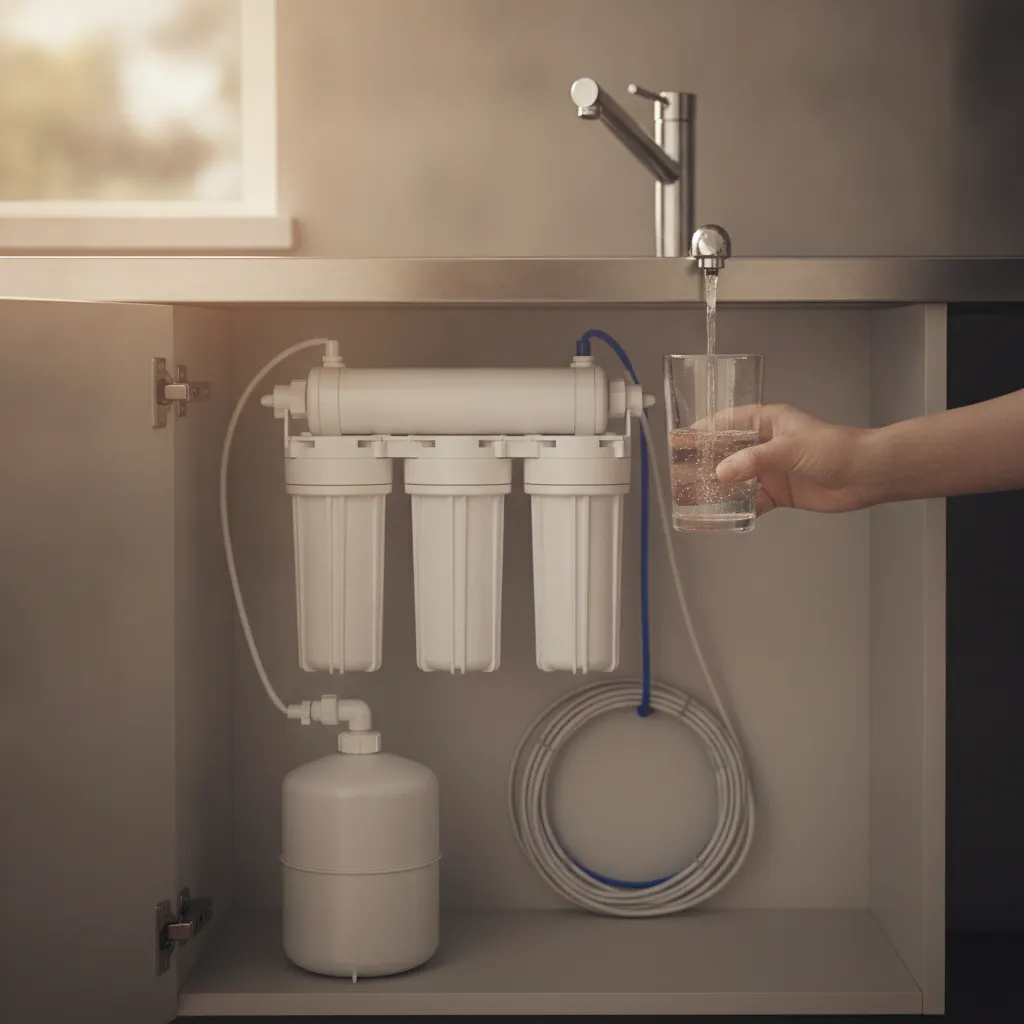
The Capella is a conventional under-sink RO system, and I mean that as a description, not a criticism. Water comes in through a quarter-turn “twist and seal” Activated Carbon Plus pre-filter, then a membrane Brondell calls the E2RO, then a carbon block polishing filter, then into a 3.2-gallon pressurized steel tank, and out through a chrome air-gap faucet on the sink deck. Filters and hanger measure 13.5 by 3.75 by 13.5 inches; the tank is 14.5 inches tall and 8.5 inches across.
Three stages is fewer than the five or six you see on competing budget systems, and Brondell’s marketing frames that as a feature. It is neither a feature nor a flaw. Extra sediment and carbon cartridges on a five-stage APEC or iSpring add capacity and cheap protection for the membrane; a three-stage design has fewer things to buy and change. The certification tells you whether the design works, and here it does.
The faucet has an integrated LED that reminds you when filters are due. Installation uses quick-connect tubing and pre-attached faucet lines. Brondell calls it easy DIY, and the retailer reviews mostly agree, with the standard RO caveats: a hole in the sink deck for the faucet, a drain saddle on the sink drain line, a cold-water tee, and about 15 inches of vertical space under the cabinet for the tank. If you have never installed one, Mike’s reverse osmosis buying guide walks through the plumbing.
One practical spec worth flagging: the manual lists inlet water requirements of less than 2 mg/L chlorine, less than 2 mg/L iron, hardness below 1,000 mg/L, turbidity below 1 NTU, and pH between 7 and 8. Municipal water clears those easily. Iron-heavy well water may not, and the manual is explicit that filter life shortens on poor-quality feed water.
The Waste Ratio Claim, Read Against the Data Sheet
Brondell’s headline for this product is “1:1 wastewater ratio,” which it calls industry-leading and up to 20 times more efficient than traditional RO. That claim needs a closer look, because the performance data sheet in the same manual gives a very different number: a product efficiency rating of 29.1 percent.
Both numbers are real. They measure different things. A 1:1 ratio means that under ideal conditions, with an empty tank and no back-pressure, the membrane sends one gallon to the drain for every gallon it makes. The NSF/ANSI 58 efficiency rating measures the share of incoming water that ends up in your glass under conditions that approximate daily use, including the back-pressure of a mostly full tank. At 29.1 percent, that is roughly 2.4 gallons down the drain for every gallon of treated water.
That is still decent for a tank-style RO system. Many older tank units score well below that on the same test, so Brondell’s efficiency claim has a real basis. But “1:1” is the marketing number, “29.1 percent” is the certified number, and the certified number is the one your water bill will see. Follow the money: tankless systems from Waterdrop and others advertise 2:1 or 3:1 pure-to-drain ratios, and Brondell wanted a headline that competes. On the efficiency rating, the Capella is good, not miraculous.
Living With a Tank: Slow Water, Finite Water
The second cost Brondell doesn’t lead with is speed. The RC250’s certified daily production rate is 21.9 gallons per day, which is about 0.9 gallons an hour. The tank holds 3.2 gallons but only about 1.6 gallons of that is actually available as water, because the rest of the volume is the air bladder that provides pressure. Brondell’s own spec sheet puts the number at “appx. 1.6 gallons and will vary depending on incoming operating pressure.”
In practice: you get a gallon and a half at the faucet before the pressure tails off, and the system needs an hour and a half to two hours to refill. Faucet flow while the tank is charged is 0.26 to 0.37 gallons per minute depending on your house pressure, so a 16-ounce glass takes about 20 to 30 seconds. Fill a stock pot and the next person waits. Retailer reviews at Home Depot and Walmart repeat this complaint often enough that I consider it settled: a couple will never notice, a family that cooks with RO water will.
That is a design category limitation, not a Brondell problem, and it is the actual reason tankless systems cost more. The Waterdrop G3P800 produces 800 gallons per day on demand with no tank, at roughly two and a half times the price. If you need fast, high-volume RO, the Capella is the wrong product. If you drink coffee, fill bottles, and cook for two or three people, the tank is fine.
There is a smaller nuisance that comes with the faucet. The Capella uses an air-gap faucet, the code-compliant way to keep drain water from siphoning back into the system. Air-gap faucets gurgle when the tank refills and can drip from the small weep hole on the faucet body if the drain line clogs or is routed with a high loop. Several owner reviews describe exactly that leak. It is fixable (clear or re-route the black drain line), but it surprises people who expected silence.
What It Actually Costs Over Five Years
The sticker is the easy part. Here are the filters at Brondell’s own prices as of September 22, 2026.
| Item | Price | Schedule |
|---|---|---|
| RF-30 Activated Carbon Plus + Carbon Block set | $79.99 | Every 6 months or 300 gallons |
| RF-50 E2RO membrane | $89.99 | Every 24 months |
That is $160 a year in carbon filters plus $45 a year amortized for the membrane, or about $205 per year. Over five years you will buy ten RF-30 sets and two membranes, roughly $980 in filters, for a five-year total of about $1,310 at list price, or about $1,245 if you catch the $263.99 sale.
Here’s what nobody tells you: at that filter price, the Capella stops being the cheap option somewhere in year three. The AquaTru Classic, a countertop RO system with no plumbing, runs about $110 a year in filters and lands between $900 and $1,075 over five years. The APEC ROES-50 and iSpring RCC7AK, the classic five-stage budget systems, use generic-sized cartridges that cost far less per year than $160. Brondell’s twist-and-seal filters are proprietary, so you cannot shop around. Both replacement products are marked “Excluded from Sale or Coupon Offers” on Brondell’s site, which tells you where the margin lives.
Two caveats on that math. First, the six-month RF-30 interval is calendar-based and conservative; a light-use household may not exhaust 300 gallons of carbon in six months, but Brondell’s manual and the WQA listing both say six months, so that is what I plan around. Second, the faucet LED counts days, not gallons. Our filter replacement guide explains why those two clocks disagree.
Where It Sits Against the Other Certified Systems
At $329.99 list, the Capella is not the cheapest name in our best reverse osmosis systems guide. The APEC ROES-50 sells for about $200 and the iSpring RCC7AK for $230 to $280, and both carry an NSF/ANSI 58 certification. What they do not carry is Standard 53 or 401. APEC’s Gold Seal covers TDS reduction only; the lead, arsenic, and fluoride numbers on its box are the company’s own tests. The Aquasana SmartFlow RO is the closest match on paperwork, certified to 42, 53, 58, and 401; it lists near $480 but often sells around $215, so on a given day it may be the cheaper of the two.
The honest pitch: the Capella is the least expensive fully certified under-sink RO when Brondell has it on sale, and a fair mid-range price for that paperwork when it doesn’t. Its advantage over the APEC and iSpring is never the sticker. It is the certified 53 and 58 claims for lead, PFOA/PFOS, arsenic V, chromium-6, and fluoride, the things you buy RO to remove.
Capella vs. Brondell’s Own Circle
Brondell sells a second under-sink RO, the Circle RC100, and the two get confused constantly because they share a faucet and a brand. The Circle is a four-stage system with a non-electric “Smart Valve” that Brondell says refills its tank faster, and it lists for around $400 at big-box retailers. The Capella costs less and is the one with the broader certification.
The difference that matters: on the WQA listings I opened, the Circle appears under NSF/ANSI 58 (40 gallons per day, arsenic V at a 50 ppb influent level, chromium-6, fluoride, lead, radium, TDS) but not under Standard 53, and Brondell does not claim Standard 401 for it. The Capella is listed under both 53 and 58 and its data sheet adds 401. Brondell markets the Circle for PFOA and PFOS reduction, a Standard 53 claim, but I could not find it on the certifier’s page. If PFAS, pharmaceuticals, BPA, DEET, flame retardants, or microplastics are on your list, the Capella is the one with the certified rows. Follow the money: the newer, cheaper Capella is the better-certified product, which suggests Brondell sees the Circle as the premium-convenience model rather than the premium-filtration model.
If your test results don’t call for RO at all, Brondell’s carbon-only under-sink unit, the Coral UC300, holds the same WQA lead and PFOA/PFOS claims for less money and wastes no water.
Who It’s For, and Who Should Pass
Buy the Capella RC250 if: you want an installed RO system with database-verified certification for lead, PFOA/PFOS, arsenic V, chromium-6, fluoride, radium, and emerging contaminants; you’re on municipal water; your household drinks and cooks with a few gallons a day rather than a dozen; and $330, or $264 on sale, is the budget. It carries broader certification than the two budget systems in our RO guide.
Pass if: you fill large pots or multiple bottles at once and will resent waiting on a tank (look at the Waterdrop G3P800); you rent or can’t drill a faucet hole (the AquaTru Classic is the certified countertop answer); your well water has trivalent arsenic or high iron, which the data sheet says this system is not designed for; or you only want to fix chlorine taste and have no health contaminant in your test results. In that last case, a certified carbon under-sink filter is cheaper to run and wastes no water. Our RO vs. under-sink filter comparison covers when RO is overkill.
A note on remineralization: the Capella does not add minerals back. RO water is low in calcium and magnesium and some people find it tastes flat. That is a taste preference, not a health issue, and I would not pay extra for an “alkaline” stage anywhere. An inline remineralization cartridge on the faucet line fixes the taste if it bothers you.
Where to Buy It
Brondell sells the Capella direct for $329.99 list with free shipping in the contiguous US, a 30-day return window with free return shipping, and a one-year warranty. It was $263.99 on sale the week before I checked, so waiting for a promotion pays if you are not in a hurry. It also shows up at Home Depot, Lowe’s, and Walmart. Brondell lists open-box units at $189.99 (down from $269.99) with the same warranty; that listing was out of stock when I checked.
One Amazon note: Brondell’s Amazon page for its under-sink RO systems combines the Circle and the Capella, and as of September 2026 only the Circle is selectable. The replacement filters are on Amazon. If you prefer Amazon, check the search link below; if the Capella is not listed, buy direct. We earn nothing on a direct purchase, and it is still the better deal.
Buy Direct from Brondell (no affiliate relationship) | Check on Amazon
Frequently Asked Questions
Is the Brondell Capella RC250 NSF certified?
It is certified by the Water Quality Association under its Gold Seal program to NSF/ANSI standards 42, 53, 58, and 401, plus NSF/ANSI/CAN 372 and CSA B483.1. It is not certified by NSF International and does not appear in NSF’s database. WQA is an accredited certifier to the same standards, with factory audits and re-testing, so the precise wording is “WQA-certified to NSF/ANSI standards.”
Does the Brondell Capella remove PFAS?
Yes, with a certified claim. The WQA listing for the RC250 under NSF/ANSI 53 names PFOA and PFOS, and Brondell’s data sheet shows 99.0% reduction from a 1.5 ppb challenge. That is the current form of the PFAS certification formerly called NSF P473. The certification covers PFOA and PFOS specifically; other PFAS compounds are not part of the certified claim.
How much do Capella replacement filters cost?
About $205 a year. The RF-30 carbon filter set is $79.99 and is replaced every six months or 300 gallons; the RF-50 membrane is $89.99 and lasts 24 months. Both are proprietary twist-and-seal cartridges sold by Brondell and on Amazon, and both are excluded from Brondell’s sales and coupons.
How fast is the Capella?
The certified production rate is 21.9 gallons per day. The tank stores about 1.6 gallons of usable water, and the faucet flows at 0.26 to 0.37 gallons per minute. Expect 20 to 30 seconds for a pint glass and an hour or two for the tank to refill after heavy use.
Is the 1:1 wastewater ratio accurate?
It is Brondell’s best-case figure. The NSF/ANSI 58 efficiency rating on the performance data sheet is 29.1 percent, measured under conditions that mimic typical daily use with a partly full tank. That is roughly 2.4 gallons to drain per gallon produced, which is good for a tank-style system but not 1:1.
Does the Capella remove arsenic?
It is certified under NSF/ANSI 58 for pentavalent arsenic (arsenic V) at a 300 ppb influent level, with 99.1% reduction on the data sheet. It is not designed to remove trivalent arsenic, which is common in well water. Brondell’s data sheet says the system should be used on water with a free chlorine residual or water shown to contain only pentavalent arsenic.
Bottom Line
The Brondell Capella RC250 is the rare mid-priced product where the certification paperwork is the strongest thing about it. WQA Gold Seal to NSF/ANSI 42, 53, 58, and 401, with lead, PFOA/PFOS, arsenic V, chromium-6, fluoride, radium, and pharmaceuticals all on an accredited certifier’s listing or its data sheet, for $329.99 list and $263.99 on sale. The two budget systems in our RO guide cost less and certify less. What you give up is speed, which is inherent to any tank system, and you take on a filter bill of about $205 a year that erodes the price advantage over time. Know both going in. If your water test says RO is the right tool and your household is not trying to fill a stock pot every night, this is the certified system I would point a first-time RO buyer toward, ideally on a sale day.
Buy Direct from Brondell (no affiliate relationship) | Check on Amazon
Sources
- Water Quality Association, Gold Seal Certified Product Listings, Brondell Inc., NSF/ANSI 53 (RC250 row: lead, PFOA, PFOS, mercury, cyst, asbestos, MTBE, turbidity, VOC), opened September 22, 2026: find.wqa.org
- Water Quality Association, Gold Seal Certified Product Listings, Brondell Inc., NSF/ANSI 58 (RC250 row: 21.9 GPD; arsenic V, barium, cadmium, copper, fluoride, hexavalent chromium, lead, radium 226/228, selenium, TDS, trivalent chromium; RC100 row), opened September 22, 2026: find.wqa.org
- Brondell, Capella RC250 Owner’s Manual and Performance Data Sheet (contaminant reductions, efficiency rating 29.1%, 21.9 GPD, 300-gallon capacity, inlet water requirements, filter cycle, warranty, arsenic facts): brondell.com
- Brondell, Capella RC250 Spec Sheet (dimensions, tank storage, faucet flow rate, filter lifespans): brondell.com
- Brondell, Capella product page (price, stock, return policy, certification statement, 1:1 claim), checked September 22, 2026: brondell.com
- Brondell, RF-30 and RF-50 replacement filter pages (pricing, sale exclusion), checked September 22, 2026: brondell.com
- EPA, Per- and Polyfluoroalkyl Substances (PFAS) National Primary Drinking Water Regulation: epa.gov
- TapWaterData, Brondell water filters overview and Brondell Circle RO review (certification scope of the Circle vs. Capella; Circle pricing): tapwaterdata.com
- NSF International, Certified Drinking Water Treatment Units database (confirming the RC250 is not an NSF International listing): info.nsf.org