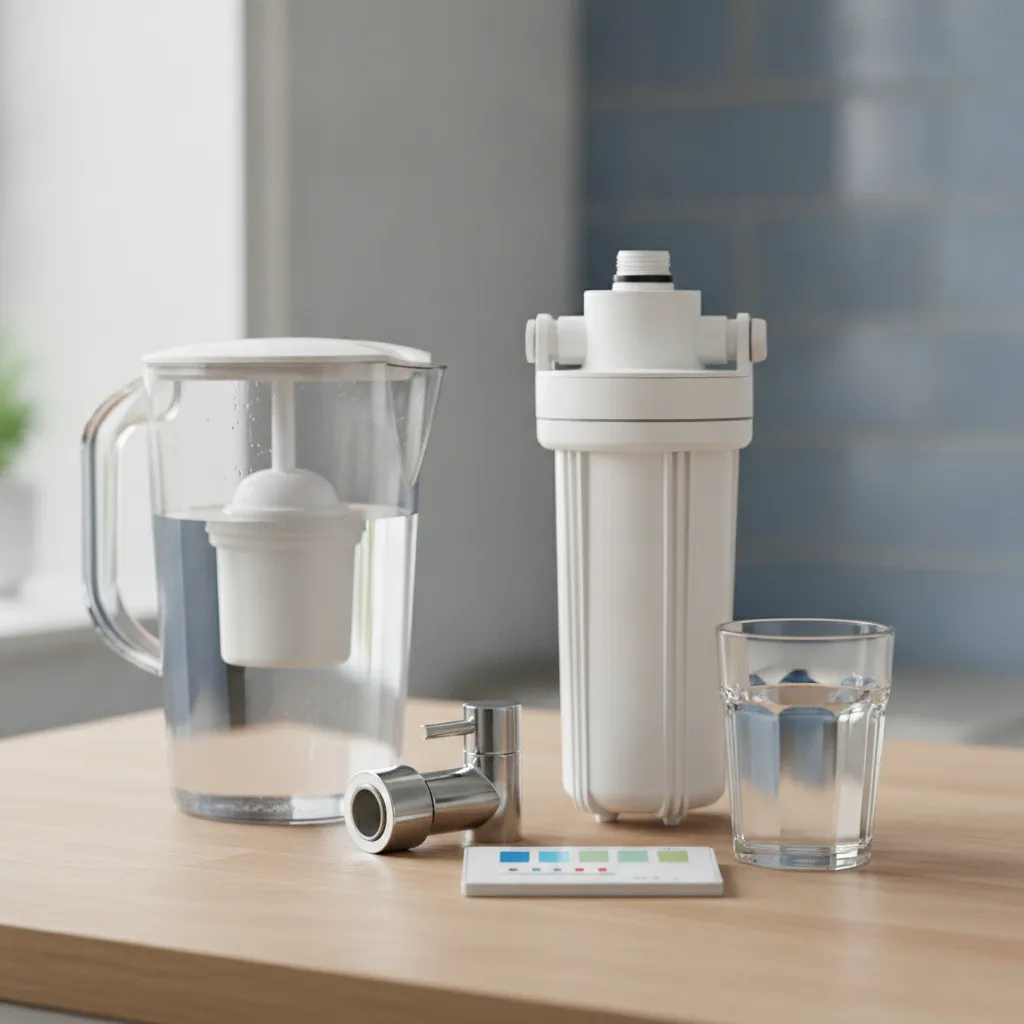
Water Filter Buying Guide for Beginners (2026): How to Choose Without Getting Scammed
LAST UPDATED: June 2026
If you only remember one thing from this water filter buying guide, remember this: buy a filter for what is actually in your water, not for what an ad told you to be afraid of. The right water filter for a beginner is the one that is independently certified to remove the specific contaminant you have — and almost everything else is noise designed to sell you something.
I wrote this because the water filter market is built to confuse you. There are pitchers that remove almost nothing and “premium” systems that cost ten times more than the certified filter sitting next to them on the shelf. This guide walks you through the four decisions that actually matter, in order, so you can stop reading marketing copy and start choosing on evidence.
KEY TAKEAWAYS:
- Test your water before you buy anything. The filter you need depends entirely on what is in your tap, and guessing wastes money.
- “NSF certified” is the only product claim worth trusting. “Tested to NSF standards” is marketing language, not certification.
- Match the filter type to your contaminant and your living situation — a renter and a homeowner with a well need very different things.
- The sticker price is not the real price. Replacement cartridges are where filters quietly cost you over the years.
- Skip anything sold on fear, “purity,” or health claims with no third-party testing behind them.
FilterdWaterGuide.com earns a commission from affiliate links in this article at no extra cost to you. It never changes which products I recommend — every pick here qualified on certification first, and I tell you when a product is uncertified for a contaminant even when we’d earn on the sale.
Start With Your Water, Not the Filter
Here’s what nobody selling filters wants to lead with: you cannot choose the right filter until you know what you are filtering out. Lead, PFAS, chlorine taste, hard-water scale, and arsenic are completely different problems, and no single product solves all of them well. Buying a filter before testing is like buying medicine before a diagnosis.
The cheapest place to start is your utility’s annual water quality report, called a Consumer Confidence Report (a yearly summary every public system must publish). It tells you what the utility detected at the treatment plant. The catch is that it does not tell you what happened to that water on its way through your building’s pipes — and lead, in particular, usually comes from your own service line or fixtures, not the plant.
That is why an at-home test matters. A strip-style kit like the Safe Home 12-in-1 Test Kit gives you a fast, rough read on common issues like lead, hardness, chlorine, and nitrate for under $30. Its limits are real: strip tests give you a color-band estimate rather than a precise number, and they cannot detect PFAS at all. Consumer testing organizations consistently note that strips are a screening tool, not a lab result.
For numbers you can actually act on, send a sample to a certified lab. Get a Tap Score Test and you get mailed results that quantify dozens of contaminants, including PFAS, with an interpretation written for non-scientists. The downsides are cost — a full panel runs well over $200 — and turnaround, since you wait one to two weeks for results. For most beginners, a cheap strip kit to screen and a lab test if anything looks off is the right sequence. Our complete guide to testing your water at home walks through both in detail.
The Only Certification That Actually Means Anything
The question you should actually be asking about any filter is not “how many contaminants does it remove?” It is “what is it independently certified to remove, and by whom?” NSF/ANSI standards are the answer. NSF is an independent organization that tests filters against defined performance standards and audits factories on an ongoing basis — so a certification is not a one-time lab result, it is continued oversight. (IAPMO and WQA are two other accredited bodies that certify products to those same NSF/ANSI standards, with the same ongoing audits.)
Each NSF standard covers a different job. Knowing four of them is enough to read almost any filter box correctly.
| NSF/ANSI Standard | What It Certifies | Plain-English Meaning |
|---|---|---|
| NSF/ANSI 42 | Aesthetic effects | Improves taste and smell, mainly chlorine. Does not mean it removes anything harmful. |
| NSF/ANSI 53 | Health effects | Reduces contaminants tied to health risk — lead, certain VOCs, cysts, and, as of recent updates, PFAS. |
| NSF/ANSI 58 | Reverse osmosis | Certifies an RO system for dissolved solids, arsenic, fluoride, and more. |
| NSF/ANSI 401 | Emerging contaminants | Reduces trace pharmaceuticals and newer chemicals. |
A few things to internalize. A filter certified only to NSF 42 handles taste, not safety — that is the most common beginner trap. NSF 53 is the one that matters for lead and PFAS, but you have to check which contaminants are listed under that filter’s specific certification, because not every NSF 53 filter is tested for every NSF 53 contaminant.
One important 2026 update: the old NSF P473 protocol, which used to be the separate “PFAS” certification, has been folded into NSF/ANSI 53. So a filter certified under NSF 53 for PFOA and PFOS is your verification for PFAS removal today — you do not need to hunt for a standalone “P473” badge anymore.
“Tested to NSF Standards” Is Not “NSF Certified”
Follow the language carefully, because brands hide here. “NSF certified” means the product is in an accredited certifier’s official database and subject to factory audits and re-testing. “Tested to NSF standards,” “meets NSF standards,” or “NSF-grade materials” means a lab checked a sample once, with no ongoing oversight — or sometimes means nothing verifiable at all.
You can check any claim yourself for free. NSF’s certified-product database lets you search a brand and model and see exactly which standards and contaminants it is listed for. If a product is genuinely certified, it is in that database (or the equivalent IAPMO or WQA listing). If a company tells you it is “tested to” a standard but you cannot find it in any of them, treat the claim as marketing. Kenji’s deep dive on lead in drinking water explains why this distinction is not pedantic — it is the difference between protection and a false sense of it.
The Main Types of Water Filters, and Who Each One Is For
Once you know your contaminant and you know to look for NSF certification, picking a format gets simple. Here is the honest version of each category.
| Filter Type | Best For | Typical Upfront Cost | Watch Out For |
|---|---|---|---|
| Pitcher | Renters, single contaminants, taste | $20–$50 | Slow, small batches; frequent cartridge changes |
| Faucet-mount / Countertop | Renters wanting more flow than a pitcher | $30–$150 | Not all certified for lead or PFAS |
| Under-sink | Homeowners wanting dedicated clean water | $150–$400 | Needs cabinet space and basic install |
| Reverse osmosis (RO) | Many contaminants at once, arsenic, high TDS | $200–$600 | Wastes some water; removes minerals too |
| Whole-house | Sediment, chlorine, hard water for the whole home | $800–$2,500+ | Does not make every tap drinking-grade alone |
Pitcher Filters
A pitcher is the right starting point for most renters and anyone solving one specific problem. The ZeroWater 10-Cup pitcher is a reasonable beginner pick because it is IAPMO-certified to NSF/ANSI 53 for lead and chromium, and its 10-cup model now carries certification covering PFOA and PFOS — verify the current listing for your exact model in the NSF database before you rely on it.
Be honest with yourself about the trade-offs. ZeroWater strips water so thoroughly that the result can taste flat or faintly metallic, and some people simply will not drink it — a filter your household avoids protects no one. Its filters also exhaust quickly in high-mineral water, which means buying replacements more often than you expect. Consumer Reports has repeatedly flagged ZeroWater’s short filter life as its main weakness even while praising its contaminant reduction. For the full field, see our best water filter pitchers guide.
Under-Sink Filters
If you own your home and want clean water on demand without refilling anything, an under-sink system is the upgrade. The Aquasana Claryum 3-Stage is a solid reference point because it is certified across NSF/ANSI 42, 53, and 401, covering chlorine, lead, and a long list of emerging contaminants.
The honest downsides: it takes up real estate inside your cabinet and requires drilling for a dedicated faucet, which intimidates first-timers and may not be allowed in a rental. Owners also report that the plastic filter housings can crack or weep over years of use, so it is not a fully install-and-forget product. Wirecutter’s testing rates Aquasana’s filtration highly while noting the install and footprint as the main friction points. Our under-sink buying guide compares the field, and if you have many contaminants at once, the reverse osmosis guide covers when RO is worth the extra complexity.
A Note on RO and Whole-House
Reverse osmosis is the most thorough option a beginner is likely to consider, and it shines when your test shows a stack of problems — arsenic, nitrate, high total dissolved solids — at once. Just go in knowing two real costs: RO sends a few cups of “reject” water down the drain for every cup it cleans, and it strips beneficial minerals along with the bad stuff, which is why many systems add a remineralization stage. Whole-house systems, by contrast, are about protecting plumbing and showers from chlorine, sediment, and scale across every tap — they are not a substitute for a drinking-water filter at the kitchen sink, and pairing the two is common.
Match the Filter to Your Actual Problem
Here is the shortcut that replaces hours of reading. Once your test points to a contaminant, the format follows.
If your concern is lead, look for NSF 53 lead certification specifically — a certified pitcher or under-sink filter both work. If it is PFAS, you need NSF 53 with PFOA/PFOS listed, which narrows the field considerably. If it is just chlorine taste and smell, even an NSF 42 pitcher or faucet filter is enough. If your test shows many contaminants or high dissolved solids, that is the case for reverse osmosis. And if you are fighting scale, sediment, or chlorine across the whole house — common on well water or hard municipal supplies — that is a whole-house job.
What a Filter Actually Costs Over a Year
The price on the box is the smallest number you will pay. Replacement cartridges are the real cost, and they are where cheap filters quietly become expensive ones.
Run the math before you buy. A $30 pitcher that needs a $15 filter every two months costs you $90 a year in cartridges — more than the pitcher itself. An under-sink system with a $60 annual filter set may cost more upfront but less per year of clean water. Always calculate cost per year, not cost per box, and factor in that hard water shortens filter life across every category. A filter you cannot afford to keep replacing is a filter you will eventually stop replacing, which defeats the entire purpose.
Installation: The One Tip That Saves You a Service Call
If you go with anything that taps into your water line — an under-sink filter, an RO unit, a fridge line — connect it with a compression fitting, not a saddle valve. A saddle valve is the little clamp-on piercing valve that brands include because it is cheap and tool-free; it is also a slow-leak waiting to happen, and a growing number of local plumbing codes in 2026 no longer allow them. A compression fitting costs a few dollars more and a few minutes longer, and it is the difference between a connection you forget about and a puddle under your cabinet a year from now.
Mistakes Beginners Make
A few traps catch almost everyone the first time.
The biggest is buying on fear. Any product whose pitch is “your water is poisoning your family” is selling anxiety, not filtration. Reputable products lead with what they are certified to remove, not with what might kill you.
The second is falling for “pure” and health claims. Water is never “pure,” and filters that promise to “boost immunity,” “alkalize,” or “energize” your water have no clinical evidence behind them. Skip alkaline and hydrogen-water devices entirely — they are marketing dressed as science.
The third is trusting big-name gravity systems without checking certification. Berkey, for example, is widely recommended online but is not a safe beginner pick: it was hit with an EPA stop-sale action, and independent testing found aluminum leaching at levels well above safe limits. Popularity is not certification. When in doubt, search the model in NSF’s database — if it is not there, it is not certified, no matter how many influencers love it.
Frequently Asked Questions
Do I really need to test my water first? Yes, if you want to spend money well. Your utility’s annual report tells you what is in the water leaving the plant, but lead and some other problems come from your own pipes. A cheap strip kit screens for common issues, and a certified lab test confirms anything serious. Testing first means you buy a filter for your actual problem instead of guessing.
What is the difference between NSF 42 and NSF 53? NSF/ANSI 42 covers aesthetic effects — mainly chlorine taste and odor — and does not certify removal of anything harmful. NSF/ANSI 53 covers health-related contaminants like lead, certain industrial chemicals, and PFAS. If your concern is safety rather than taste, NSF 53 is the certification to look for, and you should confirm your specific contaminant is on the filter’s listing.
Is a more expensive filter always better? No. Price reflects features, brand, and capacity more than safety. A $35 NSF 53 lead-certified pitcher protects you from lead exactly as well as a $300 system certified for the same thing. Pay more only when your water test calls for broader removal — many contaminants at once, or arsenic and dissolved solids that need reverse osmosis.
Can a pitcher filter remove PFAS? Some can, but most cannot. You need a pitcher specifically certified under NSF/ANSI 53 for PFOA and PFOS — the standard that absorbed the older P473 protocol. Many popular pitchers are certified only to NSF 42 for taste and do nothing for PFAS. Always verify the exact model in NSF’s database before relying on it for PFAS.
How long do water filters last? It depends on the cartridge and your water. Pitcher filters often last two to four months, under-sink filters six months to a year, and RO membranes two to three years. Hard or high-sediment water shortens all of these. Follow the manufacturer’s schedule by gallons used, not just by the calendar, since heavy use exhausts a filter faster than time alone.
Related Articles
- How to Test Your Water at Home (Complete DIY Guide)
- Best Water Filter Pitchers 2026
- Best Under Sink Water Filters 2026
- Best Reverse Osmosis Systems 2026
- Lead in Drinking Water: Sources, Risks, and Removal Guide
Sources Cited
- NSF International — Certified Drinking Water Treatment Units database
- U.S. EPA — PFAS National Primary Drinking Water Regulation (2024)
- Consumer Reports — water filter pitcher testing and ratings
- Wirecutter — under-sink and pitcher filter reviews
- SimpleLab / Tap Score — independent water testing methodology
Affiliate disclosure: FilterdWaterGuide.com is reader-supported. Some links in this article are affiliate links, which means we may earn a commission if you buy through them — at no extra cost to you. We only recommend products that are independently NSF certified for the contaminants we discuss, and commissions never determine our picks.